

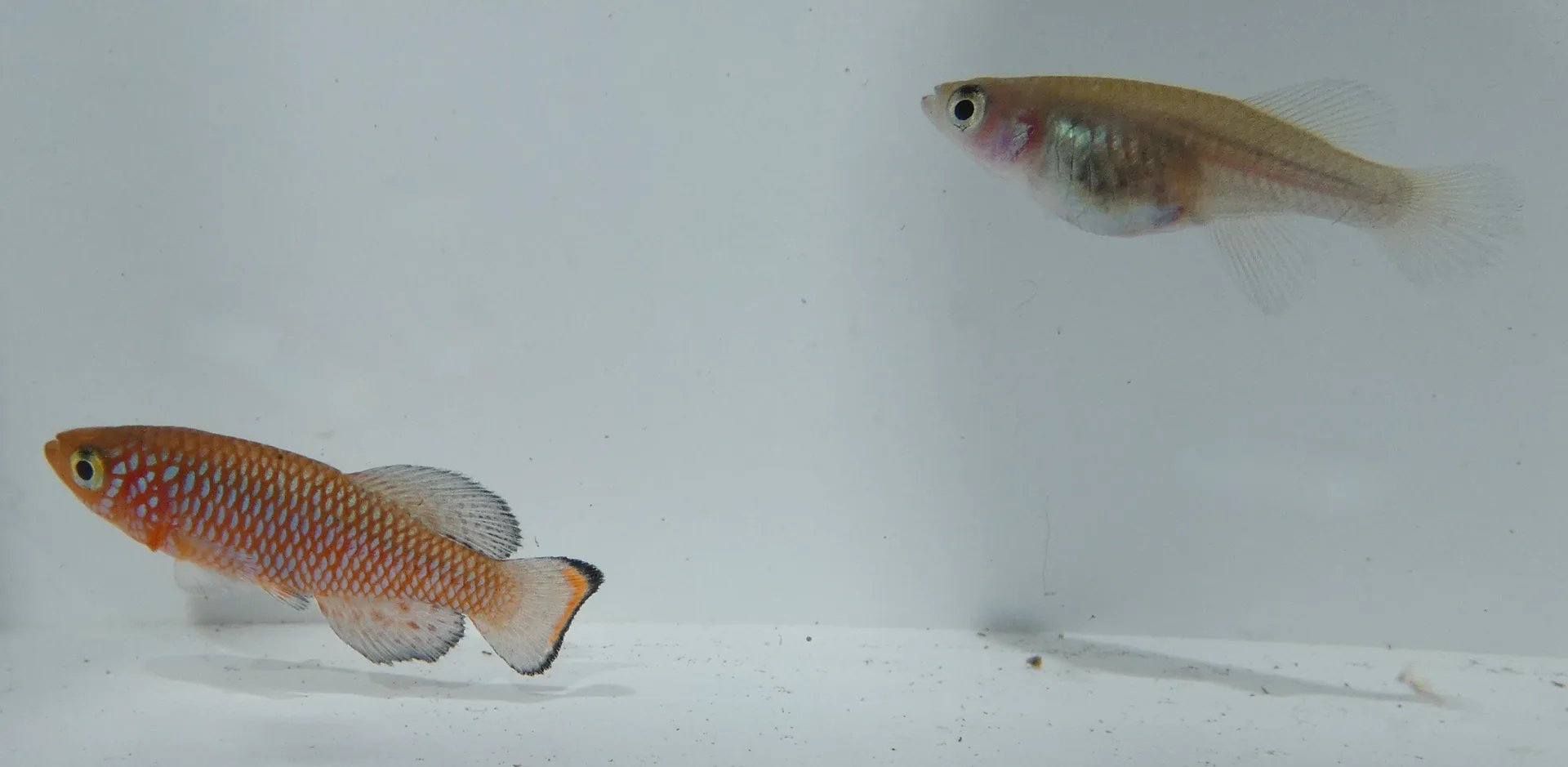
A puddle on the coastal plain of Mozambique does not look like a forever home. It looks like a mistake the rain made. For Nothobranchius rachovii, the bluefin notho, that puddle is the entire universe, and it is on a clock. When the pool dries, the adults die. The next generation is already in the mud, as eggs built to wait. If you keep this killifish as if it were a community rasbora that will cruise a planted tank for five years, you will be confused when the males are gone in eighteen months. They were not murdered by your husbandry. They finished the script.
Bluefin nothobranchius come from ephemeral pools and floodplain pans associated with the lower Zambezi, the Pungwe, the region around Beira, and neighbouring drainages in Mozambique and adjacent country. Collectors name populations by locality because colour is a local dialect: reds, blues, yellows, a mosaic of iridescence on the male, and a brown, almost invisible female. The aquarium strain most people meet is a farmed or hobbyist line of that Beira-area fish, sometimes still labelled “Rachov’s killi.” The male is the poster. The female is the reason the poster exists.
A short, loud life
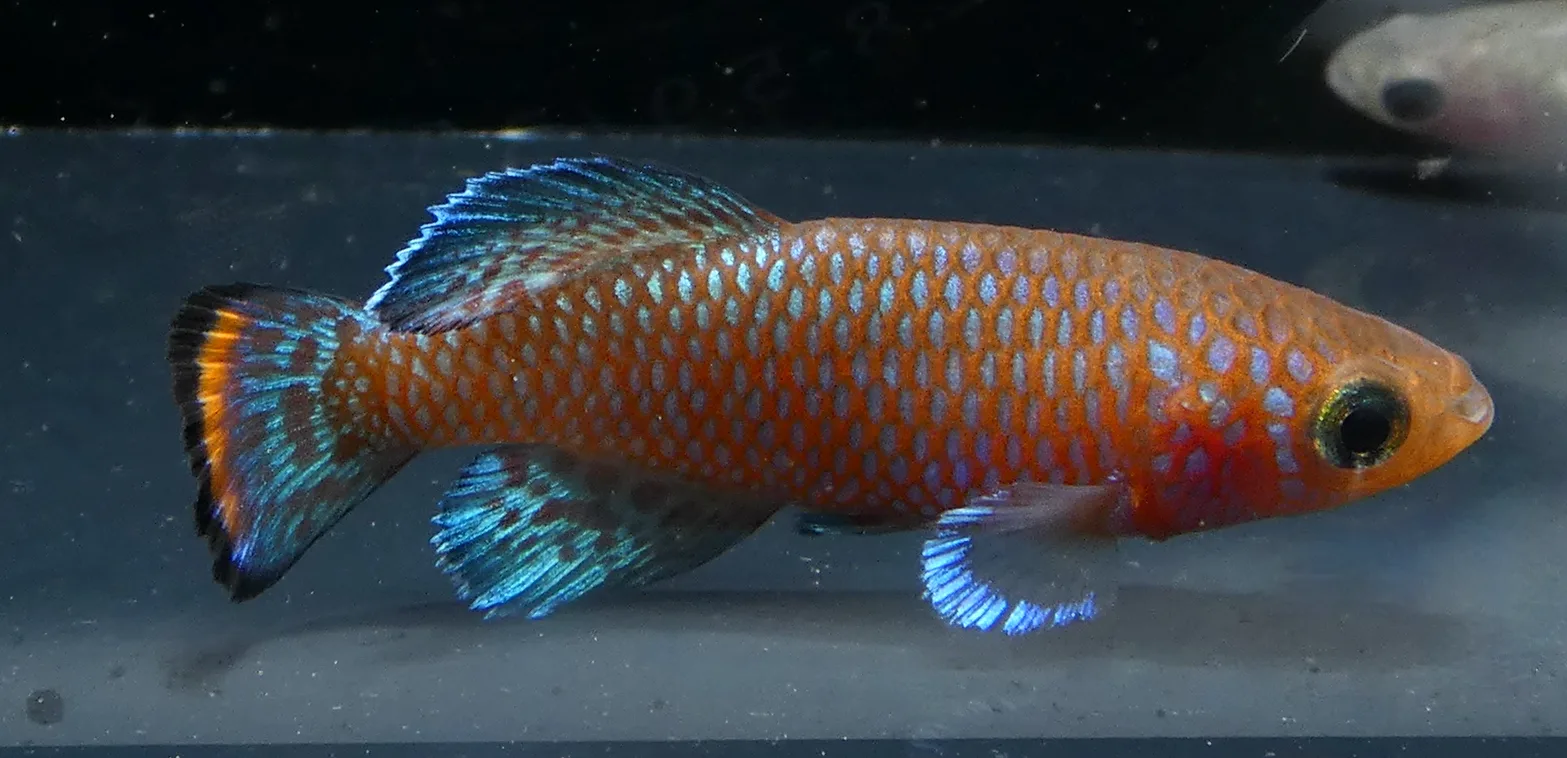
Males reach about 5 to 6 cm, females a little smaller. The male’s body is a clash of rust, turquoise and electric blue, with a dorsal and anal that can look trimmed in light. The caudal often carries a blue or white margin depending on the population. Females are beige with faint mottling. That dimorphism is the whole social system: males display, fight, and exhaust themselves; females choose, spawn, and stay camouflaged in tea-coloured water.
Lifespan in the tank is commonly 6 to 18 months, sometimes a little longer in cool, clean, lightly stocked setups, sometimes shorter if you keep them hot and dirty. Annual killifish are not stunted community fish. They are specialists. You either enjoy the intensity and the breeding, or you pick a different family.
The peat box is the habitat
A 20 to 40 litre tank can house a trio (one male, two or more females) if you are dedicated to this species alone. Larger is easier for water stability, but a palace community tank is the wrong shape of effort. Nothos want a simple box: a tight lid, a sponge filter or air-driven foam, dim light, a few clumps of Java moss or floating plants, and a container of coconut fibre or peat moss where they can dive and spawn. Sand is optional. Décor that looks like a river scape is wasted. The wild pool has mud, leaves, and not much else.
Temperature of 22 to 26°C is comfortable. Hotter water speeds metabolism and shortens life. Cooler water within reason can stretch it. pH around 6.0 to 7.2 and softness to moderate hardness work. They are not as chemically precious as some Amazonian dwarf cichlids, but they hate filth. Small tanks foul fast when you feed the live food these fish require. Change water. The peat spawning dish is not a licence to skip maintenance.
Males are territorial toward other males. Two adult males in a tiny tank without sight-breaks will fight until one is wrecked. If you want more than one male, you need space, plants, and extra females so that aggression has somewhere to go besides a rival’s fins. This is not a schooling killifish, regardless of what a tag file says. A “school” of males is a box of arguments.
If it does not wriggle, they may not believe it is food
Many Nothobranchius will learn to take frozen bloodworm, brine shrimp and daphnia. Some individuals accept high-quality granules. Plenty will not, especially wild-caught or picky lines. Live foods — grindal worms, white worms, brine shrimp, daphnia, mosquito larvae where legal and safe — are how you keep weight on a fish that lives at a sprint. Feed daily, small amounts, and siphon leftovers. A fat female fills with eggs. A thin male still displays until he drops. Neither should be thin.

Dry flake as the only diet is how hobbyists decide nothobranchius are “difficult.” They are not difficult. They are carnivores from puddles full of insect larvae.
How a puddle reproduces on your shelf
The method is famous because it works. You offer a container of damp, not soggy, peat or coconut fibre. The pair dives, the female lays, the male fertilises, and the eggs stay in the medium. After a week or two of collecting, you lift the peat, squeeze it to damp-not-wet, bag it, label it with the date and the population name, and store it at room temperature. The eggs need a dry diapause. Depending on temperature and the line, incubation is often two to four months, sometimes longer. You then wet the peat with aged, slightly acidic water, and fry hatch in hours to a day if the eggs were ready. If nothing hatches, you can dry and try again later; not every egg is on the same clock.
Fry are tiny but grow at a ridiculous pace if you feed infusoria then newly hatched brine shrimp and change water. Sex them as soon as you can tell, because brother-to-brother combat starts early. Raise extra females. The genetics of a closed hobby strain benefit from keeping numbers up rather than from one famous male.
Skipping the peat ritual means you keep a beautiful male until he dies, and then you have photographs. That is a valid way to keep a pet. It is not how the species persists in aquaria. If you do not want to incubate eggs, buy from someone who does, and do not pretend a community tank will produce a sustainable population.
Tank-mates, or why the answer is usually none
A dedicated killi tank is the default. Shrimp will be hunted. Tiny fish may be hunted or may nip the killifish. Large fish will eat the nothobranchius. Snails are mostly harmless. Some keepers add a handful of small, peaceful, surface-avoiding companions in a bigger tank, but every addition is a compromise with a fish that already has a short fuse and a short life. The honest companion for N. rachovii is extra females and a labelled bag of peat.
Diseases of a sprinting annual
Velvet (gold dust) is a classic killer of newly imported or stressed killies. It looks like a dusty sheen and clamped fins. Oodinium treatments exist; prevention is quarantine, heat not excessive, and clean water. Velvet plus a dirty small tank is a funeral. Internal parasites show as weight loss despite eating. Velvet and flukes often arrive with wild fish. Farmed fish still die of neglect faster than of mystery plagues.
Do not medicate peat full of eggs as if it were a fish. Handle eggs by keeping the medium clean going in, not by drowning the bag in copper.
Why keep a fish that is designed to die
Because the male, for the months he has, is one of the most colourful freshwater animals you can put in 30 litres. Because the breeding cycle is a complete piece of natural history you can hold in a bag of fibre. Because the alternative is that locality populations disappear from both the map and the hobby. Nothobranchius rachovii is not a community accent. It is a seasonal event you host on purpose. If that sentence feels like too much work, admire the photos and keep something that eats flake in a box for eight years. If it feels like the point of the aquarium, get peat, get females, and write the dates on the bags. The puddle only works if someone remembers to make it rain again.
Explore other topics
Dive into more aquarium guides across the site.