

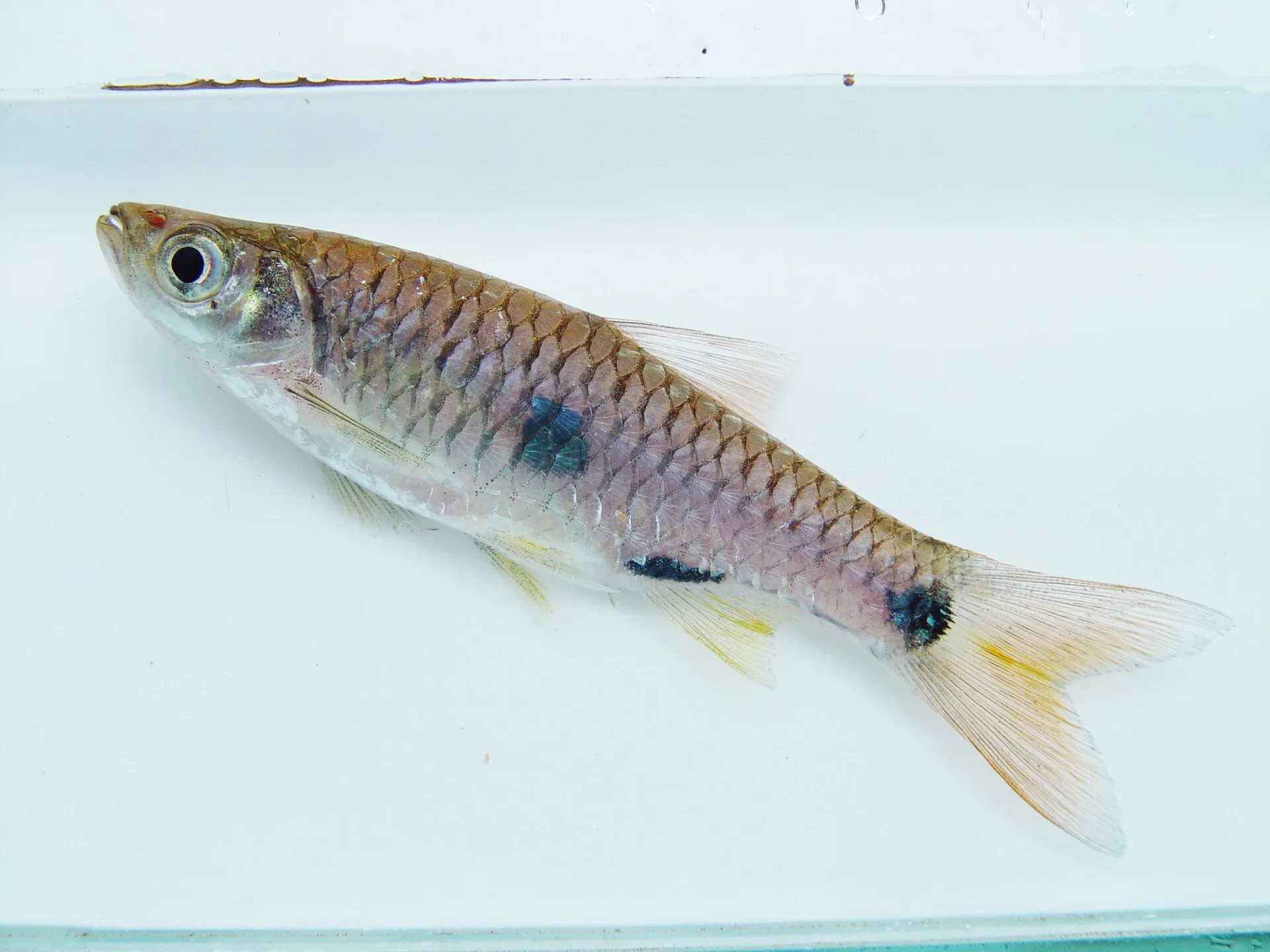
The word rasbora, in aquarium shops, has come to mean a 3 cm jewel for a nano cube. Rasbora elegans did not get that memo. The elegant rasbora, sometimes sold as the two-spot rasbora, is a forest-stream cyprinid from the Malay Peninsula, Sumatra and Borneo that can reach 15 cm, and sometimes more, with a body built like a small trout rather than a chili. People buy three juveniles, put them in 60 litres, and then write angry reviews when the “rasbora” outgrows the furniture. The fish is not the liar. The label is.
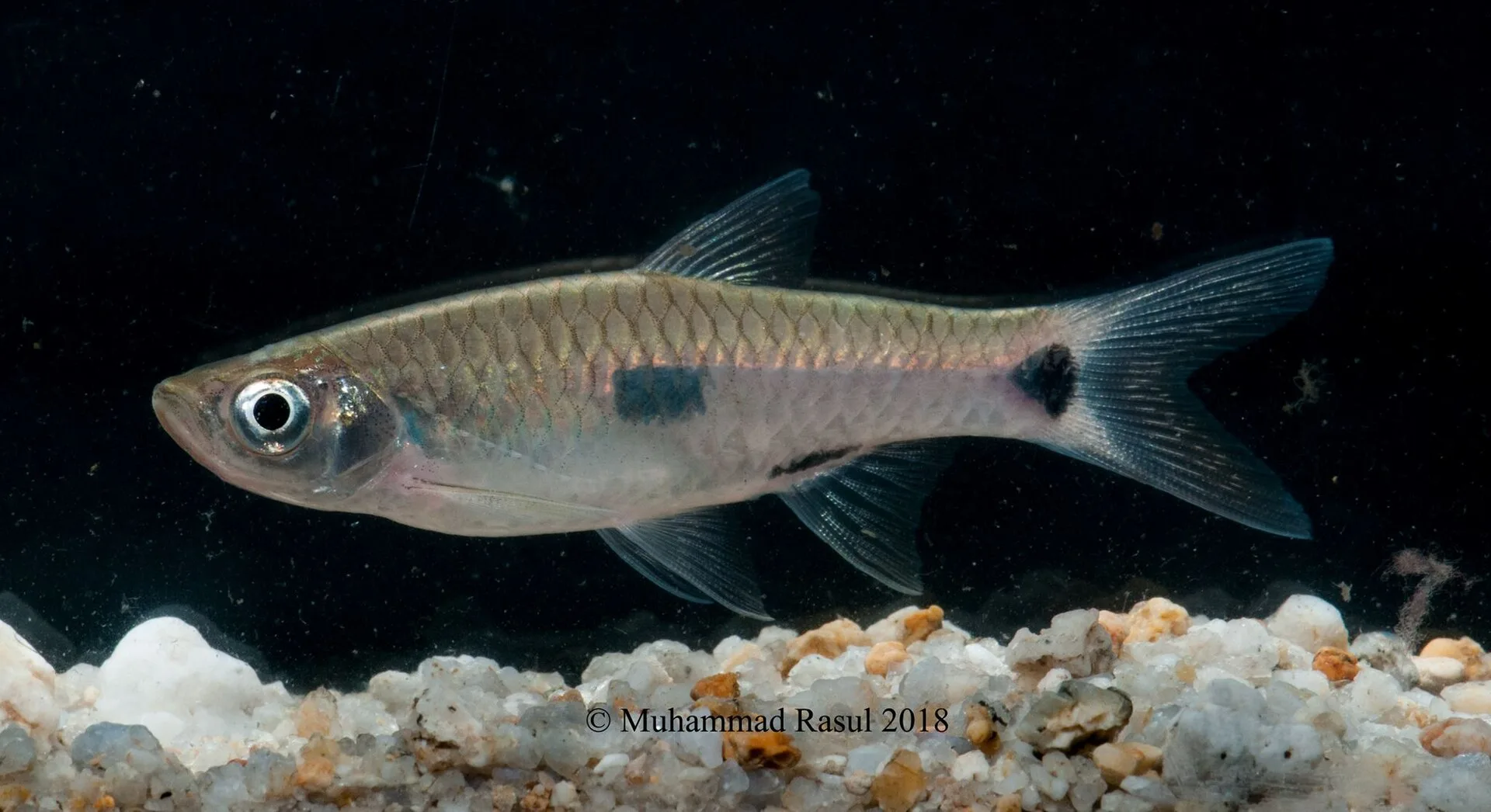
In peat-stained streams and clearer forest rivers it occupies midwater, often in groups, taking insects from the surface film and anything edible that drifts. The two dark marks — one behind the gill, one at the tail — are the field character. The rest of the body is silver-olive with a yellowish wash, a large eye, and a clean, forked tail. It is elegant in the sense of proportion, not in the sense of miniature. A full-grown specimen in a long tank is a serious, fast, handsome animal. In a nano tank it is a cramped, faded, skittish waste of a species.
How big is “elegant,” in centimetres you cannot negotiate
Plan for 12 to 15 cm total length. Some wild-caught fish and well-fed captives push toward 18 to 20 cm. That is catfish territory in the minds of many keepers, yet it is still sold next to fish that stay the size of a thumbnail. A group of six adults wants 200 litres or more, with length as the precious dimension. Height is nice for planting. Length is how they stay sane.
Males are slimmer and often show a stronger yellow in the fins when they are competing. Females are heavier through the belly. The two spots stay on both sexes. You will not get the dramatic colour split of a killifish; you will get a school of silver fish that look expensive when they are in condition and cheap when they are not.
Forest water, without turning the room into a swamp
Temperature of 22 to 26°C, pH 5.5 to 7.5, and softness to moderate hardness cover the range. They are adaptable compared with tiny blackwater specialists, which is why farms can raise them, but they still colour and behave better with some tannin, a dark bottom, and plants or wood that break lines of sight. A river-style layout with a clear swimming channel and structure at the ends fits them. Strong filtration is welcome if the flow is a current they can use, not a washing machine. They put out a lot of waste once they are large. Under-filtering a 200 litre tank full of 15 cm cyprinids is how you get nitrate headaches and dull scales.
A lid is not optional. A 15 cm rasbora that spooks can clear a rim. Decorations should not include narrow vertical gaps that a panicked fish will wedge into. Substrate can be sand or smooth gravel. They are not dedicated diggers, but they will root at leftover food.
Feeding a midwater hunter that grew up
Juveniles take flakes and baby brine like any small cyprinid. Adults need proper meals: floating and slow-sinking pellets sized for a 12 cm fish, frozen krill, mysis, chopped prawn, insect foods, and some vegetable matter so the gut keeps moving. They will eat flake forever if that is all you offer, and they will look like underfilled socks. Feed amounts they finish. A school this size can wreck water in an afternoon if you enjoy watching a feeding frenzy and walk away from the leftovers.
They will take insects from the surface. A few flightless fruit flies or a pinch of freeze-dried insect is enrichment, not a gimmick. They are not herbivorous silver dollars; do not expect them to mow a garden. They will, however, sample soft plants if they are hungry and bored.

Company, and the myth of the gentle giant rasbora
Elegant rasboras are not aggressive in the cichlid sense. They are large, fast, and mouthy enough to inhale very small tank-mates. A 15 cm adult and a 2 cm neighbour is a food chain, not a community. Keep them with similarly scaled, robust fishes that enjoy the same temperature and a bit of flow: other large rasboras, medium barbs that will not shred them, gouramis too big to swallow and too calm to be harassed, and bottom-dwellers that can compete for sinking food. Skip anything tiny. Skip slow, long-finned show fish in a cramped tank. Skip large predatory cichlids that will rearrange the school into lunch.
They want a group. Six is a sensible start in a tank that can actually hold six adults. Two fish of this size often pace and startle. The school is how they feel hidden in open water.
Eggs, and why nobody in the shop talks about them
They are egg scatterers. Breeding reports exist from large, well-planted tanks with soft water and a huge diet of live food, followed by removing the adults. It is not a kitchen-windowsill project. If you want fry, you need a breeding volume that matches the adults, a grate or a dense plant trap, and a plan for feeding hundreds of small fry that will themselves grow into large fish. Most keepers will never spawn them and that is fine. The conservation of the species in the hobby depends more on not stuffing juveniles into nano tanks than on heroic home breeding.
Reading the two spots like a dashboard
When the shoulder and caudal spots are crisp and the body is clean silver-olive, the fish is probably comfortable. When the spots smear, the fins clamp, and the school sits at the back glass, check ammonia, temperature spikes, and bullying. Skinny, large-headed fish are underfed or parasitised; cyprinids this size hide camallanus well until they are hollow. Flash-swimming against décor can mean flukes. A fish that peels off to gasp in the corner may have gill damage from poor shipping. Quarantine new arrivals. A 15 cm fish that dies of ich in a display full of other expensive animals is a more expensive lesson than a spare tub and a sponge filter.
Acclimation should be slow if the shop water is far from yours. Large rasboras handle a range, but they do not handle a 1.5 pH jump in ten minutes. Drip. Then feed the next day, not the next hour.
The honest sales pitch
If you have a long 200 litre tank, enjoy active silver fish, and can feed more than leftover flake, Rasbora elegans is one of the most quietly impressive cyprinids you can keep. It does not glow like a neon. It does not pose like a show betta. It swims the way a forest river looks in photographs, which is to say it needs room, oxygen, and a group. If you wanted a nano rasbora, you wanted a different Latin name. This one grew into its adjective. Elegant, at this size, means long, clean lines in a lot of water, not a jewel on a shelf.
Keep the glass clean enough to see the two spots. Keep the water changing on a schedule that matches the bioload. Keep the lid on. That is the whole trick, and it is more than enough, because the trick is also never to believe a 3 cm fish in a cup will stay a 3 cm fish when the cup is labelled elegans.
Older literature sometimes mixed this species with other spotted rasboras. If your adult lacks the two distinct blotches and instead shows a dark lateral stripe, you may have a different Rasbora. Enjoy the fish you actually have, but do not copy care from a chili rasbora article. Body mass, appetite and swimming speed here are in another league, and the league has a 15 cm minimum entry.
Explore other topics
Dive into more aquarium guides across the site.