

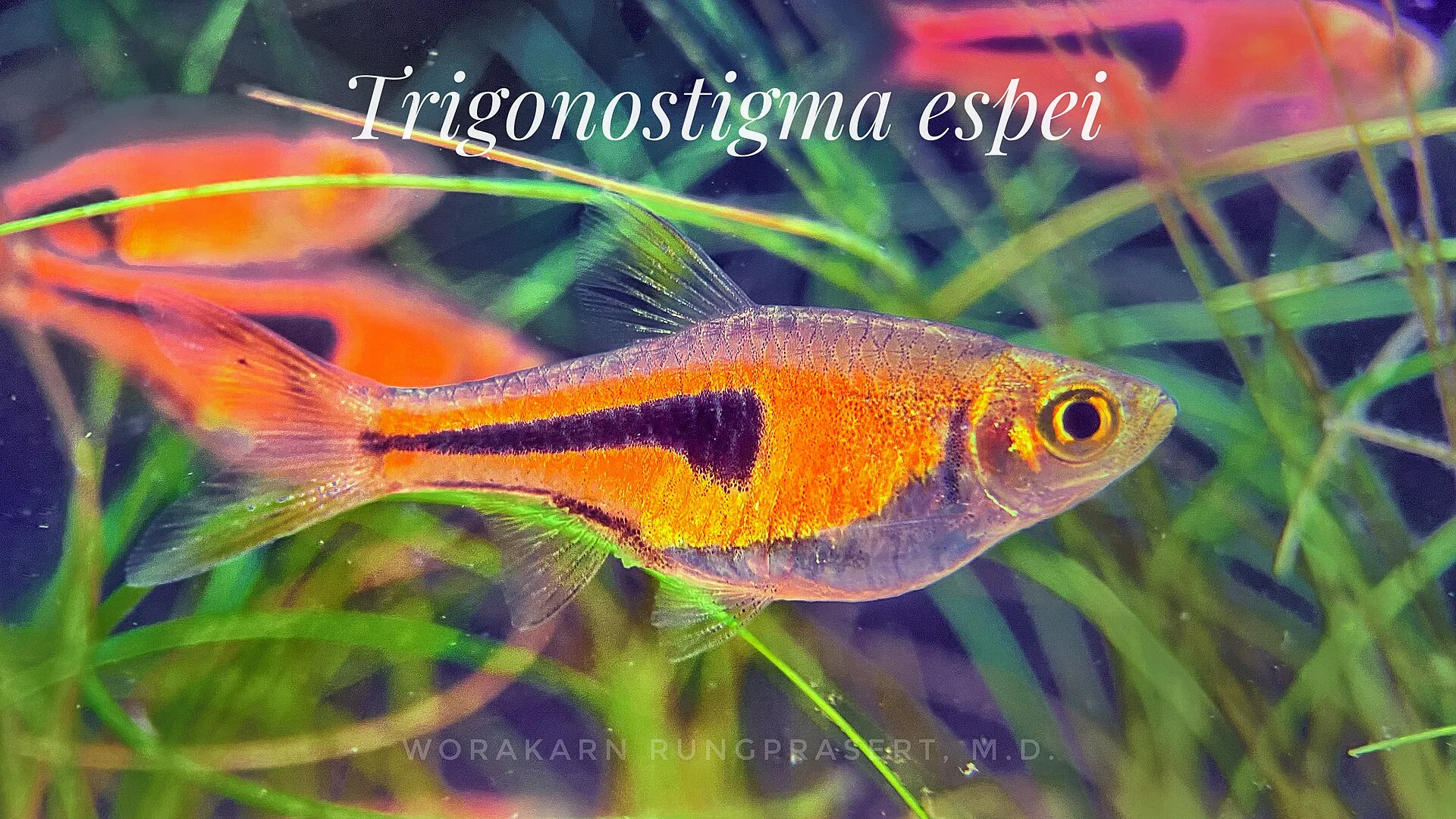
People keep asking about the lambchop
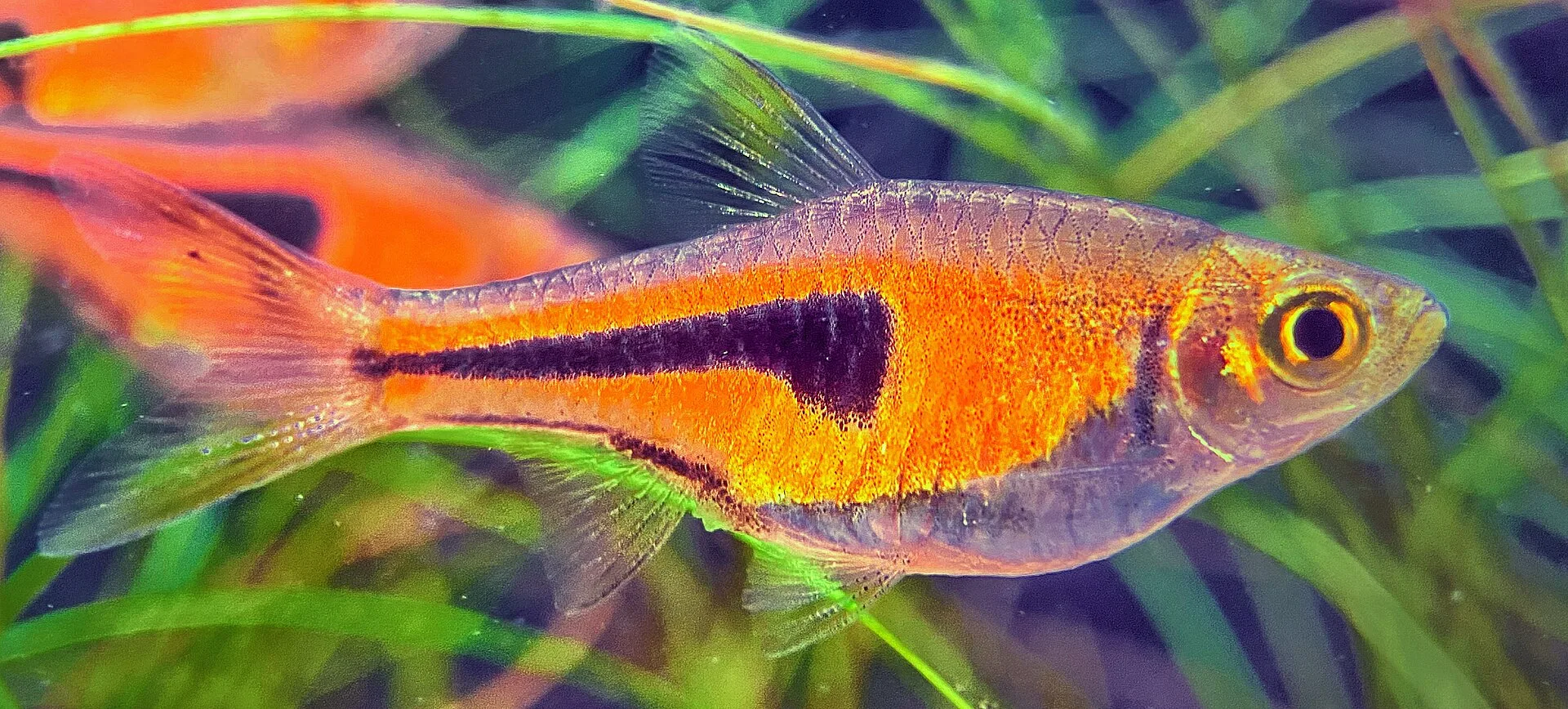
Is Espei rasbora just a pale harlequin? No. Trigonostigma espei is its own species, from peat-influenced streams and pools in Thailand and Cambodia, including drainages associated with the Cardamom mountains and the Gulf of Thailand coast. It shares the harlequin’s triangular black “chop” on the rear body, but the ground colour is a warm copper, pink or orange, and the fish stays smaller and more delicate than the common harlequin rasbora (Trigonostigma heteromorpha). If your shop tank is labelled “espei” and the fish are chunky, dull and 4 cm already, look again. True espei adults are usually in the 3 to 4 cm range, slim, and almost luminous when they are comfortable.
How many do I need? This is a shoaling fish that uses the school as cover. Eight is a working minimum; twelve in a 60 to 80 litre tank is when the group starts to move as a single copper ribbon instead of a handful of nervous individuals. Two or three will hide, lose colour, and pick at each other. The “schooling” tag on a care sheet is not a suggestion. It is the difference between a display and a row of hiding places.
What water do they actually want? Soft, slightly acidic, and stained if you can manage it. Think pH 5.5 to 7.0, low to moderate hardness, temperature 23 to 27°C. They will survive in harder tap water, which is how many farms raise them, but the copper intensifies and spawning becomes realistic when the water is closer to a peat swamp: tannins from catappa, alder cones or a little peat in a mesh bag, dimmer light, and leaf litter. They are not demanding in the way discus are demanding. They are simply honest. If you blast them with bright light over a white sand desert and hard alkaline tap, they will look like mistakes.
The tank is a shaded pool, not a racetrack
Sixty litres can work for a dedicated group if the footprint is long and the décor is layered. Plant heavily at the back and sides. Leave a midwater path. Floating plants knock the glare down, which matters more for espei than for most barbs. A dark substrate makes the pink read as pink. Fine sand or smooth gravel lets them pick at food that drifts down. They occupy the middle of the water column, hovering, then flicking forward as a group. A powerhead is unnecessary. A gentle sponge or hang-on filter that does not suck slim bodies into the intake is enough. Cover the tank. Small rasboras jump when startled, and a cat jumping onto the cabinet counts as startled.
They are peaceful to the point of being victims. Do not house them with large, rowdy barbs, with fish that eat 3 cm mouthfuls, or with relentless fin-nippers. Suitable neighbours are other small, calm, soft-water fishes of similar size: tiny rasboras, small gouramis that will not gulp them, shrimp if the rasboras are well fed and the shrimp have moss to hide in. Avoid anything that treats the midwater as a hunting lane. Avoid big, clumsy cichlids. This is a species that disappears from a mismatched community without drama; you simply count fewer copper wedges each week.
What goes in a mouth that small
Wild espei take minute invertebrates and biofilm. In the aquarium they will learn to eat crushed flakes and micro-pellets, but they do better when you also offer baby brine shrimp, daphnia, cyclops and microworms. A group that only ever sees large pellets will starve in slow motion while food rots in the corners. Feed small amounts twice a day. Watch the back of the school. The fish at the rear are the ones that tell you whether your feeding method works.
They are not algae eaters. They are not cleaners. If you want the glass clean, you clean the glass. If you want them plump, you feed tiny animal foods on a schedule, not a weekend dump of flake.
Can I breed the lambchop without a laboratory?

Yes, if you take the water seriously. Trigonostigma species press eggs onto the underside of broad leaves, often in slightly softer, more acidic water than the display. A species tank with Java fern, Cryptocoryne, and a pair or a small group that has been eating live food for two weeks is the classic approach. Some keepers use a separate breeding box. Spawning often follows a rain-style water change: a little cooler, a little softer, tannins in the bucket. The adults will eat eggs if they find them, so either pull the leaf or pull the fish. Eggs hatch in a day or so. Fry are tiny. Infusoria or commercial fry food designed for egg-layers comes first; brine shrimp nauplii come when the mouths are large enough. Raising them is a numbers game against water quality. Small, frequent changes beat one giant rescue change after an ammonia spike.
Males are slimmer and often more intensely orange, with a crisper black wedge. Females are fuller in the belly when ripe. The difference is subtle compared with livebearers. Buy a group and let pairs form rather than trying to order “a pair” from a list of identical 2 cm fish.
Things that go wrong, and things that only look wrong
They lost their orange after I brought them home. Stress, hard water, bright light, or a week of refusing food. Dim the tank, add leaf litter, offer baby brine, and wait. Colour returns if the fish are healthy. If they also clamp fins and scratch, look for ich or flukes from the shop, and treat in quarantine, not by guessing in the display.
One fish hangs at the surface. Check oxygen, temperature and ammonia. Espei rasboras should not gasp. A single fish isolated from the school may be sick or bullied; a whole school at the surface means the water, not the personality.
They ignore flakes. Many newly imported or pond-raised batches are weaned on live food. Grind the flake, mix it with frozen cyclops, and reduce the particle size until they eat. Do not assume a fish that ignores food is “just shy” for a month. Shy with a round belly is fine. Shy with a pinched belly is dying.
My shrimp numbers are falling. Adult espei can pick off newborn shrimp. Adults of larger shrimp species usually coexist if the aquascape is dense. If you wanted a shrimp-only tank, this was the wrong centrepiece.
A small fish that still needs a full sentence of care
Espei rasboras get sold as “easy community fish” because they are peaceful and pretty. Peaceful is not the same as indestructible. They want a crowd of their own, softish water, shade, and food that fits in a 3 cm fish. They do not want a carnival of large, fast, hard-water animals. If you can offer a planted 60 to 90 litre tank, a school of ten, and a little patience while they colour up, Trigonostigma espei is one of the few small cyprinids that looks like a living metal leaf when the light hits the wedge. If you cannot, there are farmed fish that tolerate neglect better. This one would rather you did not bother than that you kept three of them over white gravel under a shop light.
Quarantine still applies. A two-week observation tank with a sponge filter and a clump of moss will show you whether they eat, whether they scratch, and whether anyone is fading from the inside. Medications for skin parasites should be dosed for small, scaled fish, not for a 20 cm cichlid. When they move to the display, drip-acclimate if your pH and hardness differ from the shop. A pH crash on transfer kills more delicate rasboras than old age ever will.
Once settled, the daily picture should be a loose shoal that expands and contracts as a unit, picking at the midwater, rarely sitting on the bottom, never parked in a corner for hours. That is Trigonostigma espei doing what peat-swamp shoalers do. Anything else is a tank problem wearing a fish-shaped symptom.
Explore other topics
Dive into more aquarium guides across the site.