

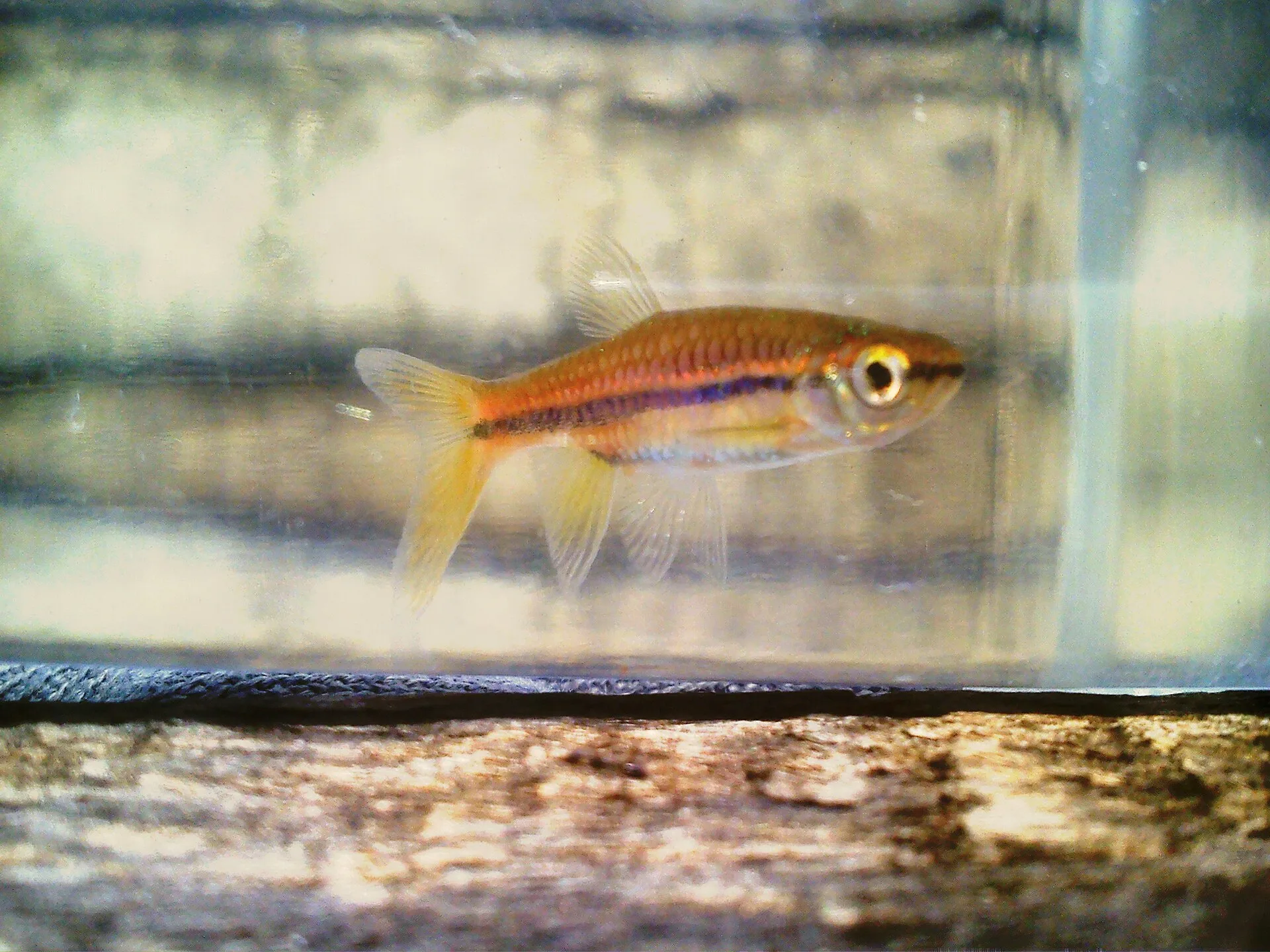
Brilliant rasbora is a trade name that undersells the fish. Rasbora einthovenii is a proper stream cyprinid, 8–12 cm when grown, with a dark longitudinal stripe that reads as a living line through the water. It is not a 2 cm peat speck. It is not a glowlight. It will not thrive in 40 litres of still blackwater, and it will not thank you for Tanganyika salts. You are keeping a Southeast Asian river schooler that needs distance, oxygen, and a lid.
People buy three of them for a community tank because the stripe looks elegant in the shop. Three fish of this size in a short aquarium become nervous, faded, and skittish. Ten fish in a long tank become the reason you sit in front of the glass.
Vegetated streams, not peat cups
The species is native to Southeast Asian streams with plants, wood, and seasonal variation in flow. Water is typically soft to moderately soft, not the extreme pH 4.5 of a deep peat swamp, and not the pH 9 of Lake Tanganyika. The fish use the midwater, moving as a group along the channel. Banks provide cover; the channel provides the commute.
Copy the channel. A planted rear, open centre, and some wood or leaf pockets at the ends is closer to home than a wall of rift rock or a leaf-litter apisto tank. They will pick at the surface and the midwater. They are not sand-sifters and they are not cave fish.
A stripe you can read from across the room
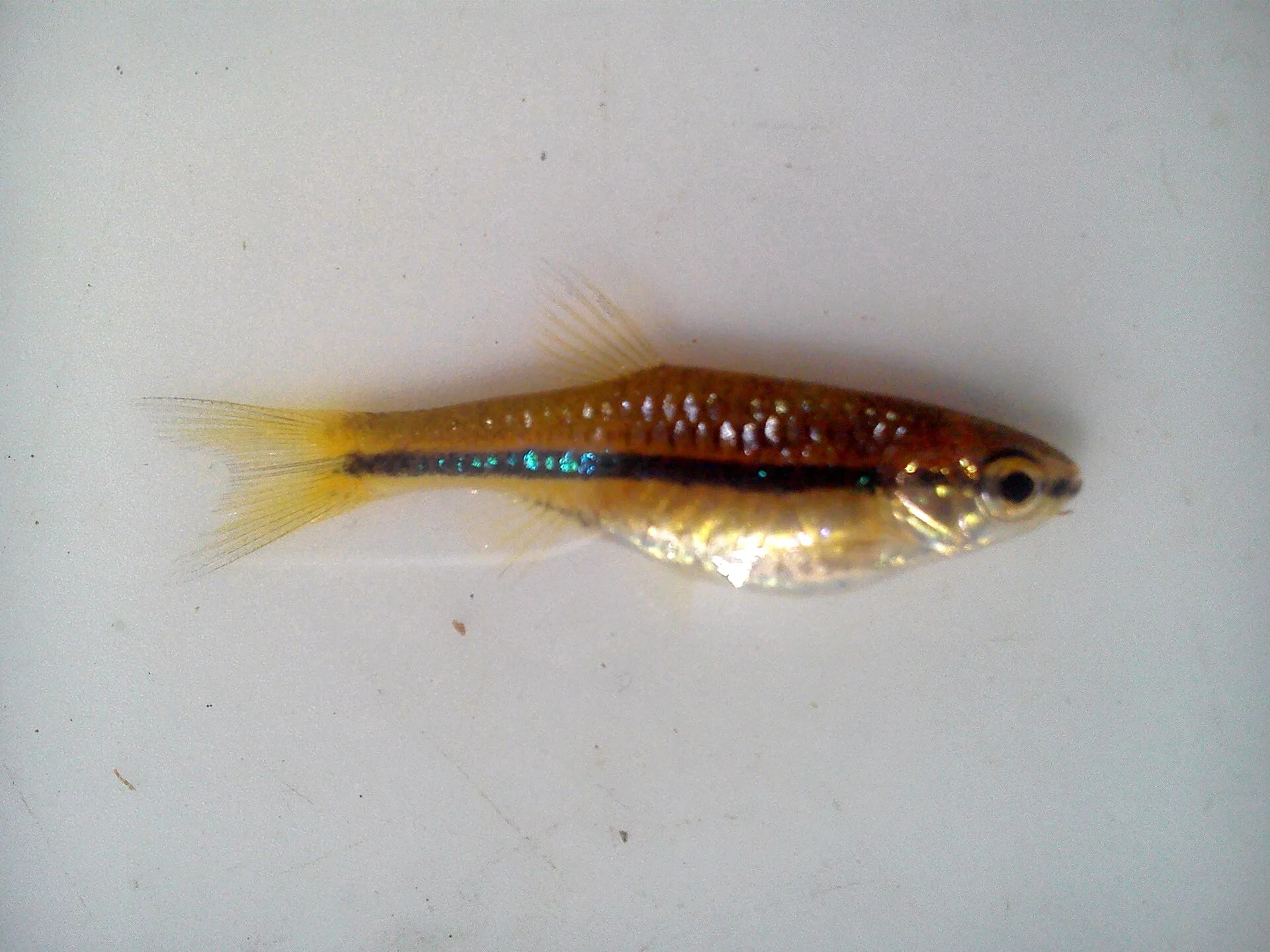
The body is silver to olive with a bold dark stripe from head toward the tail. “Brilliant” refers to the clean, high-contrast look of a well-kept school, not to neon pigment. Males are often slimmer; females fill when conditioned. Fins are relatively modest — this is a swimming machine, not a veil-tail. If the stripe looks broken and the fish is clamped, look at oxygen, school size, and whether a bully is chasing them off food.
Do not confuse them with the smaller blackline rasbora (Rasbora borapetensis) or with scissortails that advertise with the caudal pattern. Einthoven’s rasbora is about the body stripe and the adult size. A 12 cm fish needs a different grocery list than a 4 cm harlequin.
One hundred fifty litres of length
Give this rasbora 150 litres and, more importantly, a long footprint. Height is wasted if the school cannot turn. Filtration should move water and keep oxygen high without creating a white-water rapid that pins them at one end. Plants at the sides, swimming room in the middle, and a tight cover are the architecture. They can jump. The lid is not optional.
Substrate can be sand or smooth gravel. They do not require a 10 cm sand bed like an eartheater. They do not require snail shells. They do appreciate a current they can choose to sit out of, which is why plants and wood at the ends matter.
If you only have a tall nano, this is the wrong rasbora. Look at Boraras or Trigonostigma hengeli instead.
Cooler, oxygenated, not swamp-hot

Temperature 22–26°C suits them better than a 30°C discus tank. pH 5.5–7.5 covers captive fish; stay away from both extremes unless you know your population. They want dissolved oxygen. A still, warm, heavily covered tank that is perfect for a chocolate gourami will leave brilliant rasboras gasping at the surface. Keep the surface moving. Do not overheat.
Cycle fully. A school of 10 cm cyprinids produces real waste. Small frequent water changes beat rare huge ones. If your tap is very hard, mix down; if it is very soft, you still do not add crushed coral to “help the filter.” Match the stream, not a Malawi handbook. Chemistry background: water chemistry basics. Cycling: cycle the aquarium properly.
A midwater omnivore with a real appetite
Feed quality flakes or pellets sized for a 10 cm mouth, plus frozen bloodworm, daphnia, and brine shrimp. They will take some vegetable matter in prepared foods. They will not live on powdered fry food meant for clown rasboras. Feed so the whole school gets some; they are faster than many tetras and will outcompete glowlights if you keep both in a short tank.
Uneaten food in a 150 litre river tank still becomes ammonia. They are active. They are not messy in the way a large cichlid is messy, but a hungry school of eight will still foul a neglected filter.
Schooling with fish that can keep up
Stock a group of six at an absolute minimum; eight to twelve is the behaviour you actually want. Tankmates: other peaceful, similarly sized stream fish, larger rasboras, barbs that do not shred fins, and robust Corydoras in a sandy planted river layout. Bad mix: 2 cm Boraras (they become food or at least terrified), slow long-finned gouramis in a small tank, and any territorial cichlid that claims the midwater.
Do not add them to a Tanganyika setup. The water is wrong and the cichlids will harass a pelagic schooler that has no rock to hide in. Do not add them to a Uaru tank unless the volume is huge; the Uaru will win the food war and the water will be warmer than this rasbora likes.
Scattering in plants, then eating the evidence
They are egg scatterers. Condition with live and frozen foods. A separate long tank with plants or mops, slightly softer water, and the adults removed after spawning is the standard cyprinid approach. Fry are larger than Boraras fry but still need small foods first. You will not get parental care. You will not get a cave. If you wanted a fish that guards eggs, you wanted a cichlid from a different continent.
The usual failures
Short tanks. Groups of three. No lid. Water too warm and still. Feeding nano powder because the label said rasbora. Ich after a chill from an oversized water change. The fix is almost always more length, more friends, more oxygen, and food that matches a 10 cm omnivore.
Quarantine new fish if you can; watch the stripe and the appetite. A brilliant rasbora that inspects the front glass in a group is healthy. One that sits behind the heater alone is not.
Related swimming companions on this site include the scissortail rasbora (different tail language, still a river schooler) and the smaller harlequin if you need a planted-community size. R. einthovenii is the one you buy when you have the length to do the stripe justice.
Explore other topics
Dive into more aquarium guides across the site.