

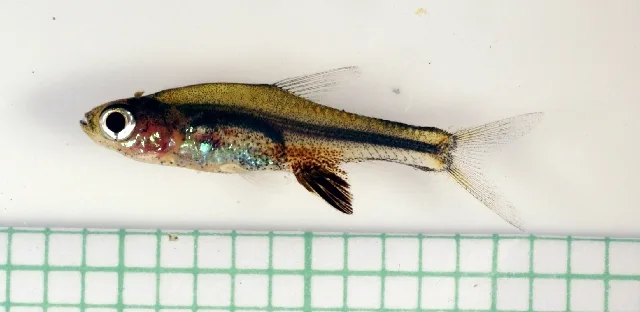
The trade calls it volcano rasbora. The animal is Sundadanio axelrodi, a tiny Sundaland cyprinid from Borneo peat swamps, closer in ecology to a nano danio than to Rasbora einthovenii. Adults are about 2–2.5 cm. Males can throw a metallic blue-green sheen that looks volcanic only when the water is stained, the light is low, and the fish is displaying. In hard, bright community water they look like beige needles and then they disappear.
If you keep this species like a harlequin, you will fail. If you keep it like a clown rasbora, you will be much closer. The remaining difference is the male colour language: this is a display fish in a tea-cup swamp, not a striped river patrol.
Tea-stained Borneo, almost still
Wild fish inhabit peat swamps on Borneo. The water can be extremely soft, pH down toward 4–6.5, stained dark, full of tannins and leaf material. Flow is negligible. The fish live in the upper and mid layers among plants and flooded structure. Collecting and shipping are hard on them; captive-bred fish exist but still expect peat chemistry if you want the blue.
Do not “buffer up” this tank for snails that need calcium. Do not add aragonite. The volcano rasbora is a peat specialist. Treat the water as a weak tea, not as a crystal river and not as a rift lake.
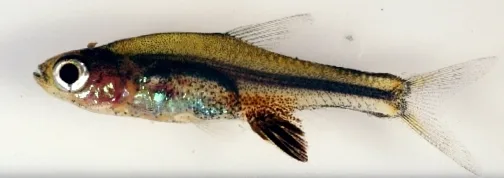
When the male actually looks like a volcano
Females and unimpressed males are modest: a small, slightly compressed body, reddish to brownish tones, nothing that photographs well in a store. A displaying male is the event — iridescent blue-green flashing along the body, more like a neon tetra’s trick than a rasbora stripe, except it is not a tetra and the water must be acidic for the show to happen. You buy a group so that males have an audience and females have cover.
Sexing in a dealer tank is guesswork. Sexing in a mature peat tank is obvious once a male lights up. There is no shell, no nuchal hump, no Julie barring. If your fish is 8 cm long, someone sold you the wrong “rasbora.”
Thirty litres of peat, heavily planted
A 30–40 litre blackwater tank is the right size for a dedicated group of ten or more. Plant it until you can barely see the back glass. Float plants. Add leaves. Use a sponge filter. Dark substrate. No rapids. A lid, because tiny fish jump when the room knocks.
This is closer to a Boraras layout than to a 150 litre brilliant rasbora river. It is not an apisto cave system, though leaf litter overlaps. It is not a Tanganyika sand flat. If you only have hard tap and a community already running, skip Sundadanio.
pH that would scare a livebearer
Temperature 23–28°C. pH 4.0–6.5. Soft. Stable. Zero ammonia. These fish have no spare body mass. A cycle that is “almost done” will kill them. Read the cycling article and wait. Mix RO if you must; remineralise barely. The chemistry basics piece is relevant here because peat tanks fail when people chase numbers with acid bottles instead of using RO, botanicals, and patience.
Small water changes of matched water. Do not bleach the tea colour out every week. Do not let nitrate run because “it’s a planted tank.” Nano peat fish die quietly.

Dust, cyclops, and watching the shy ones
Omnivore, functionally a micropredator on zooplankton. Powdered foods, baby brine, cyclops, infusoria-grade products, microworms. Large pellets are furniture. Feed twice daily, tiny amounts. Males colour up when they are well fed and unchased. If only the front fish eat, you have too much flow or a tankmate problem.
They will not graze algae like a Uaru. They will not sift sand like a Geophagus. They will not take wafers at night like a pleco. Feed the water column they actually use.
A species tank is the honest answer
Best with their own kind, or with other peat nanos that will not eat them: Boraras, perhaps tiny pencilfish, shrimp that tolerate low pH. Dangerous: anything with a mouth, including many “peaceful” tetras, and certainly any cichlid. Corydoras in hard-water sand are a different project. Hatchets want a long surface and a lid for different reasons; they also outcompete at the top.
Do not use volcano rasboras as dither fish for dwarf cichlids. The cichlids will treat them as moving snacks.
Eggs in the swamp you already built
Egg scatterer among plants. Males display; females scatter. Adults eat eggs. Fry are minute. A dedicated mossy tank and infusoria are required if you want numbers. Accidental fry in a leaf-heavy display are a bonus, not a plan. This is not a mouthbrooder, not a cave spawner, not a shell-dweller.
Losing the blue
The blue goes first when chemistry is wrong, then the appetite, then the fish. Velvet and ich are fast on a 2 cm body. Quarantine in matching peat water, not in a hard-water hospital tank that “works for everything.” Observe whether males still display. A tank full of beige fish that never flash is a husbandry report, not a genetic one.
If you wanted the red nano instead, compare chili rasbora and clown rasbora. If you wanted a blue fish in alkaline water, that is a Tanganyika problem and a different salt mix. Sundadanio axelrodi is the peat swamp’s metallic flash, and only that.
Buying them without buying a beige needle
Dealer tanks are fluorescent, hard-water, and crowded. Sundadanio axelrodi in that setting looks like a failed guppy. Ask whether the fish are captive-bred, how long they have been eating, and whether the holding water is at least on the soft side. A group that already shows one male with a hint of metal is worth more than a cheaper bag of twelve stressed fish that will die in the bag. Float, drip, and lights-off introduction into a mature peat tank. Do not add them to a tank you started last weekend with bright sand and a skeleton filter.
Once home, resist the urge to “clear the water” with chemical purifiers that strip tannins. The tea is the enclosure. If you need to see them, use a torch from the side, not a 6500 K flood from above. The blue flash is a display, not a 24-hour LED show. Give them a photoperiod with a dim dawn; sudden full brightness sends the school into the moss for hours, and hours in the moss means they miss the only feeding of powdered food you remembered to do.
Explore other topics
Dive into more aquarium guides across the site.