

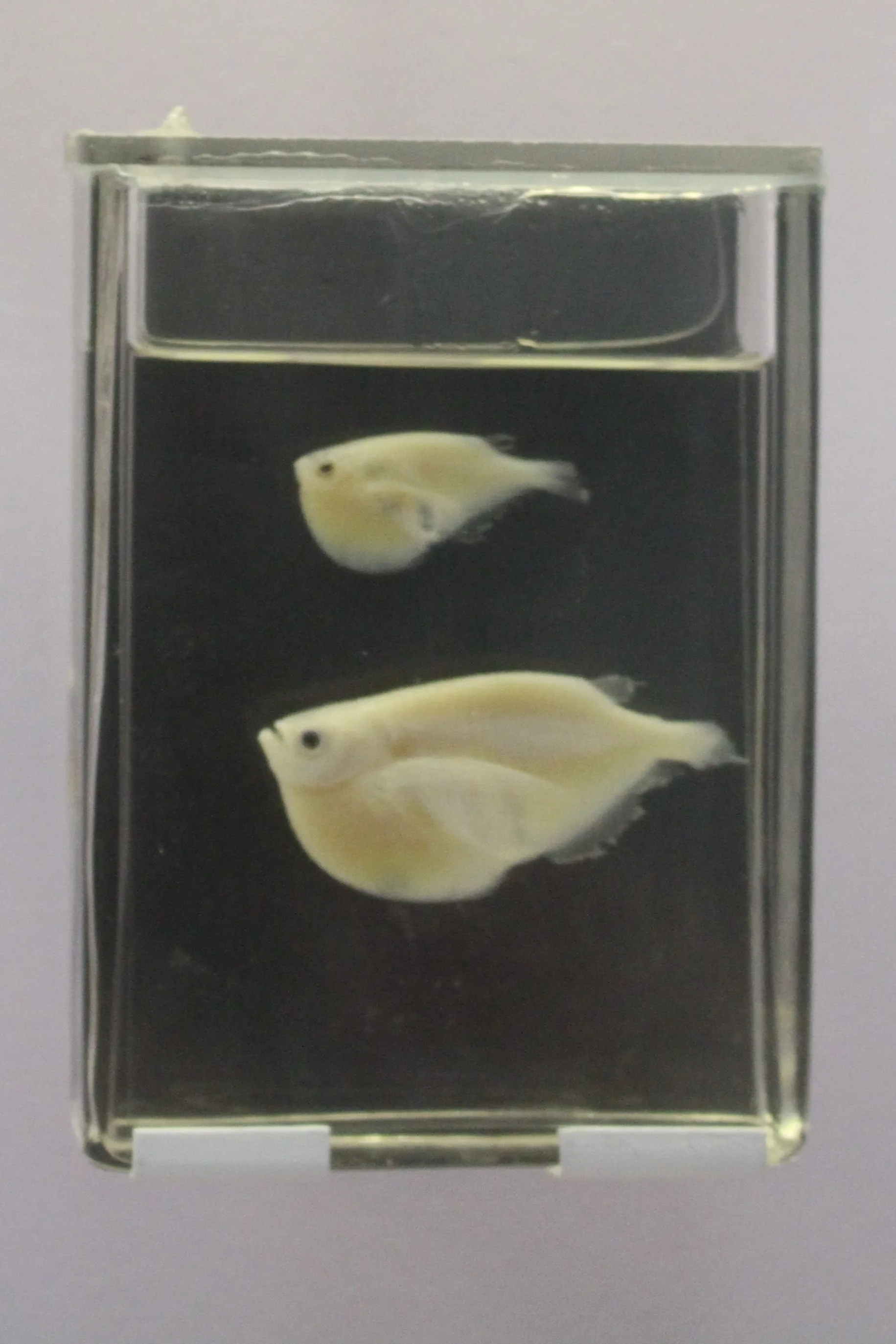
Gasteropelecus sternicla, the common hatchetfish or river hatchetfish, is the silver, slightly larger hatchet you see more often than the marble. It still lives in the surface film of Amazon, Orinoco, and Guiana waters. It still jumps. It still dies in open-top tanks. What it does not share with Carnegiella strigata is the same fragility, the same adult size, or the same marbled paint.
Silver, a black line, and a bigger engine
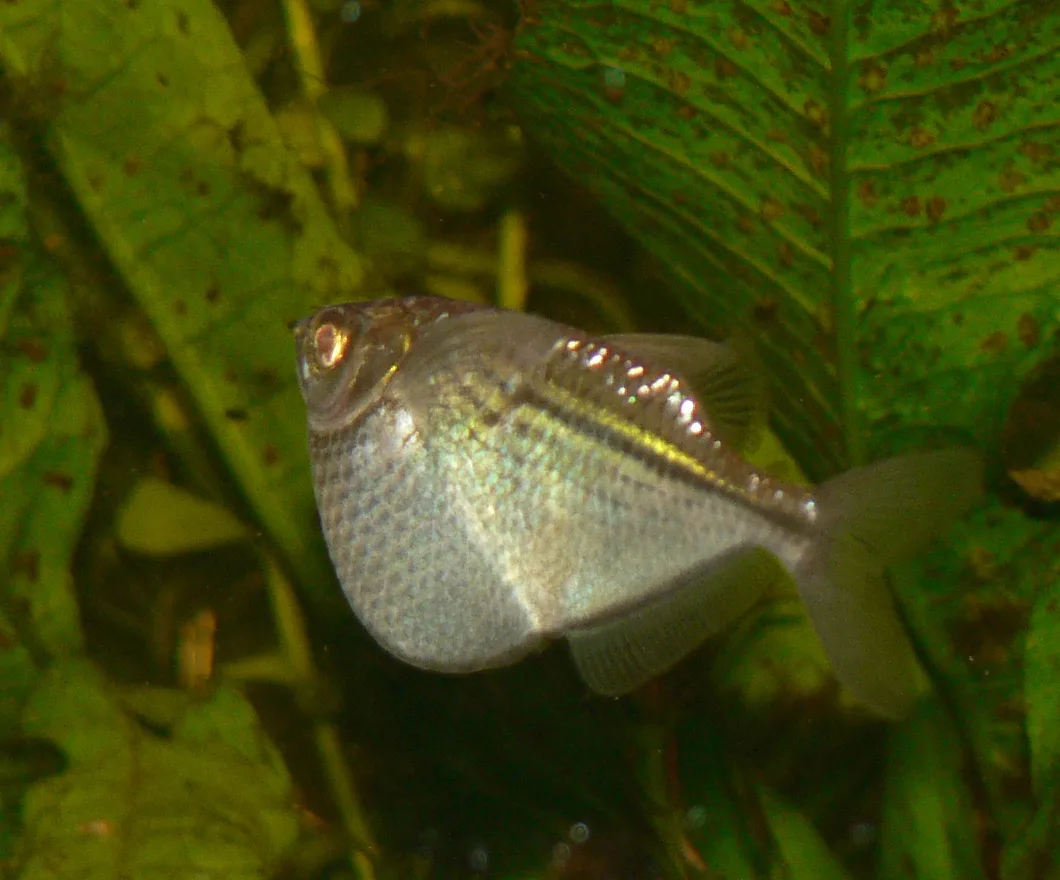
Adults reach about 5–6.5 cm. The body is metallic silver with a dark longitudinal line and a hatchet keel. There is no marble maze. In good condition they look like small chrome axes hanging under the glass. In poor condition they look like thin knives with a hollow chest. Sexing is difficult; females may be deeper-bodied when gravid. Buy a school and do not pretend you can pick pairs from a shop vat.
Lid geometry for a stronger jumper
The common hatchet can hit a gap harder than a marble. Cable cut-outs, filter hoods that do not seat, and “open aquascape” photography are how they leave. Cover every millimetre. If you use a hang-on-back filter, block the overflow slot with sponge or a custom cover. They do not need a splash-tetra air gap for spawning; they need the opposite: a sealed top and water filled to a sensible level so they can still sip the film without leaping into dry air every time a shadow passes.
That is a different lid problem than Copella arnoldi. Splash tetras need humid air to glue eggs. Hatchets need no exit. Do not build one lid strategy for “all surface fish.”
Length along the ceiling
They patrol the top. A long tank (90–120 cm) with a school of six to ten gives them a runway. A tall nano gives them a postage stamp of surface and a long drop if they panic. Depth of water is secondary. Litres that sit unused in the lower two-thirds only help if you keep other fish there.
Flow should ripple the surface lightly, not chop it. They come from rivers and can handle more movement than marbles, but a powerhead aimed at the top will exhaust them and blow food away. Temperature 24–28°C, pH 6.0–7.5, softness preferred. They are a bit more adaptable than marbles, not as adaptable as Mexican tetras.
Surface feeding in a mixed river tank
Floating flakes, insects, and foods that remain in the film are mandatory. Common hatchets are bolder feeders than marbles, which means they can monopolise the top if you also keep Carnegiella. Feed enough, or keep one hatchet species. Midwater tetras will steal sinking food; that is fine if you also deliver a surface course. Watch the silver line along the belly. Concavity means you are feeding the wrong depth.
They are omnivorous micropredators. Frozen bloodworm at the surface, daphnia, and quality flake rotate well. Garlic-soaked foods sometimes tempt new imports; the real issue is usually stress and parasites, not flavour.

Who belongs under them
The water below can hold Corydoras, small peaceful characins, and plants. The water beside them at the top should not hold a crowd of aggressive gouramis or a betta that claims the same corner. Angelfish will pick at hatchets. Large danios will outpace them at feeding and may nip. Splash tetras overlap the surface; in a big Amazon tank both can work if there is enough film and enough food. In 60 litres, pick one surface story.
Schooling is visual. A single common hatchet hangs like a mistake. Five or more align along the glass and look like the fish on the care sheet.
Eggs in floating plants, not on the lid
They scatter among floating plants or near the surface. Breeding is sporadic in home aquaria. Soft water, heavy live-food feeding, and a tank without egg-eaters are the usual requirements. Do not wait for jumping pairs on glass; that is Copella. Do not wait for cave spawning; that is a different Mexican tetra morph. Hatchet eggs are aquatic. Fry need tiny foods at the top of a nursery tank with a cover.
Imports, keels, and quiet deaths
Even “common” hatchets are often wild-caught. They hide illness at the surface because hanging there is normal. Learn the difference between rest and listlessness: clamped fins, no interest in fruit flies, and a keel that sharpens over days. Quarantine under a lid. Treat ich with oxygen high. Avoid oily surface scums. Inspect for injuries from jumping into the cover — snout damage is a lid that is too low or a fish that was panicked with a net from above.
If you want marble and small size, keep Carnegiella. If you want chrome axes on a long, sealed surface in a slightly more forgiving chemistry band, Gasteropelecus sternicla is the hatchet that earned the word common. It is still a jumper. The word common does not mean optional lid.
Compare marbled hatchetfish and, for a surface fish that farms eggs in air, the splash tetra.
Hardware that fails hatchets specifically
Hang-on-back filters with an uncovered intake slot, glass lids cut for a sponge filter air line, and rimless tanks photographed without water are the three classic losses. After a jump, people blame “skittish tetras.” Common hatchets are not tetras. Check every cable notch with a flashlight from inside the tank. If you can see room light through a gap, a 6 cm silver axe can find it.
Heater placement matters because they live at the top. A heater that overheats the upper third while the base runs cooler is a hatchet problem, not a Corydoras problem. Use a reliable heater, check with a thermometer at the surface, and keep flow enough to mix without chopping the film. When you net plants, work from the side, not from above like a heron. Overhead nets are how keels hit glass.
If you must treat ich, keep aeration high and remember oily or film-disrupting products make a surface feeder skip meals. Feed through the treatment with tiny floating portions so the keel does not hollow out while the spots recede.
Explore other topics
Dive into more aquarium guides across the site.