

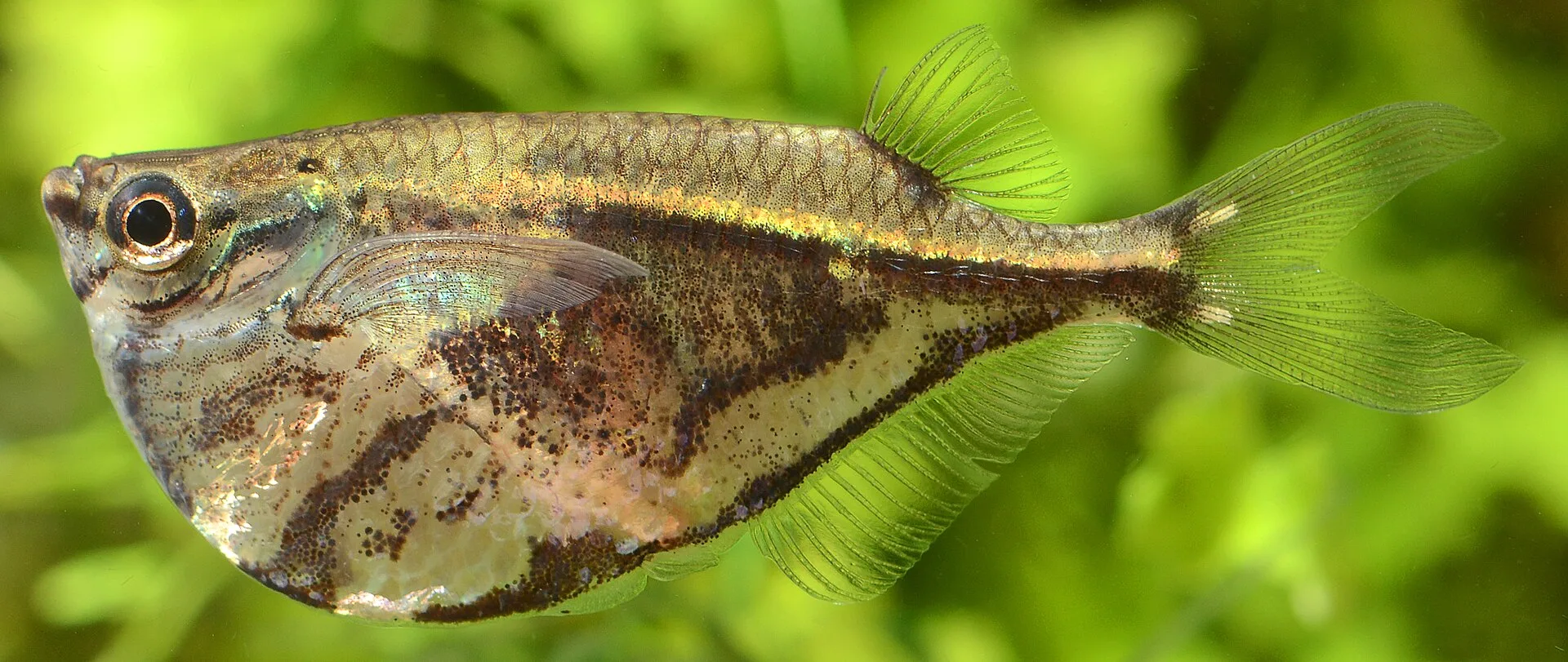
The marbled hatchetfish (Carnegiella strigata) is built like a hatchet because it lives in the top centimetre of Amazon and Guiana water and, when startled, it can burst through the surface and glide. In a home tank that anatomy reads as one rule: a tight-fitting lid, no heater-cable gaps, and no open-top aquascape. Keepers who treat hatchets like midwater tetras find empty tanks and fish on the carpet.
A keel, a wing, and a film
The deep, compressed belly is muscle and a keel, not fat. Enlarged pectoral fins let C. strigata skip across the surface. In the wild that escape is aimed at aerial and aquatic hunters in blackwater streams and flooded forest. In the living room it is aimed at the first hole in the cover. They do not “settle down” and stop being jumpers. A lid is permanent hardware, as non-negotiable as a heater for a discus.
They are among the smaller gasteropelecid hatchets, about 3.5–4.5 cm. The marble pattern — dark wavy marks on a silver-gold ground — distinguishes them from the plainer silver Gasteropelecus sternicla. That pattern fades when the fish is thin, shocked, or sitting in hard, bright water.
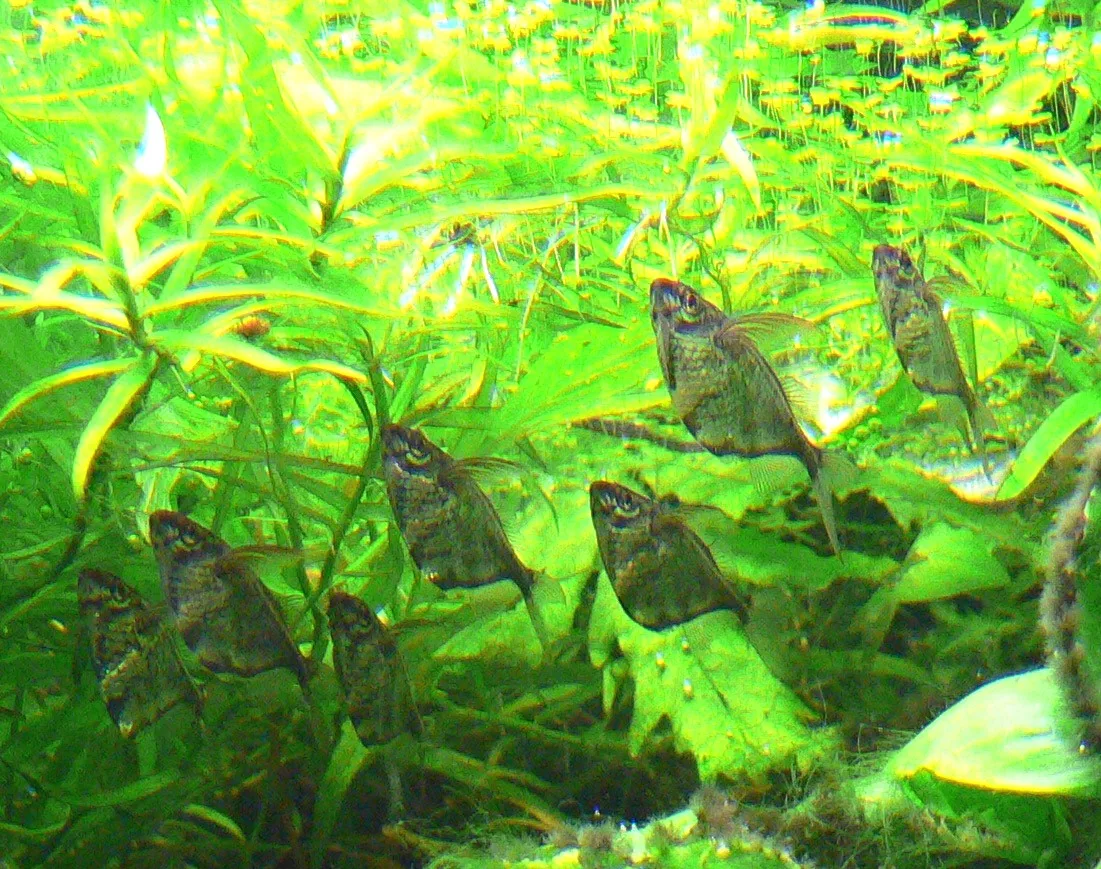
Blackwater chemistry, not a community default
Marbled hatchets want soft, acidic, warm water: roughly 24–28°C, pH 5.0–7.0, low hardness, and preferably a tannin stain. Many imports are wild-caught. They arrive stressed, refusing flake, and carrying a history of netting and air. Hard tap and a bright sterile tank kill them quietly. This is the opposite of Mexican tetra flexibility and the opposite of Buenos Aires tetra plant-razing toughness.
Ammonia and nitrite must be zero. They have a high oxygen need at the surface; a dirty film and a gasping school is an emergency. Do not confuse surface gulping with “that’s just how hatchets breathe.” Check temperature, oxygen, and whether the filter outlet is ripping the film to foam.
The surface is the whole habitat
Decorate the top. Floating plants (kept in check so they do not block all feeding) and branches that break the surface give security. The bottom can be simple. They will almost never go there. Midwater plants are for tankmates, not for the hatchets. Flow should be gentle at the film. A spray bar along the back that creates a slow drift is better than a powerhead that makes waves.
Tank length at the surface matters more than litres of unused depth. A long, relatively low tank of 80 litres or more for a school of six to ten is more honest than a tall 80 litre cube whose top is a small square. They school. A pair of hatchets is a pair of nervous jumpers.
Food that never leaves the film
In nature they take insects trapped on the surface. In the tank they need floating foods: quality flakes that stay up, fruit flies, small crickets, frozen foods thawed and held at the top, and specialised floating micropellets. If you dump sinking granules, Corydoras eat and hatchets starve. Feed in several small passes. Watch the keel: a concave belly on a hatchet is a crisis, not a “slim morph.”

They are poor competitors. Danios, large tetras, and even hungry gouramis will beat them to flake. Feed the hatchets first, or keep them with other gentle, lower-water fish that do not raid the top.
Schooling without midwater bullies
Six or more marbled hatchets, small peaceful tetras that stay below, Corydoras, and shrimp can work. Splash tetras also use the surface; two surface specialists in a small tank means a food fight at the film. In a large Amazon tank you can layer them if you feed enough at the top. Avoid angelfish and anything that hunts from below at the silhouette of a 4 cm fish.
Do not mix them with common hatchetfish and assume they are the same animal. Gasteropelecus is larger, silver, and a little more robust. Carnegiella is the delicate marble. Care overlaps (lid, surface, soft water) but the smaller fish loses contests.
Spawning Carnegiella
They scatter eggs at or near the surface among floating plants. Soft blackwater, a well-fed pair, and the removal of adults give the best chance. Breeding is uncommon in home tanks compared with zebra danios. Do not expect a marble hatchet to jump-spawn like a splash tetra. Eggs stay in the water. Fry are tiny and need infusoria at the surface.
Why they die in the first two weeks
Wild-caught hatchets refuse food, jump into lids until they injure their keels, and pick up ich. Quarantine in a covered tank with gentle filtration and surface foods. Do not add them to an uncycled community. Internal parasites show as a keel that never fills. If a fish sits listless at the surface with clamped fins, test water and isolate. Medications that wreck the surface film (oily treatments) are awkward on a species that eats there; follow product guidance and still keep oxygen high.
A marbled hatchetfish is not a tetra with a funny shape. It is a surface glider from stained forest water, and the lid is part of its skeleton as far as you are concerned. For the larger silver cousin, see common hatchetfish. For water chemistry that matches blackwater imports, start with aquarium water chemistry.
Wild-caught marble, farmed hopes
Some marbled hatchets in the trade are still wild-caught. They may refuse flake for a week. Offer fruit flies, baby crickets too small to bite, and thawed frozen foods held at the film with tongs if you must. Do not conclude they are “not eating” because sinking pellets vanished. Those pellets are in a Corydoras.
Once they eat, keep the lid discipline forever. A fish that survived export will still leave through a 1 cm gap the first time a dog jumps at the glass. Marbles are smaller and more panic-prone than common hatchets; they hit the lid harder relative to their size. Soften lighting, add floating plants, and never tap the glass to make them “fly.” You will get injury, not a show.
Explore other topics
Dive into more aquarium guides across the site.