

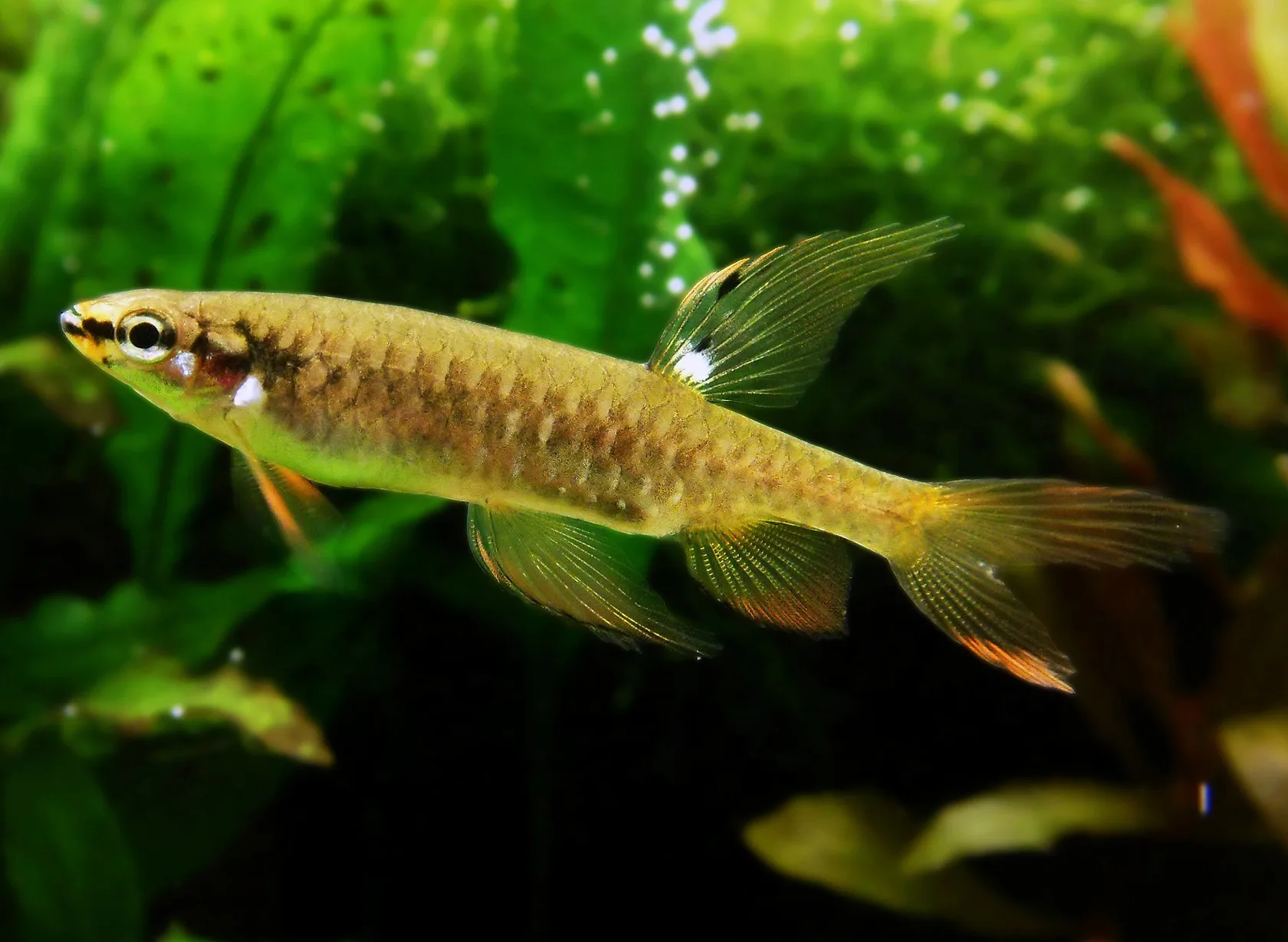
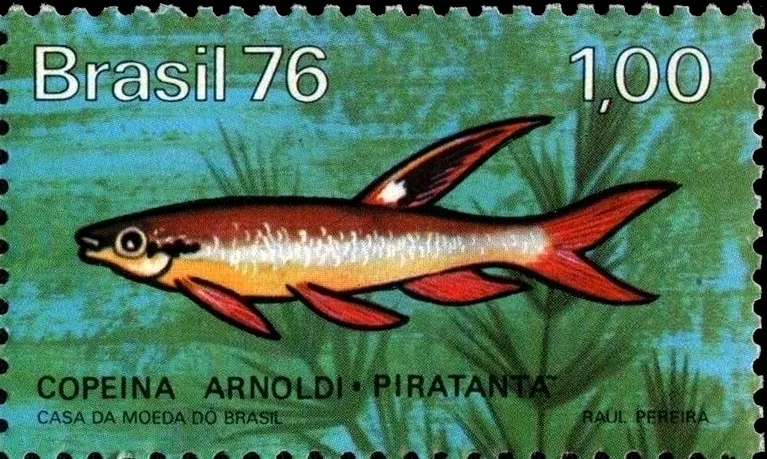
Most tetras scatter eggs in plants and then eat them. The splash tetra (Copella arnoldi, still listed in older books as Copeina arnoldi) jumps out of the water, sticks eggs to a leaf or the aquarium glass above the waterline, and then the male spends hours flicking water onto that clutch with his tail so the eggs do not dry. If you keep this fish under a tight lid with no air gap and no overhang, you have blocked the behaviour that defines the species.
A lebiasinid that only looks like a tetra
Splash tetras belong to Lebiasinidae, the pencilfish family, not Characidae. They come from lower Amazon and Guiana drainages: warm, often stained, slow water with overhanging vegetation. Adults reach about 5–8 cm, males larger, with an elongated body, a brown-olive colour, and a dark spot on the dorsal fin. They live at the surface. They are not midwater schoolers like a garnet tetra and they are not cave fish.
Water should be warm and soft: 24–29°C, pH roughly 5.5–7.0, low hardness. They tolerate a community that is already set up for Amazon surface fish. They do not tolerate cool, hard, alkaline water copied from a livebearer tank.
The jump, the clutch, and the male’s duty
Spawning is a paired leap. Male and female line up below a leaf, a piece of driftwood that breaks the surface, or even the tank glass. They jump together, press to the surface above the water, deposit a small batch of eggs, and fall back. They repeat until a cluster sits in air. Then the female is largely done and the male takes station underneath, splashing the eggs every minute or so until they hatch and the larvae drop into the water.
In nature the trick puts eggs out of reach of most aquatic egg-eaters. In the aquarium it means you must leave an air gap. A completely filled tank with a tightly sealed lid gives them nowhere to stick eggs. A tank filled to the brim with no overhanging leaf gives them glass, which can work if you allow a few centimetres of humid air and you do not wipe the clutch off thinking it is dirt.
If you do not want fry, you can still keep splash tetras, but you should still give them surface architecture. Denying the jump is not “simplifying care.” It is keeping a specialist in a box that fights its reproductive biology.
Building a tank they can actually use
Lower the water line by several centimetres. Add a broad leaf (real plants that emerge, or a clean plastic strip as a spawning plaque) a short distance above the surface. Keep humidity high in that air gap so eggs do not desiccate before the male can splash. Use a lid — they jump at other times too, and you will lose fish through a gap — but the lid must sit above that air space, not on the water.
Length of the tank matters less than a stable surface film and gentle flow. A sponge filter or a spray bar that does not chop the surface to pieces is enough. Hatchetfish also want a calm surface, but hatchets do not spawn in the air. Do not copy a hatchet layout and call it done; add the overhang.

A 60–80 litre tank can house a pair plus a few companions, or a small group. Males may compete for the best spawning plaque. Provide more than one overhang if you keep multiple males.
Surface food, not midwater leftovers
They take insects and other small prey from the film. Floating flakes, fruit flies, baby crickets in tiny sizes, and frozen foods that hang at the surface all work. Sinking pellets are a poor primary diet. If you keep them with greedy midwater tetras, feed surface foods first and confirm the Copella actually ate. They are peaceful but they are not fast enough to win a flake blizzard against danios.
Who can live under the same lid
Pencilfish, small hatchetfish, and calm Amazon tetras can share the lower and middle water if the tank is large enough and feeding is split. Avoid fish that eat surface eggs or that thrash the top constantly. Avoid anything that will jump into the air gap and wreck a clutch. Discus tanks are usually too sacred and too tightly covered for this project. Bettas may fight a male splash tetra for the surface.
They are not a dither fish for cichlids. A cichlid will eat the jumping pair.
Raising fry that fall from the ceiling
Once larvae drop, they need still, warm, food-rich water: infusoria, then vinegar eels or microworms, then baby brine shrimp. The male’s splashing does not continue as parental care in the water; once the fry are aquatic, you have a normal tiny-larva problem. Many keepers move the plaque to a nursery or catch fry after hatch. Do not dose the display with fry-killing medications while a clutch is in air; the male is working in a humid gap you also breathe over.
Health at the film
Surface fish show hunger first as a hollow belly and a refusal to come up. Dirty surface film (protein scum) is a husbandry failure for this species specifically. Keep the top clean without destroying the air gap. Ich and bacterial infections happen after shipping; quarantine in a tank that still has a lid and a little air space, because they will jump in a hospital tank too.
If you wanted a tetra that spawns like a tetra, pick a Hemigrammus. If you wanted the only commonly kept fish that farms its eggs on the wrong side of the waterline, Copella arnoldi is the project, and the tank has to look like a humid creek edge, not a filled cube.
See also Beckford’s pencilfish for a related family member that stays in the water, and marbled hatchetfish if your interest is surface life without aerial eggs.
Explore other topics
Dive into more aquarium guides across the site.