

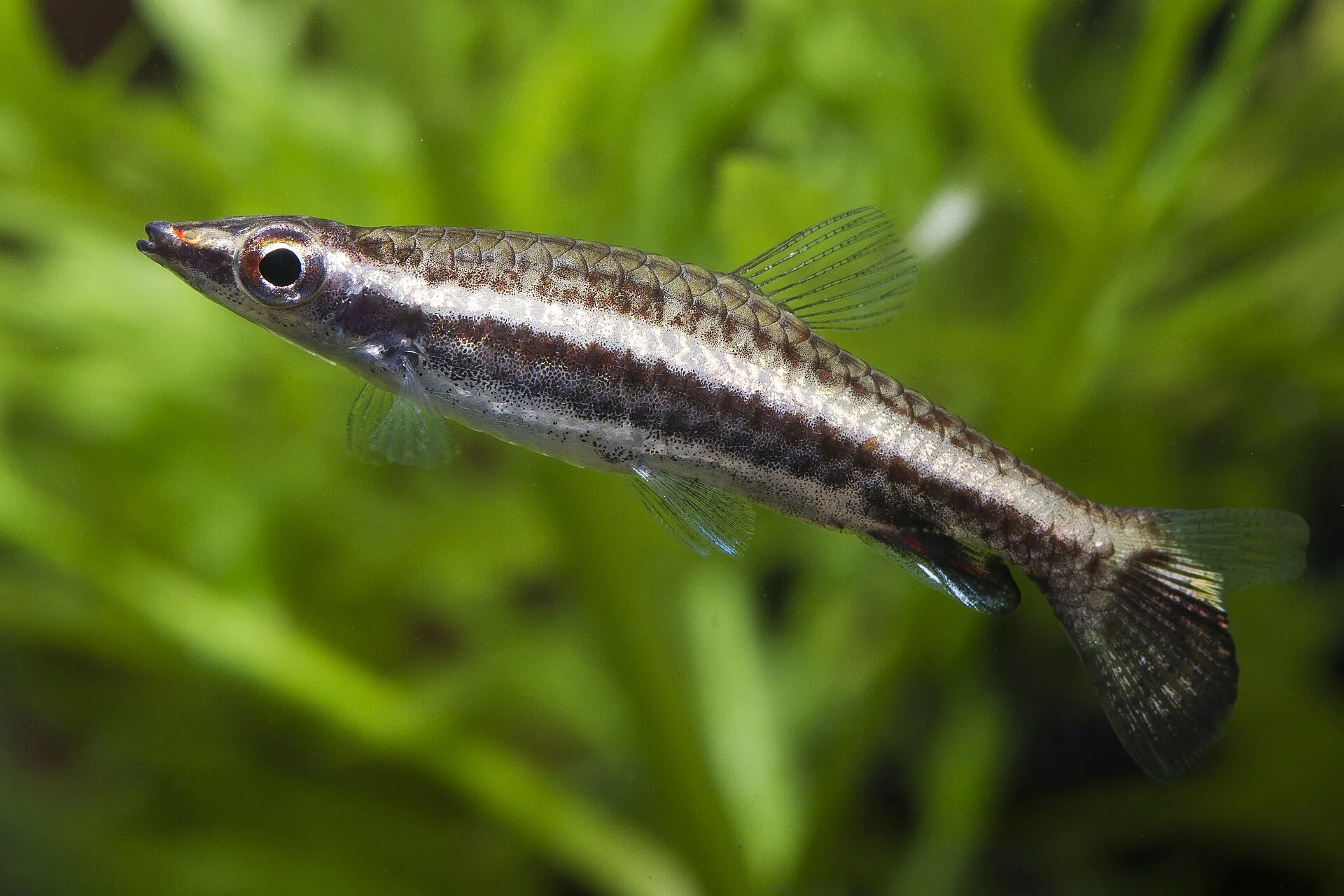
It does not swim the way a tetra swims. Nannostomus eques, the diptail or hockey-stick pencilfish, holds its body at a diagonal, head-up, tail-down, as if the whole school were hanging from invisible threads. That posture is the species. Once you have seen it, every other pencil looks like it is doing something else. They come from Amazonian blackwaters, stay around 5 cm, and spend their time in the upper half among plants and roots, picking at tiny prey. They are shyer than Beckford’s pencilfish, more particular about soft stained water, and they will not thrive in a hard, bright community of barbs.
The caudal has a darkened lower lobe that, with the slanted body, reads as a hockey stick. The body is brown to gold with a stripe. Males are slimmer and more intensely marked; they display in that same tilted posture, which looks like a ceremony. Females are rounder. A school of ten in a dim, planted tank is a slow mobile. Two fish in a chrome-and-white designer cube is a waste of a remarkable swimming style.
Hanging in the stained layer
Nannostomus eques is found in Amazon drainages in sluggish, vegetated, often tea-coloured water. They occupy the surface and upper midwater, among branches and aquatic plants, taking insects and microcrustaceans. Current is low. Light is broken by forest and by stain. The diagonal swim may be a way of holding station and watching the surface film. You do not need to know the biomechanics. You need to give them still, stained, planted water so they will do it in front of you instead of behind a heater.
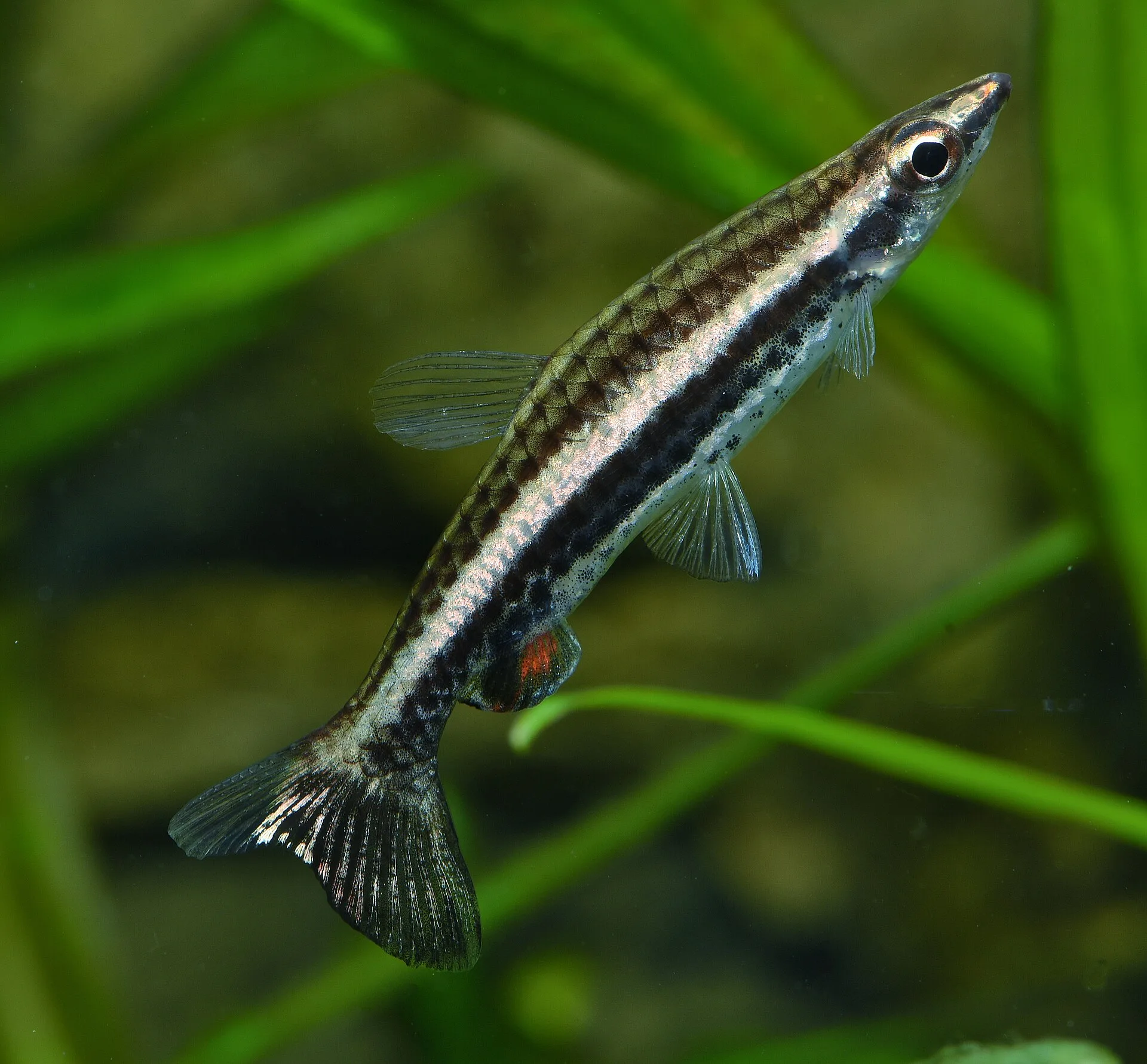
The lower lobe tells you who you bought
If the fish swims level and lacks the hockey-stick caudal emphasis, you may have another Nannostomus. Eques is the tilted one. Adult size about 5 cm. Colour is modest until the tank is right, then the gold and the stripe deepen. They are not a neon. They are a silhouette species. The pleasure is the angle of the school against dark water and pale botanicals.
Sexing: males slimmer, more colour in fins, more displaying. Buy a group of young and let the ratio fall where it falls, or buy ten and do not worry. Extra males in a large planted tank display. Extra males in a tiny tank harass.
A forest in the top third
Eighty litres of heavily planted, gently filtered water, with floating plants and wood that breaks the surface, is the right kind of home. They do not need a long racing lane like a rainbowfish. They need clutter at the top: roots, frogbit, Amazon frogbit, Indian fern, branches. Open water below can exist for other fish; the diptails will not use it much. Sand, leaves, tannins. A sponge filter. Almost no current at the surface — a ripple at one end is enough for gas exchange.
Lid on. They live at the top and they will leave through a gap. Filter intakes covered. Lighting low to moderate. If you need bright light for carpet plants, give the pencils a shaded end with floaters. They will live in that end. That is fine. That is where you look.
Blackwater as a working method

pH 5.0–7.0, very soft to soft, 24–28°C. They colour and settle in tannin-stained water. If your tap is hard, RO plus a little remineralisation plus botanicals is the path. Dumping them into pH 8 community water is how they fade, clamp, and pick up ich. They are not as forgiving as beckfordi. Weekly changes of matched, soft water. Do not do a 70 percent tap change because the tank “looked dirty.” The stain is not dirt. The mulm on the sand can be siphoned lightly without clearing every leaf.
CO2 in a high-tech tank can be compatible if pH is stable and they have a low-flow refuge. It can also kill small surface fish if you overshoot. Be competent with the gas before you add eques, not after.
Food in the film and the twigs
Live and frozen microfoods: baby brine, cyclops, daphnia, fruit flies if you culture them, crushed flake once they are confident. They feed in the upper water. Sinking wafers do nothing for them. Fast surface competitors (hatchetfish in a small tank, large gouramis) will starve them. Feed small amounts several times if the school is shy. Evening feeding when the light drops often works. Watch for the diagonal bodies to break formation and pick. That is eating. If they never break formation at food time, the food is wrong or the competitors are too fast.
Quiet neighbours, or none
A species tank with botanicals is the showcase. Mixed, they work with other calm, small, soft-water fish that do not occupy the same surface: small tetras in the middle, Corydoras on the sand, shrimp. Hatchetfish compete for the top. Aggressive or nippy fish ruin the posture — the school hides and you never see the angle. Dwarf cichlids in a large tank can work. Large cichlids cannot. They will eat them.
Keep ten or more. A pair is not a school and will not display the hanging behaviour as a group phenomenon, which is half the point.
Eggs in the roots, if you are lucky
Scattered among plants and rootlets, no parental care. Breeding is reported in soft, stained, densely planted tanks. Fry are tiny and need infusoria. This is more specialist than beckfordi. If you are not set up, do not strip the tank looking for eggs. Keep the adults. The posture is the exhibit.
Let them hang
Drip acclimate into soft water. Quarantine in a dim, planted, covered box with a sponge and baby brine. They may hide for days. Do not brighten the room to check every hour. When they hang at 45 degrees in a group, they have arrived. Ich is a risk after hard-water shops; treat gently in quarantine. Nannostomus eques is a fish you keep for a way of being in the water, not for a neon stripe. Stain, still surface, tiny food, a crowd of pencils. Then the hockey sticks start to hang, and you understand why this species was never just “another pencil.”
Explore other topics
Dive into more aquarium guides across the site.