

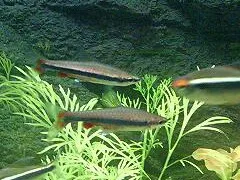
Among pencilfish, Nannostomus beckfordi is the one that forgives. It comes from drainages in Guyana, Suriname, and adjacent Brazil — the Guiana Shield and nearby lowlands — and it has been in the hobby long enough to become the default pencil: a 3.5–4 cm stick of a characin that swims level, schools if you buy enough, and will take dry food after a week of frozen coaxing. That reputation should not make you careless. It is still a small South American fish that wants soft, warm, planted water and a group. It is not a danio. It is not a rasbora from hard water. It is Beckford’s pencilfish, and the males will spend the afternoon fencing with their snouts if the school is too small to dilute the argument.
The body carries a dark longitudinal stripe and a gold or red flush that intensifies in good water. Males are slimmer, more coloured, with a more intense anal-fin pattern. Females are fuller. If you have only seen them in a bright, bare dealer tank, they looked brown. In a dim, planted aquarium they look like they were always supposed to be there.
Shield streams, not a blackwater-only myth
Nannostomus beckfordi occupies creeks and still margins with plants, roots, and often some stain, but it is more adaptable than N. eques or a wild rummynose from the upper Negro. Soft to moderately soft water, 24–28°C, gentle flow. In the wild they take tiny invertebrates in midwater and at plant surfaces. They do not sift sand. They do not own caves. The vertical space they use is the middle, in a loose group that tightens when frightened.
Copy plants and calm. Copy a school. Do not copy a rapids. Do not copy a Malawi shelf.
A pencil that holds itself straight
Unlike the diptail pencilfish, Beckford’s holds a more horizontal posture. That is the quick visual if a shop has mixed Nannostomus. Size is small: 4 cm is a fair adult. The stripe is the identity. Colour morphs and “gold” strains exist in the trade; they are still beckfordi. Health is a full belly and intact fins, not a particular shade on day one.
Males spar. It looks like kissing or jousting and is usually harmless in a group of ten. In a group of four it can become a campaign against one fish. Buy more than you think. They are cheap compared to the filter you already own.
Weeds, dimness, a lid for the one that panics
Sixty litres for a school of eight to twelve. Plants in clumps — stems, moss, floating cover — and a lane through the middle. Darker substrate makes them bolder. Fine leaf litter is optional and helpful. Flow from a sponge filter or a baffled outlet. They will jump when a shadow hits the tank; cover it. They will also wedge into filter intakes; sponge guards.
Lighting should not be a showroom blast. They colour and school better under broken light. A planted tank with floaters is the usual good home. A high-tech CO2 rocket with powerhead gyres is a stressful one unless the gyres are elsewhere and the pencils have a still pocket.
Soft is kind, stable is kinder
pH 5.5–7.0, low to moderate hardness. They will live at pH 7.2 in decent tap if you change water and do not combine them with fish that need pH 8. They will look better and spawn more in the sixes. Tannins help visually and modestly chemically. Ammonia kills them like any small characin. They are “hardy” relative to other pencils, not relative to a platy.

Drip acclimate. Shop water is often different. Weekly 20–30 percent changes with matched temperature. They show bad water as a faded stripe and a school that sticks to the back glass.
Micro food, twice, in the midwater
They have tiny mouths. Micro pellets, crushed flake, frozen baby brine, cyclops, daphnia. Live baby brine brings them into breeding condition and fattens thin imports. They will learn to take dry food at a consistent feeding spot. They will lose every meal to danios. If you keep them with faster fish, feed in two places and watch the pencils. A keel-shaped belly is your failure, not their fussy nature.
Feed morning and evening. They do not need a night feeding. They are not nocturnal catfish.
A group that fences, then schools
Eight or more. Peaceful toward other small, calm fish: small tetras, other pencils if the tank is large, Corydoras, shrimp. Avoid fin-nippers (ironically some pencils nip — beckfordi is milder than trifasciatus in many accounts, but crowded males still pick). Avoid large cichlids. Avoid a tank that is all motion. Dwarf cichlids can share a larger tank because they use the floor; keep the pencils numerous so they are not picked off as odd ones.
They eat their own eggs and tiny fry. Adult shrimp usually survive.
Scattered eggs, no parenting
Egg scatterers among plants and moss. No care. If you want fry, a breeding tank with Java moss, very soft water, and the adults removed, or eggs collected. Infusoria then baby brine. This is doable and not as iconic as rummynose breeding in the literature, but hobbyists spawn beckfordi regularly. Most community tanks will not produce a second generation. Keep the adults well anyway.
The first pencil you should actually try
Quarantine the school as a school. They eat frozen food in a planted box with a sponge. Ich after a chill. They recover if you do not combine medications meant for large cichlids at full cowboy strength. Two weeks, then into the weeds.
Imports sometimes arrive with thin faeces and no interest in flake. A week of baby brine in a quiet tank fixes more of that than a deworming protocol copied from a discus forum. If they still pass white string after they are eating well, then look at internal parasites — but start with food and stillness. They are small. Overmedication is a real way to finish a school that would have fattened on cyclops.
Nannostomus beckfordi is the pencilfish for a keeper who wants the shape and the stripe without a museum of blackwater equipment. Give them numbers, plants, and food that fits, and the fencing in midwater is the behaviour, not a problem. The problem is buying three. The behaviour starts at eight.
Explore other topics
Dive into more aquarium guides across the site.