

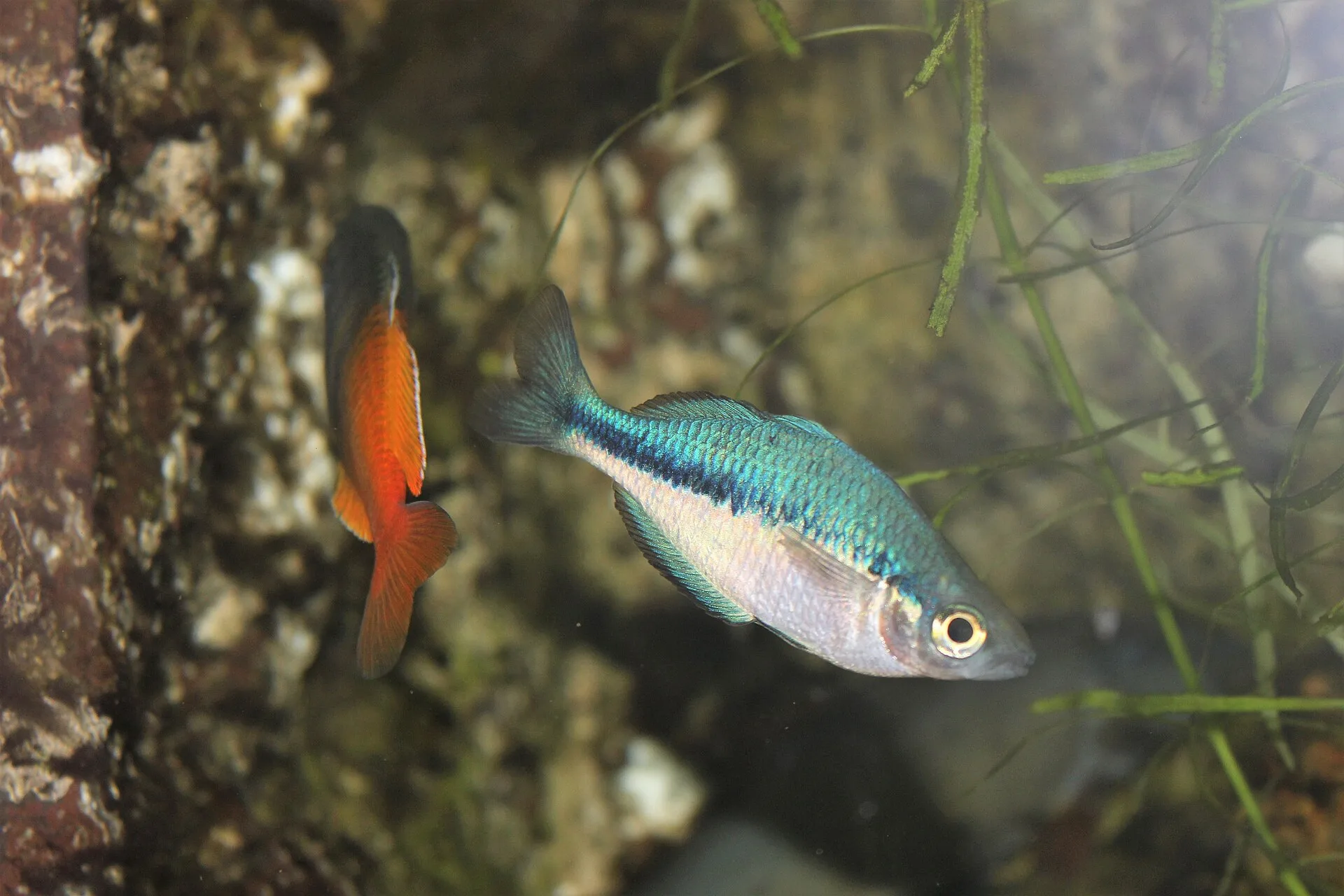
Australia is a continent of rainbowfish, and Melanotaenia splendida is the one whose name admits it. The eastern rainbowfish (and its subspecies — splendida, inornata, tatei, and others depending on which revision you follow) is a bigger, tougher, more boisterous melanotaeniid than the dwarf neon. Males can push 12–15 cm in large tanks, with a deep body and a wash of colour that changes with drainage: yellow, red, blue-green, a dark mid-line. This is not a 60 litre fish. This is a school for a long, well-filtered aquarium with hard-ish water, a lid, and neighbours that can take a bit of bustle.
Subspecies and locality matter to specialists. To a shopper, the fish on sale as “Australian rainbow” is usually a splendida-type that wants space, oxygen, and a crowd of its own. If the bag says praecox, you have the small one. If the fish already has a shoulder and a look of speed, you have this article.
Rivers that run a long way
Melanotaenia splendida occupies a huge range across northern and eastern Australia in rivers, billabongs, and creeks. Water chemistry varies from quite soft to hard and alkaline. Temperature varies with inland winters and tropical summers. The through-line is swimming room, vegetation at the edges, and a surface they can break when they feed. They are not cave fish. They are not brackish gobies. They are river schoolers.
Inland keepers in Australia sometimes run them with a cooler winter. In a centrally heated home abroad, 22–28°C is the usual band. They will survive at the bottom of that better than a discus will. They will not thank you for 31°C and no air movement.
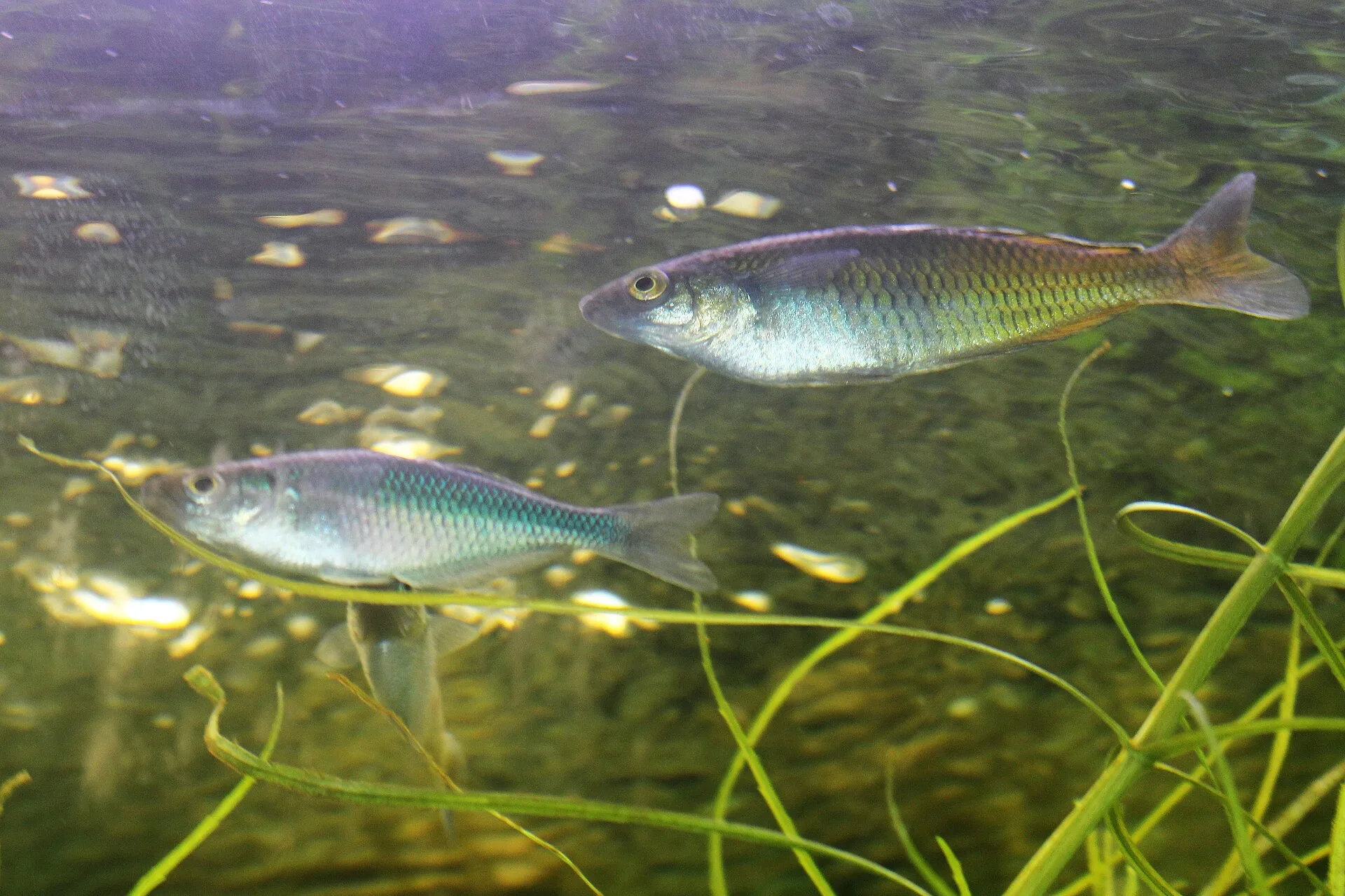
Depth of body is a male boast
Males deepen through the body, extend the posterior dorsal and anal, and throw more colour when ranking. Females stay slimmer and paler. A mixed school of eight to twelve in a 150 litre-plus tank is the classic picture. Two males in a 70 litre box will look like they hate each other because they have nowhere to parade. Juveniles are silver with a hint of the adult pattern. Colour is a two-year project, not a weekend.
Different drainages look different. Do not mix localities if you care about keeping a line true. If you do not care, still keep a big school so the behaviour is right even if the genetics are a smoothie.
Think in centimetres of length, not in pretty gallons
A hundred and fifty litres is a starting volume for a school of modest-sized adults; more is better, and length is the dimension that matters. Plants at the back — they will eat soft plants and they will spawn in fine leaves. A clear central run. Strong filtration with surface agitation. They are messy, hungry, and aerobic. A tight lid; large rainbows jump, especially at lights-on and when spooked by a shadow.
Décor can be Australian in feel — wood, gravel or sand, Vallisneria — or a generic planted tank that can take a bit of digging at plant bases. They are not excavators like cichlids, but they are not careful either. Weight plant roots or use pots.
Harder water is allowed

pH 7.0–8.0 is comfortable for many splendida forms; they also live in softer water in parts of the range. Moderate to hard is a good default. This is one of the rainbows that can share chemistry with livebearers or with hard-water Australian natives. It is a poor roommate for extreme blackwater tetras. Temperature 22–28°C. Weekly substantial water changes; they pollute like the school they are.
Salt is not required. Some coastal-adjacent populations might see a little, but you are not keeping a marine fish.
They will eat like they swim
Flake, pellets, frozen mysis, brine shrimp, daphnia, vegetable matter, even small insects. Feed twice a day. They are omnivores with a bias toward taking anything that fits. Colour improves with crustaceans and with time, not with a single colour flake. Underfeeding makes a silver school. Overfeeding makes algae and nitrate. They will take food from every level if it is small enough; they prefer the upper half.
Bustle, not bullying — until the tank is too small
Peaceful toward other robust fish of similar size. They may nip fins if bored or crowded, and they will eat fry. Good companions: other large rainbows in a huge tank, hardier barbs, larger rasboras, catfish that can handle the activity. Poor companions: slow, long-finned, tiny, or shy cave-dwellers. Shrimp are snacks. Dwarf cichlids will be buzzed all day.
The school should be the centrepiece, not an add-on to a cichlid pair.
Mops, marbles, a separate box
Egg scatterers like other melanotaeniids. Condition them, offer a mop or Java moss, remove eggs or parents. Fry grow fast on baby brine if you keep up with water quality. Subspecies keepers isolate lines. Community keepers enjoy the chase and accept that eggs become breakfast. Breeding is easy compared to a mouthbrooder; raising hundreds is a space problem.
Buy for the adult shoulder
Quarantine the school. They eat in transit recovery if you give them flake the same day. Ich after a chill. They are generally hardy once settled. The failure mode is almost always a tank that is too short, a school that is too small, or water that is too dirty.
A note on subspecies that shop bags ignore: fish sold as eastern rainbows may be M. s. splendida from the east, inornata from the north, or mixed aquarium lines. Body depth, the amount of red in the fins, and how yellow the flank becomes will differ. None of that changes the need for length and a crowd. It does change whether you should throw two “Australian rainbows” from different shops into a breeding project and call the fry a locality. If the line matters, buy from a native-fish keeper who can name a river. If it does not, enjoy the school as a river fish and do not invent a drainage on the internet.
They will live five years and more in clean water. Colour in the third year is often better than colour in the third week. That is not a reason to keep them in a temporary tank. It is a reason to buy the long aquarium first. Melanotaenia splendida is the Australian rainbow as a river fish: big enough to see from across the room, hungry enough to need a real filter, colourful enough to justify the glass if you give them a year and a metre of water to use. Anything less and you kept a silver fish that jumped.
Explore other topics
Dive into more aquarium guides across the site.