

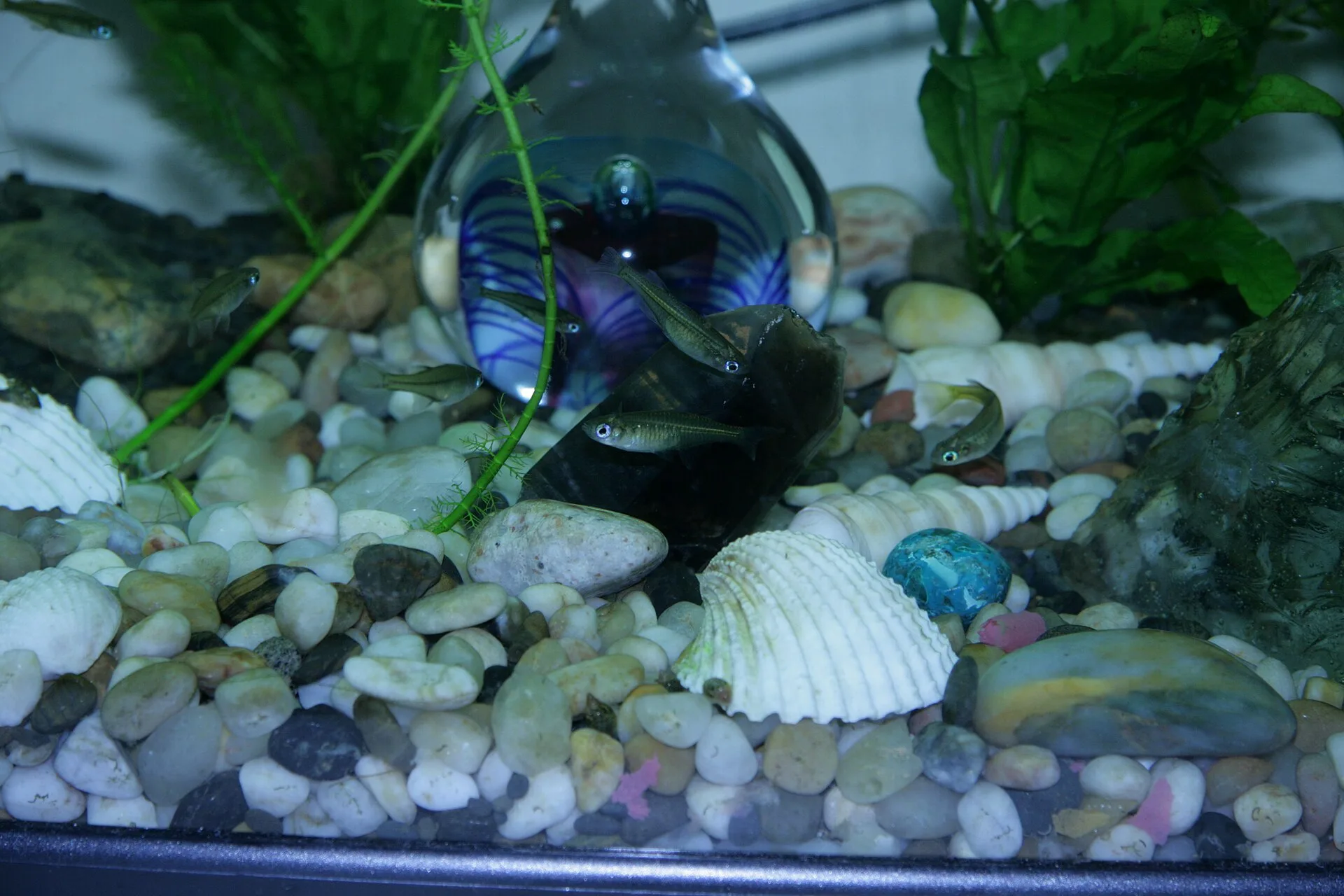
The eye is the name and the advertisement. Pseudomugil signifer, the Pacific blue-eye, is a tiny Australian atheriniform from coastal drainages of the east, from Cape York down into New South Wales, with populations that see fresh water and others that brush brackish. Males grow filamentous fins they hold like flags. Females stay smaller and plainer. Adults are 3.5–5 cm. That size is why they vanish in a tank of large tetras and why they shine in a long, low aquarium of their own, with a school of ten or more and food that does not skip past a 2 mm mouth.
They are not a nano afterthought. They are a surface school with courtship that looks like a dance if you sit still. People who keep them well talk about the fins. People who keep them poorly talk about how they “disappeared.” They jumped, or they starved, or they were eaten. All three are common.
East coast creeks, sometimes a taste of tide
Pseudomugil signifer occupies a long latitudinal range. Northern fish see warmer water; southern fish take cooler winters than a discus keeper would believe. In a heated home aquarium, 22–26°C suits most stock. Some populations are associated with slightly brackish lower reaches. Freshwater tank-bred fish are the usual shop stock and can be kept hard-fresh. If you know you have a brackish locality, match it. If you do not know, stable hard freshwater is the default, not a mangrove tank you guessed at.
Habitat is vegetated margins, slow sections, surface film, insect rain. They live up. The aquarium should live up: open surface, plants that break the line but do not cage them, a lid that actually latches.
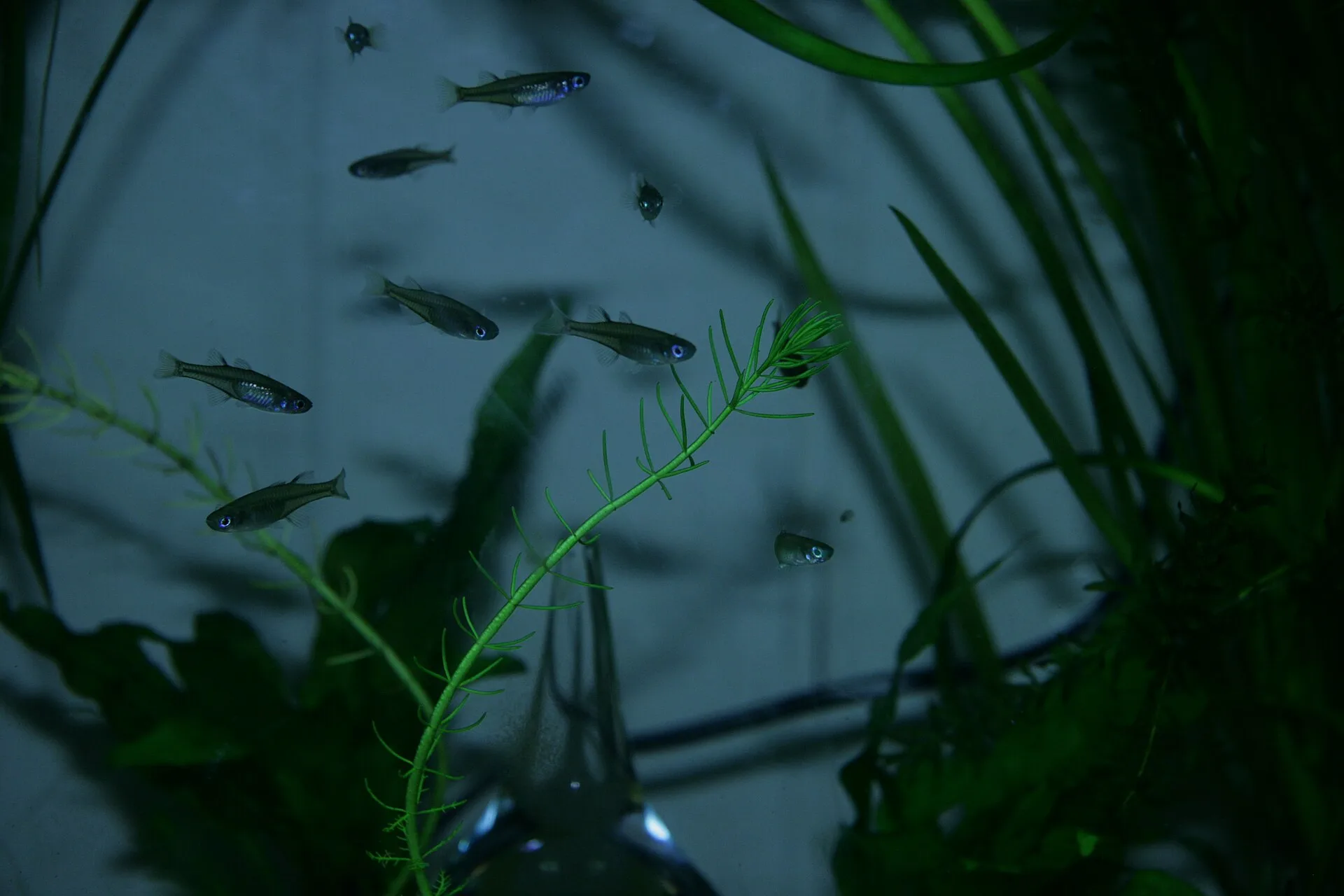
Filaments only the male bothers to grow
Males have longer dorsal and anal fins, often with thread-like extensions, and more yellow or iridescence depending on the drainage. They flare at each other and at females in a shivering display that is the reason to keep them. Females are smaller, rounder when full of eggs, with shorter fins. The blue eye is shared. Body colour is olive to yellowish, not the neon of praecox. If you wanted neon, you wanted a different rainbow. If you wanted a miniature flag, you are in the right creek.
They are short-lived compared to a pleco — a few years. Enjoy the display while it lasts and keep a school so the behaviour does not die with one male.
A low tank is a feature
Sixty litres can work for a school if it is long and covered. Eighty is more comfortable. Height is wasted on them except as a jump they will attempt. Plants: fine leaves, Java moss, floating stuff at the ends. Open water down the middle of the surface. No aggressive flow that pins them; a gentle ripple is enough. Sand or gravel, irrelevant except for aesthetics. They will not use a cave. They will use a mop if you are breeding.
Filter intakes must be fine. Adults can be sucked against a grate; fry definitely will be. Sponge filters are ideal. Hood every hole. These fish are Olympic jumpers relative to their size.
Harder and cooler than Amazon nanos

pH 6.5–8.0, moderate to reasonably hard water. Soft acid rummynose water is not their best home. Temperature in the low to mid twenties; southern stock may even appreciate a winter dip if you are a specialist, but a stable 24°C is fine for mixed pet-shop fish. They are not fragile in the wild — they are fragile in the sense that everything eats them and they dry out on the carpet.
Weekly small water changes. They live in a small body of water in your tank terms; ammonia from overfeeding baby brine will punish them. Match temperature. They show a chill as flashing and then ich.
If the mouth cannot open that wide, do not feed it
Micro pellets, crushed flake, live baby brine, vinegar eels, daphnia, cyclops. Adult brine shrimp may be too big for smaller individuals. They feed at the surface and in the film. Midwater pellets that sink past them feed the corys. Feed small amounts several times a day rather than one dump. A fat blue-eye has been offered food it can swallow. A thin one is the default in mixed tanks with danios.
Culturing baby brine is the difference between a school that displays and a school that dwindles. Frozen cyclops is the lazy alternative that still works.
Ten fish, no hunters
A school of ten or twelve. Tank mates, if any, should be tiny and peaceful: other blue-eyes, small rasboras, shrimp. No cichlids. No large gouramis. No “just one betta.” No empire gudgeon. This is a species tank in spirit even when you add a few shrimp. Males will display constantly; in a large school that is entertainment. In a trio it is harassment.
They are peaceful. They are also food. Anything with a mouth over a centimetre wide is a risk.
Daily eggs if you want them
Egg scatterers, often spawning daily in condition, eggs stuck to mops and moss. Parents are not dedicated eaters of every egg but they will snack. Pull mops to a hatching box. Fry are minute. Infusoria first, then the smallest baby brine. This is how dedicated keepers maintain strains from different drainages. If you are not hatching, you can still keep adults happily; the mops become décor the males display beside.
Count them through the glass, then count again
Acclimate slowly. Quarantine a school in a covered, sponge-filtered tank and prove they eat microfood. Do not add six blue-eyes to a 200 litre community as “sparkle.” You will own zero by month two. Ich treatments on tiny fish need aeration and careful dosing. Prevention is stable temperature and no thugs.
Pseudomugil signifer is Australian coastal fauna at thumbnail scale. The blue eye only reads across the room when there are many eyes, the surface is calm enough to display on, and nothing larger is hunting. Build that, latch the lid, feed the film, and the filaments were the point all along — not a nano trend, a small male, doing a large dance.
Explore other topics
Dive into more aquarium guides across the site.