

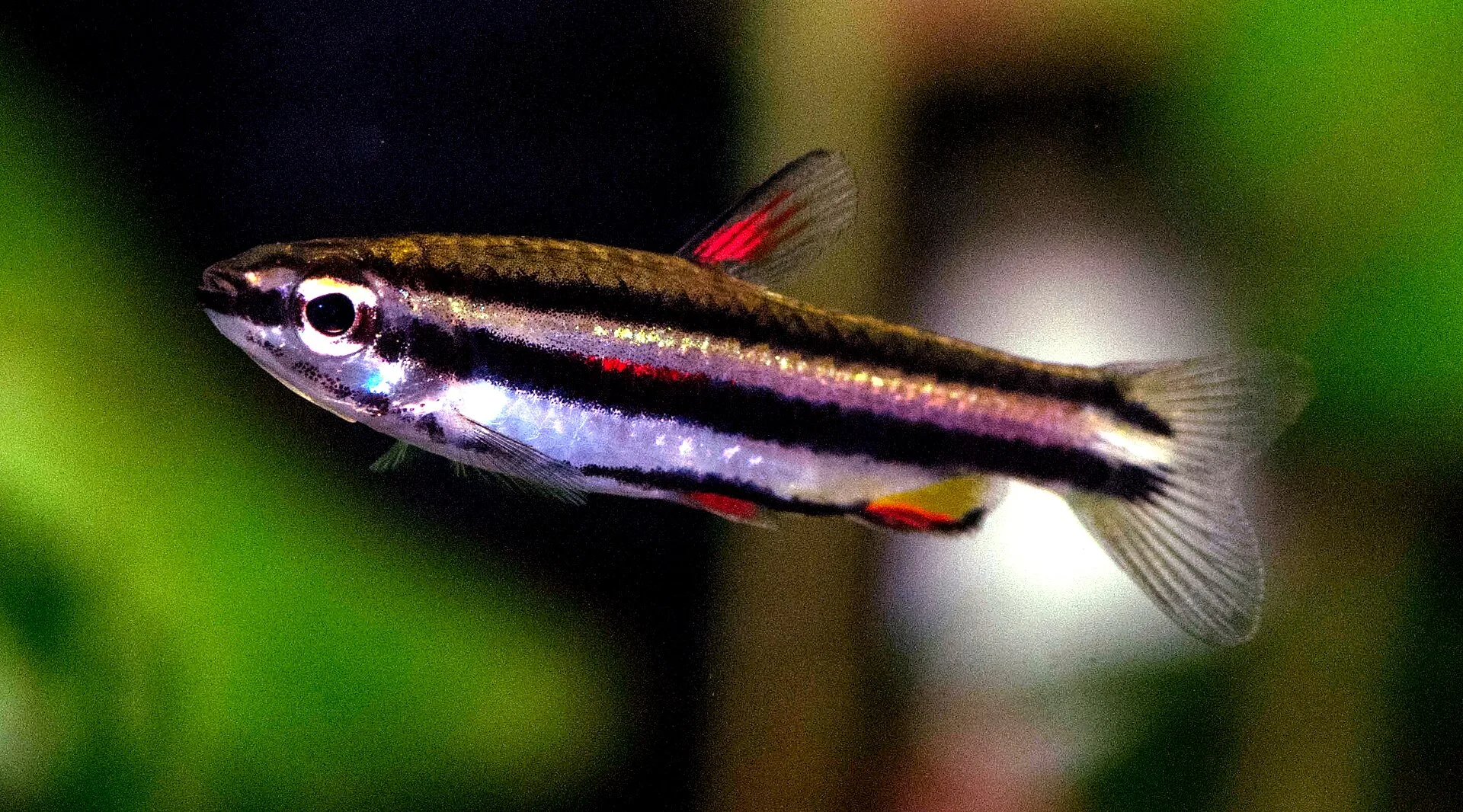
The dwarf pencilfish is a lebiasinid the size of a large shrimp. Nannostomus marginatus stays around 2.5–3.5 cm and wears three horizontal dark lines on a gold body. It is not a tetra, not a rasbora, and not a fish you toss into a 200 litre cichlid tank as “dither.” Mouths are tiny. Nerves are high. Water should look like a still, stained Guiana creek, not a danio river and not a Mexican spring.
Three lines on a needle
The species ranges through Suriname, Guyana, and parts of Brazil. It uses quiet, vegetated, often tannin-stained water. In the aquarium that means low flow, leaf litter or moss, floating plants, and a school of ten or more so individuals stop looking like lost splinters. Temperature 22–28°C, pH 5.0–7.0, soft water. They can live in harder tap if acclimated, but colour and spawning fade.
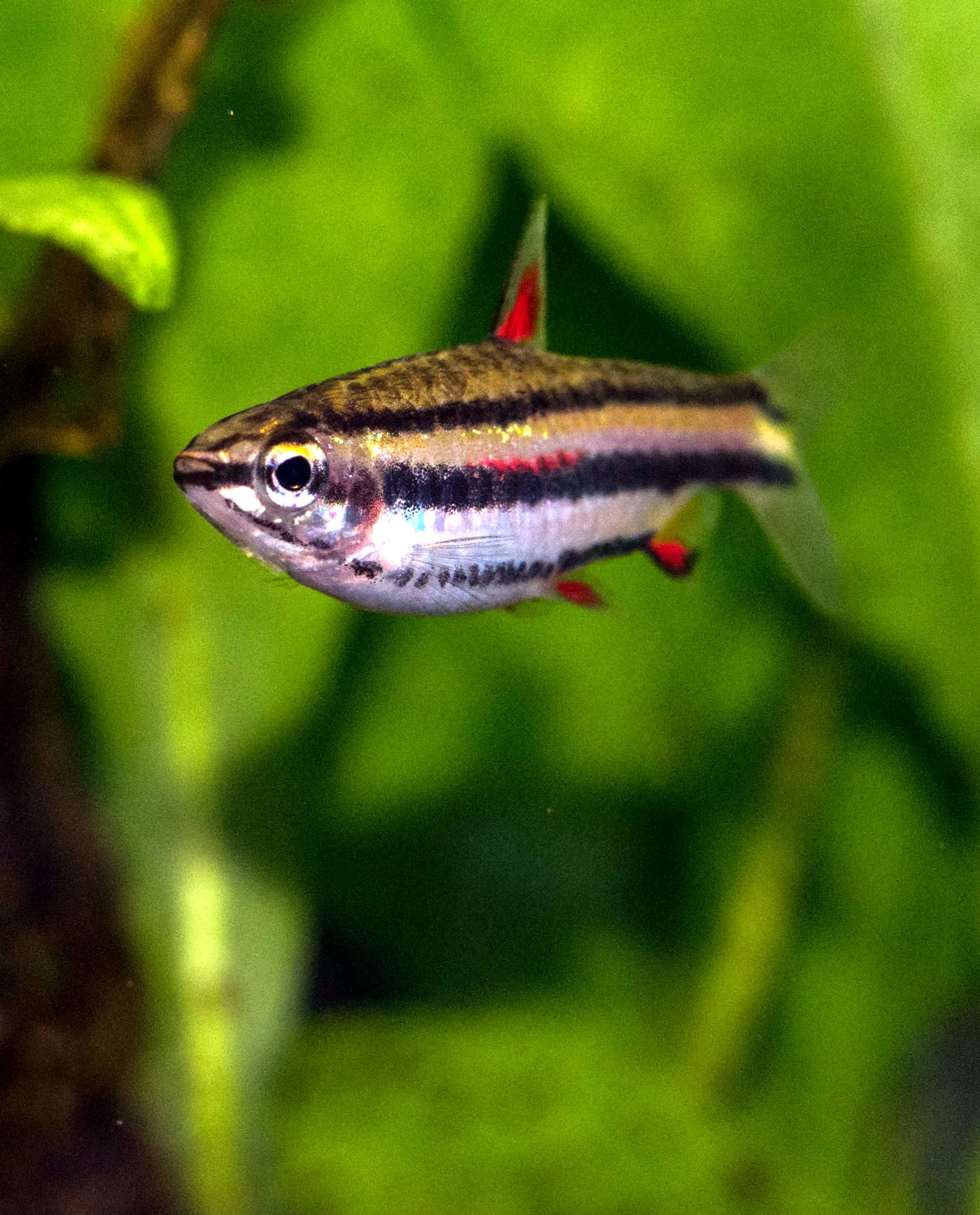
Males are slimmer, often with richer red in the fins and more intense stripes; they will display to each other with a stiff, parallel hover that looks aggressive and rarely ends in damage if the group is large and the tank has sight breaks. Females are rounder. Night colour can darken; that is normal, not disease.
Still water is the point
Hill-stream danio flow will pin dwarf pencils to plants until they waste. A sponge filter or a gentle air-driven return is enough. They occupy the middle to upper third, often at an angle, picking at tiny prey. They are not surface gliders like hatchets and they do not jump-spawn like splash tetras, though they will jump if panicked. A lid still matters.
A 40–60 litre planted tank can be a species display. Bigger is fine if you do not fill it with fast cyprinids. Height is less important than plant density and calm.
Mouth size dictates the menu
If the food does not fit a pinhead mouth, it is décor. Use crushed flake, powdered foods, baby brine shrimp, cyclops, infusoria, and microworms. Adult brine shrimp and whole bloodworms are for other fish. Feed small amounts several times a day. In a community, assume the pencils lose unless you target-feed at their level when the lights are not blasting.
They will graze aufwuchs and tiny bits off leaves. That is not a complete diet. Do not starve them on “they’ll find infusoria in a mature tank” unless the tank is actually a soup of microfauna.
Nano company that cannot swallow them
Good: other small Nannostomus if you can tell species apart, small rasboras like chili rasboras in a large enough peat-friendly tank, tiny tetras such as embers, shrimp, and small Corydoras. Bad: most danios, most “community tetras” over 5 cm, gouramis that suck from the surface, and anything sold as a hatchet school in the same 40 litres. Related pencilfish such as Beckford’s and three-lined are closer in manners; the dwarf is simply smaller and loses contests.

They are peaceful. Males displaying is not a reason to break the school into pairs. Pairs hide. Groups display and then eat.
Eggs among moss, not among hatchet lids
They scatter small eggs in Java moss and fine plants. Soft, acidic water and heavy live-food feeding help. Adults eat eggs. A breeding box or a mossy tank without the parents is the way to get fry. Fry are extremely small. Infusoria is not optional. This is closer to a Boraras spawn than to a zebra danio marble spawn.
Do not lower the water for aerial eggs. That is Copella. Do not add shells. That is a lake cichlid. Do not assume cool hill-stream temperatures. That is a Devario.
Seeing illness on a 3 cm fish
Skinny pencils disappear. Weigh them with your eyes every feed: belly should be slightly rounded, not concave. Ich shows as specks on a tiny body and kills fast. Velvet is a yellow-gold dust that is easy to miss on a gold fish; behaviour (clamped, scratching, breathing hard) matters. Quarantine in a covered, planted hospital with sponge filtration and food they can eat. Medications dosed for 10 cm fish by guesswork will overdose a dwarf pencil tank; calculate volume honestly.
If you wanted a striped tetra from Paraguay, that is Ulrey’s tetra, a different family and a larger mouth. If you wanted a surface axe, that is a hatchet. If you wanted three lines on a two-and-a-half-centimetre lebiasinid that hovers in stained, still water, Nannostomus marginatus is the specialist, and the whole tank has to be built around a mouth the size of a comma.
Night colour, day hunger, and the three-line trick
Dwarf pencils often darken after lights out. New keepers panic and dose medication. Wait until morning and see whether the stripes return to the daytime pattern and whether the fish feeds. True illness is clamped fins, scratching, and a belly that stays hollow through several targeted feeds.
Because they hover at odd angles, people think they are “deformed” or swim-bladdered. The diagonal hover is normal lebiasinid posture, closer to a three-lined pencil than to a tetra. What is not normal is a fish stuck in a corner of a current tank. Move the flow down or move the pencils out.
A mature moss wall is both décor and a pantry. It grows infusoria and gives males a stage that is not the open glass. Vacuum around it, not through it, or you throw away the micro-food web a 3 cm mouth depends on. That maintenance detail does not apply to Malabar danios, which would treat the same moss as a snack bar and a spawning casualty.
Three lines on a 3 cm lebiasinid only work when the water is quiet enough to hover in. Build the tank around that hover: moss, stain, tiny food, a crowd of the same needle-shaped fish. The moment you add a danio’s current or a hatchet’s surface circus, the dwarf pencil stops being a pencil and becomes a passenger.
Target-feeding with a pipette at midwater, after the lights have been on long enough for them to hover in view, is the difference between a fat school and a disappearing one. If you cannot spare that minute, do not keep a fish whose mouth cannot compete with a flake blizzard aimed at the glass.
Explore other topics
Dive into more aquarium guides across the site.