

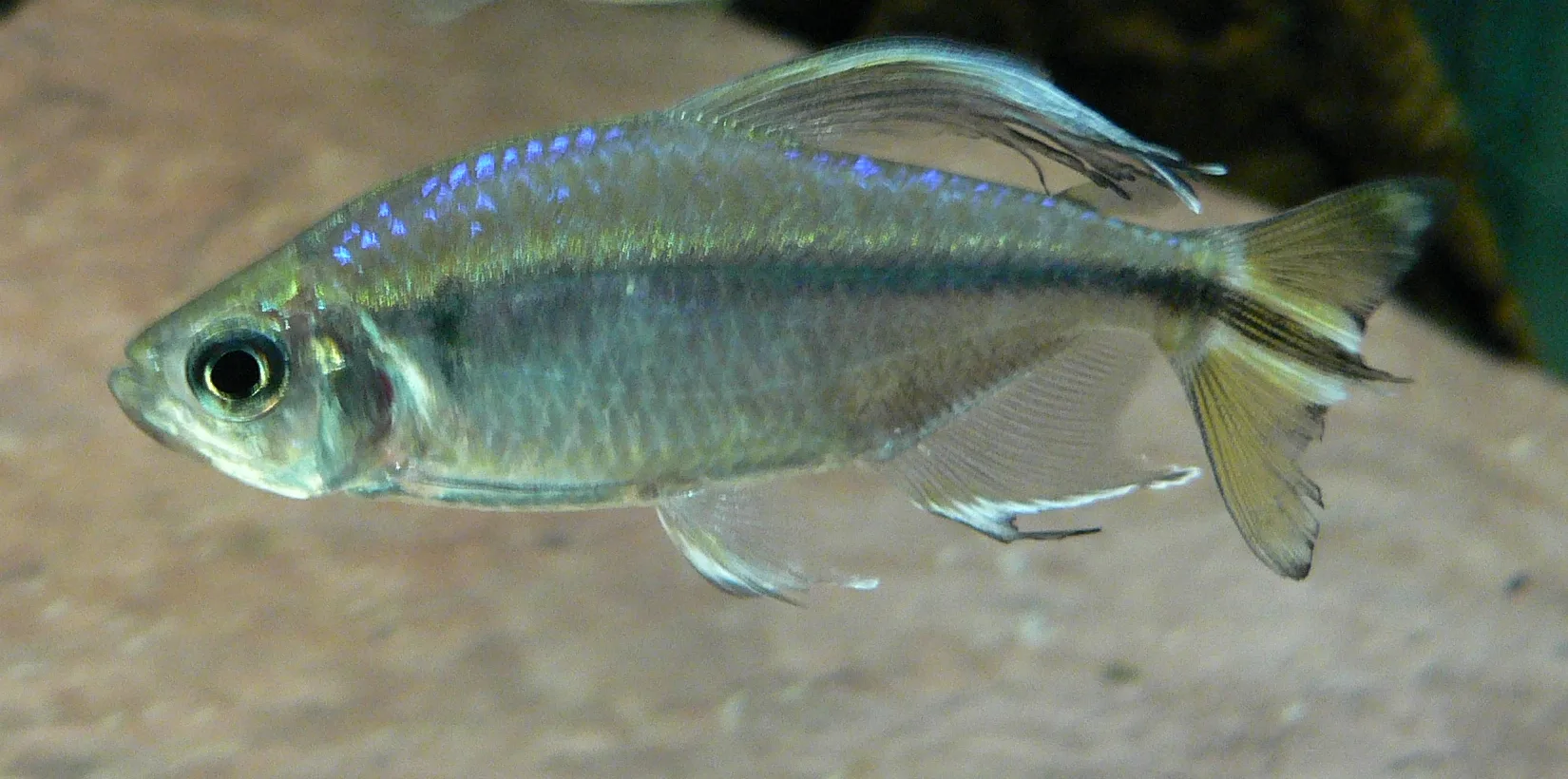
The yellow tail Congo tetra is an African alestid, not a South American characin that happens to have a yellow tail. Alestopetersius caudalis comes from Congo Basin waters. It shares a family with the better-known Congo tetra (Phenacogrammus interruptus), not with neons and phantoms. If you copy a cardinal tetra recipe — tiny tank, peat-only, no swimming room — you will get a shy, faded fish that never shows the gold and yellow the name promises.
Congo water, Congo space
Wild fish inhabit forested rivers and pools in the Congo drainage: warm-temperate tropical, often soft and slightly acidic, with tannins and room to school. In captivity aim for 22–26°C, pH about 6.0–7.5, and softness if you can. They are not rift-lake cichlids. They are not Mexican tetras. They want clean, oxygenated water and a long footprint.
Adults reach 6–8 cm, males larger and more ornate. A school of eight needs something in the 100–150 litre class with length, not a 60 litre cube. They are bigger and more nervous than Cochu’s blue tetra. They are smaller and less “show-fish” than a full male Congo tetra with the trailing caudal filaments, but they still need that African midwater volume.
The yellow flag and the male’s fins
The body is gold to olive with iridescence. The caudal fin carries a yellow to amber wash that gives the common name. Males develop more extended dorsal and anal fins and stronger colour; females stay rounder and plainer. In a dim, tannin-stained tank with a dark substrate the gold reads as metal. In a sterile white tank the fish looks like a washed-out bar.
They colour slowly after import. Expect weeks, not hours. A school that hides in a corner is telling you the lighting is too harsh, the group is too small, or the tankmates are too pushy — not that you bought the “wrong variety.”
Shyness is part of the husbandry
Alestopetersius are flighty. Overhead cover from floating plants, wood that breaks sight lines, and a background make them swim in the open. Sudden shadows (people leaning over an open tank) send them into the lid. They can jump. A cover is required, but they are not hatchets; they use the whole middle of the tank once they feel safe.
Flow should be moderate. A dead still blackwater box makes them sulk; a hill-stream torrent makes them exhaust themselves. Think forest river, not Mae Taeng rapids and not a peat puddle for Boraras.
A school large enough to dilute pecking
Keep eight or more. In small groups males harass each other and the yellow looks patchy. They are not vicious like some barbs, but they are not ember tetras either. Tankmates should be similar-sized African or adaptable fish: other Congo-type tetras in a large tank, peaceful Synodontis that will not eat them, larger rasboras, and so on. Tiny South American tetras will lose food and nerves. Hatchets may work in a huge Amazon-style tank, but this is not an Amazon fish; mixing continents only makes sense if water and temperament overlap on purpose.
Do not put them with mbuna because both are “African.” Mbuna water and mbuna manners will wreck an alestid school.

Diet for a larger African characin
They are omnivores with a strong invertebrate component. Quality flakes or small pellets, frozen bloodworm, brine shrimp, daphnia, and the odd vegetable flake keep them in condition. Males putting out finnage need regular protein. They will take food in midwater readily — easier than hatchets, greedier than yellow phantoms. Feed twice a day what they finish in a minute. They produce more waste than a nano rasbora school; filter and change water for an 8 cm fish, not for a 2 cm fish.
Breeding Alestopetersius at home
They scatter eggs, typically in the morning after rain-like water changes and heavy conditioning. Soft water helps. Adults eat eggs. A separate breeding tank with a mesh or mop, then infusoria and baby brine shrimp for fry, is the realistic path. Do not expect the aerial clutch of a splash tetra or the cave rituals of Astyanax cave morphs. African tetras are egg scatterers in plants and open water.
Sexing is easier than in many small Hemigrammus once males grow fins. Still buy a group; you want several females to spread male attention.
Import nerves and long-term gold
New fish may hide for days. Dim the lights, feed well, and do not add them to a tank of hungry danios. Ich follows temperature swings. They are more sensitive than Buenos Aires tetras and less delicate than wild marbled hatchets. Quarantine in a covered tank with hiding cover and midwater feeding.
If you wanted the classic Congo tetra’s iridescent body and lyretail, keep Phenacogrammus and give it even more space. If you wanted a gold-and-yellow Congo-basin school that stays a little smaller and a little less common in shops, Alestopetersius caudalis is the alestid that belongs in a long, stained, African-soft display — not in a neon tetra barrel.
African soft water is not Amazon peat by default
Congo Basin water can be stained and soft without being a Boraras swamp. Yellow-tail Congo tetras like tannins and dim light, but they also like swimming room and a little current. A 40 litre blackwater cube that suits Phoenix rasboras will stunt and scare an 8 cm alestid. A 150 litre forest-river layout with botanicals, a dark rear, and a school of ten is the picture.
Male finnage is a husbandry report. If the yellow tail is there but the dorsal stays short and chewed, you have either nipping, poor diet, or a group too small to spread aggression. Add fish of the same species, not a random tetra from Peru, when you need to dilute chasing. Peru tetras will not speak the same social language and may simply become targets or competitors.
Keep a cover. Flighty African tetras hit lids. They are not trying to spawn in the air. They are trying not to be eaten, a habit that does not turn off in a living room.
Explore other topics
Dive into more aquarium guides across the site.