

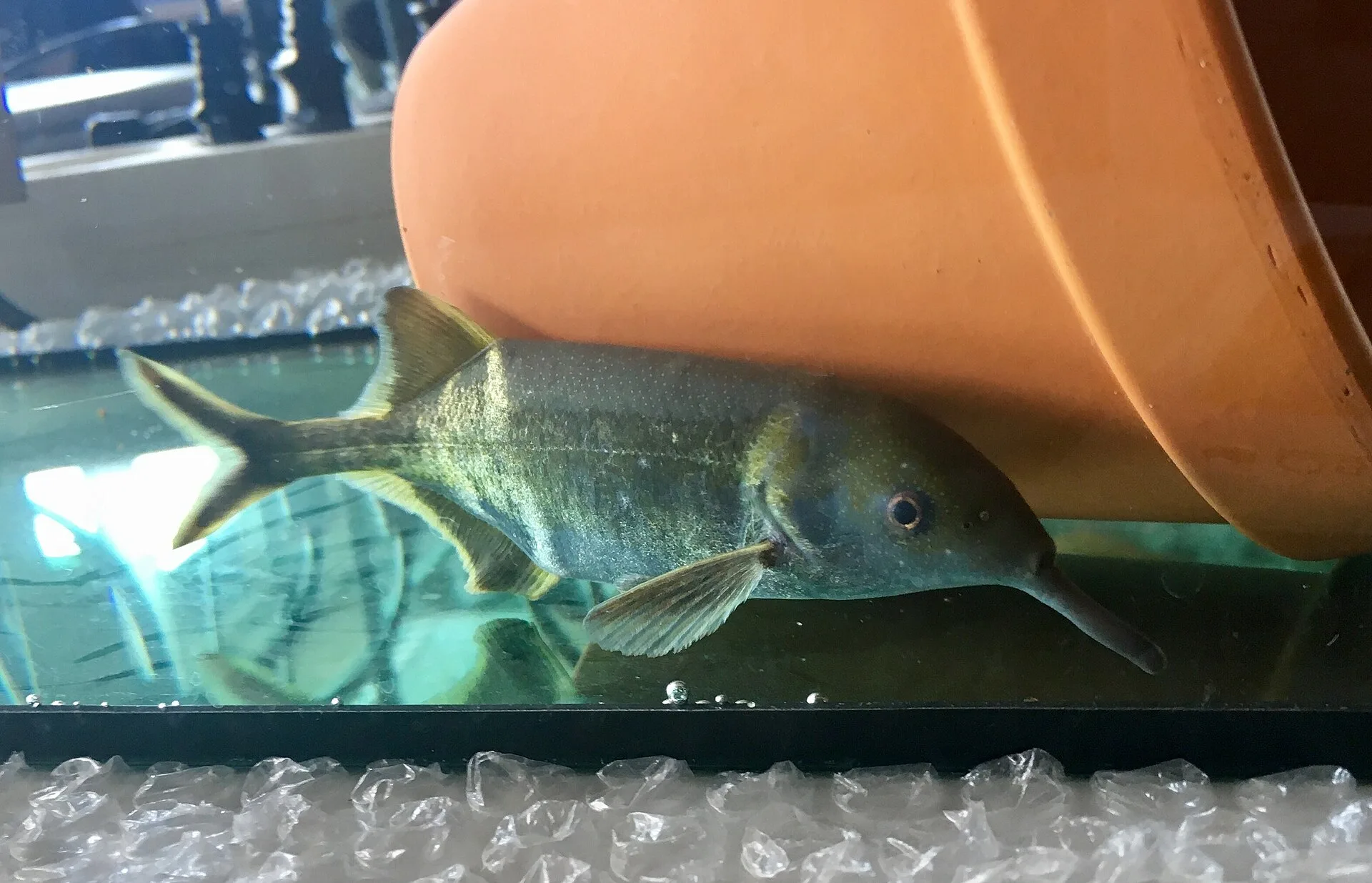
The chin of Gnathonemus petersii is not a joke nose. It is a probe packed with electroreceptors, part of a weak electric system this mormyrid uses to read a dark African stream. The elephantnose fish hunts at night, pulses into the water, and lives in a world you cannot see. That is why metal décor, strong current full of stray voltage, and a tank mate that bullies at dusk all go badly. You are keeping a weakly electric animal, not a novelty goldfish with a trunk.
Adults reach 20–25 cm. Shops sell 8 cm fish. If your tank is 80 litres, stop. This is a large, expensive, long-lived oddball that needs soft water, sand, dim light, and live or frozen food. It is also territorial with its own kind in ways that are hard to predict because the argument is electrical. Two may school. Two may fight. Five in a big tank may settle. There is no tetra-style stocking formula.
Night rivers in West and Central Africa
The species is native to West and Central African rivers, including Congo drainage waters, in turbid or stained, vegetated, slow to moderate habitats. They work the bottom and the lower water at night, probing sand and silt for insect larvae. Daytime is spent in cover. The electric organ and the receptors on the chin and body map obstacles and prey when eyes are the wrong tool.
Your tank should be dim, with hiding places, a sand floor they can poke, and no sharp gravel that damages the chin. Plants can be present; they help with cover and they like the shade. A bright, barren “show tank” produces a fish that hides behind the heater all day and panics at lights-on.
The trunk is a sensor
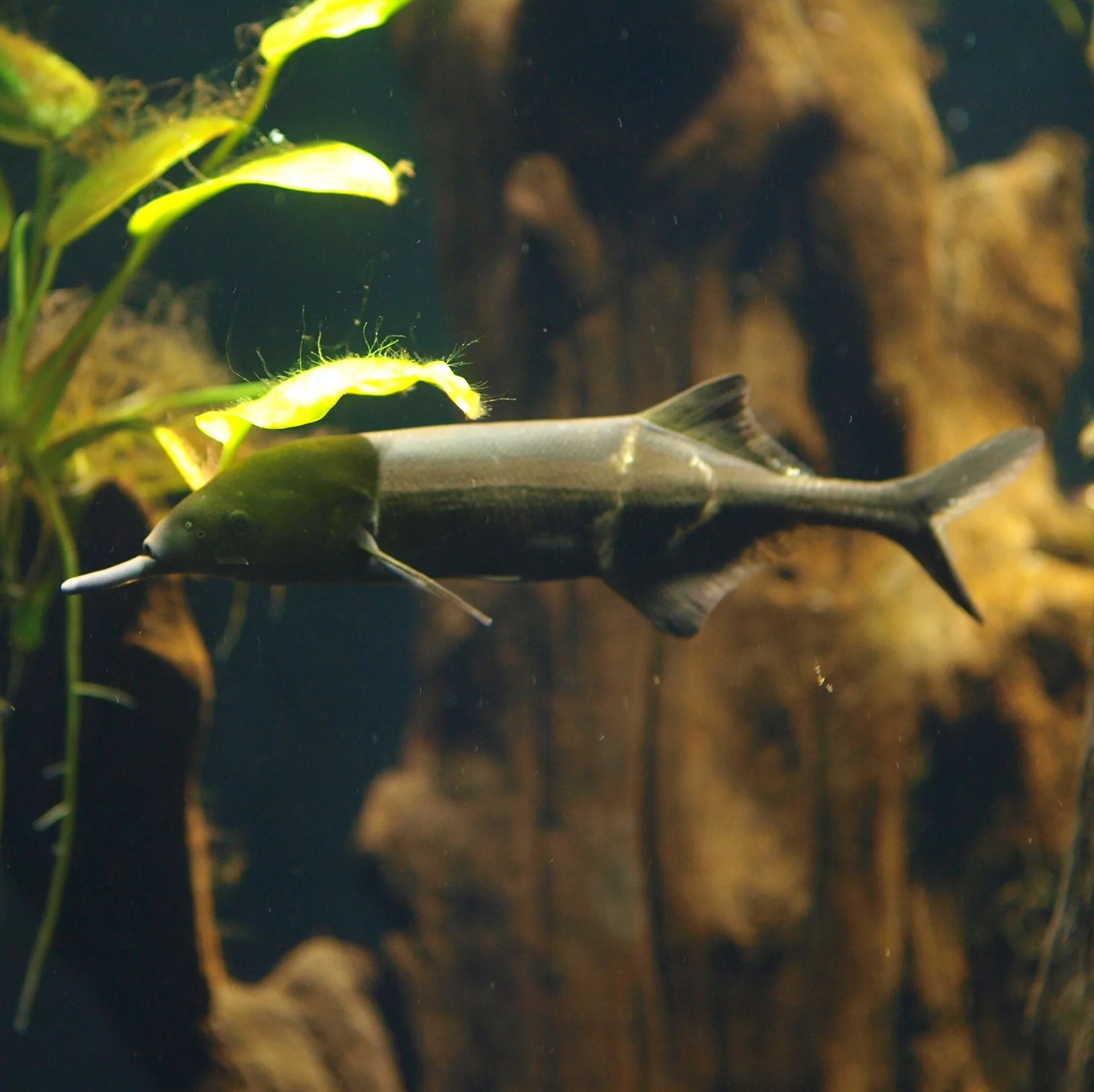
The lower jaw extends into a fleshy Schnauzenorgan. It is not a bone tusk. It can be damaged. It should not be sucked against an uncovered filter. The body is dark, often with two pale bars toward the tail, and a forked caudal. They swim with a hovering, slightly awkward motion that is normal. They are not sick because they do not swim like a barb.
Sexing is difficult. Males may show a concave anal fin indentation when mature; females a rounder profile. For most keepers this remains uncertain. Breeding in home aquaria is rare. Buy them to keep, not to spawn on a schedule.
Volume, sand, and electrical quiet
One hundred and fifty litres is a starting point for one adult; more if you attempt a group. Length and floor area matter. Fine sand is the correct substrate — they probe it. Provide pipes, wood, and plants as day hides. Dim the room or use floating plants. Current should be gentle; they are not rapids mormyrids of a different niche. Heater and filter must be electrically sound. Stray voltage is a live issue for a fish that navigates by electricity. Use a grounding probe if you have reason to suspect voltage, and service equipment that leaks.
Avoid sharp resin ornaments and metal. Avoid substrate heaters that create odd fields if you can. This sounds fussy until you watch a fish scrape its chin raw on gravel.
They jump poorly but can lunge. A cover prevents the rare disaster. More important is covering the filter intake so the Schnauzenorgan never goes in.
Soft water they can read

Temperature 24–28°C, pH 6.0–7.5, soft to moderately soft water. Conductivity that is stable matters because their electric sense is calibrated to the water they live in. Huge swings in TDS after a water change are more than a chemistry shock; they are a sensory shock. Match new water. Use RO blended to a known GH if your tap is liquid rock or wildly variable.
They are sensitive to poor water quality. They are not “hardy oddballs.” Weekly changes, gentle but thorough. Medications, especially those that affect the nervous system or conductivity, should be used with unusual caution. When in doubt, treat in a separate tank and research mormyrid sensitivity rather than dosing the display because a tetra has ich.
Food that still wriggles at dusk
In the wild they eat insect larvae and small invertebrates in the substrate. In the tank, live and frozen bloodworm, blackworm, brine shrimp, mysis, and similar foods work. Some individuals take sinking pellets; many do not, especially at first. Feed after lights-out or at dusk, and stay to confirm the trunk is working the sand. A fish that “never eats” is often a fish you fed at noon while it hid.
They will not outcompete aggressive day feeders. Target-feed. A hollow-bellied elephantnose is a common tragedy. Daily feeding is better than a feast twice a week.
Company is a gamble among themselves
Other species: choose peaceful, non-boisterous fish that will not steal night food — some tetras, calmer West African fish, nothing that rips fins or rams. No large cichlids. No aggressive catfish that own the night shift. Shrimp may be hunted.
Conspecifics: some people keep a group in a large, heavily structured tank so aggression is diluted. Some keep one. Two in a small tank is the worst of both. Watch. If one fish is hiding with a damaged chin and the other owns the sand, separate them. There is no shame in a singleton. A singleton still needs the volume, because the adult is not small.
Spawning is not the plan
Captive breeding is exceptional and not a standard home-aquarium outcome. If you ever see courtship, document it and get help from specialist keepers. Do not buy a pair expecting fry. Sexing is uncertain and the environmental cues are poorly copied in most living rooms.
The long night
Quarantine in a dim, sandy tank with hiding pipes and frozen food at night. They often refuse food for days after shipping. Patience. Do not jab the chin. Do not keep the light on to “check on them” every hour. Ich treatments must be chosen carefully. Organophosphate and some other compounds used in fish medicine can be disastrous; know what you are adding.
A well-kept Gnathonemus petersii is a decade fish, a nocturnal intelligence in the glass. You will see more of it if you sit in the dark with a dim torch than if you stare at the tank at noon. That is not a defect in the fish. That is you, finally, keeping it on its schedule. Sand, soft stable water, meat at dusk, electrical quiet, and enough room that the trunk never has to share a corner with a bully. Meet those, and the elephantnose stops being a novelty and starts being what it is: a mormyrid, on purpose.
Explore other topics
Dive into more aquarium guides across the site.