

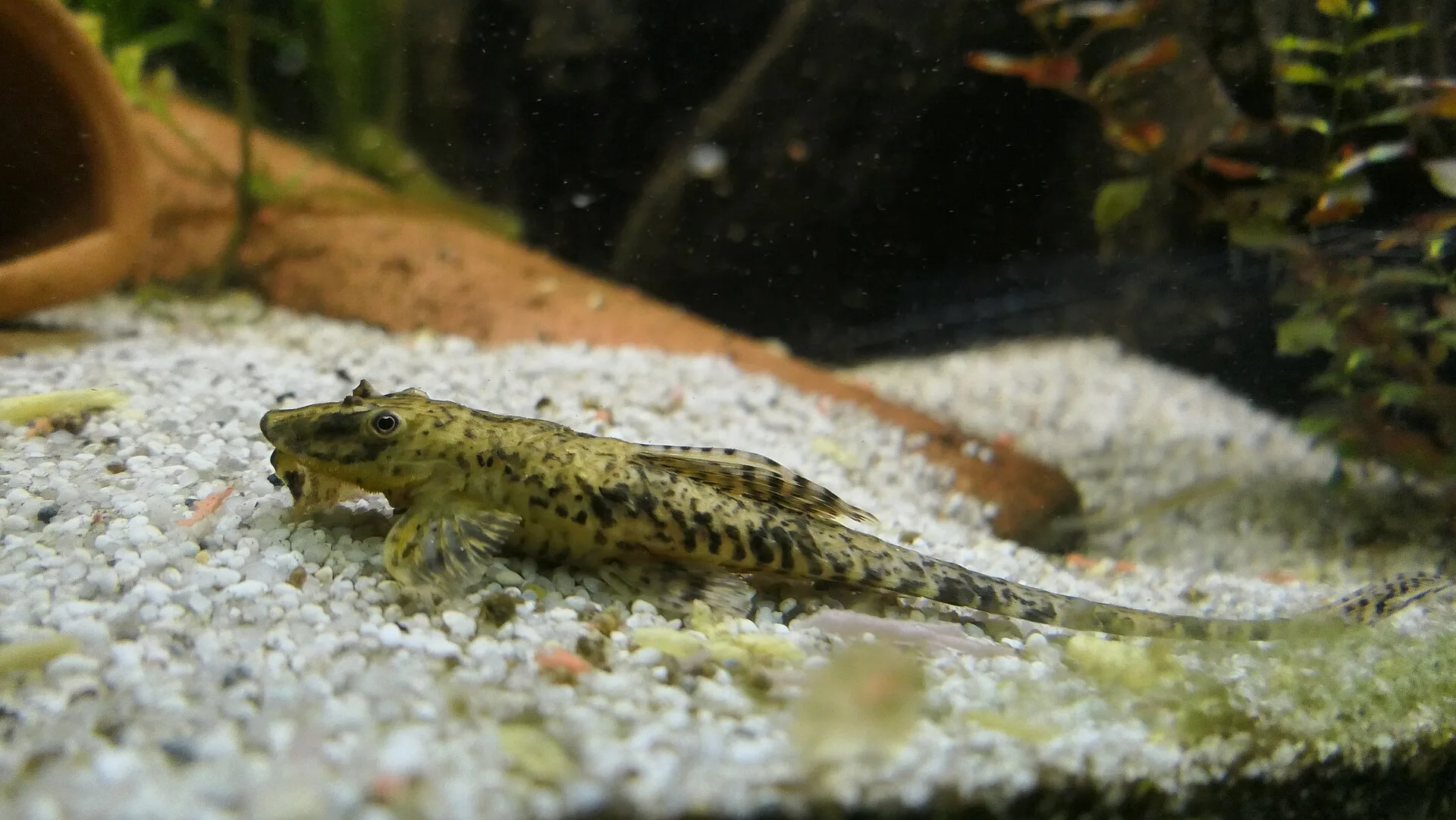
Seen from above, Rineloricaria lanceolata is a dead leaf with a face. The chocolate whiptail — one of several whiptails in the trade — is a slender loricariid from South America that lies on sand, in leaf litter, and along wood, blending until it moves. People buy it as a novelty and then cannot find it for a week. That is success, not a missing fish. You have to build a tank where a camouflage artist has a job, and you have to feed it as an omnivore that still wants vegetables, not as a shark that wants pellets only.
Species names on bags are often wrong. R. lanceolata is a relatively stocky, often brownish whiptail; other Rineloricaria look similar. Care overlaps. If you have a 15 cm whip with a long caudal filament and a habit of sitting on sand, you are close enough to use this as a working manual. If you have a Sturisoma or a royal whiptail, the swimming is more midwater and the tank should be taller. Look at how your fish actually sits.
Leaves that are animals
Whiptails of this group come from South American rivers and streams with sand, snags, and packed leaves. They are not open-water fish. They are not cave plecos in the ancistrus sense, though they will use tubes to spawn. Flow is moderate. The bottom is the habitat. An aquarium that is all midwater décor and coarse gravel is a poor translation.
They are peaceful, almost to a fault. They lose food to faster fish. They get sucked into uncovered filters. They get vacuumed by well-meaning keepers who thought the leaf was a leaf.
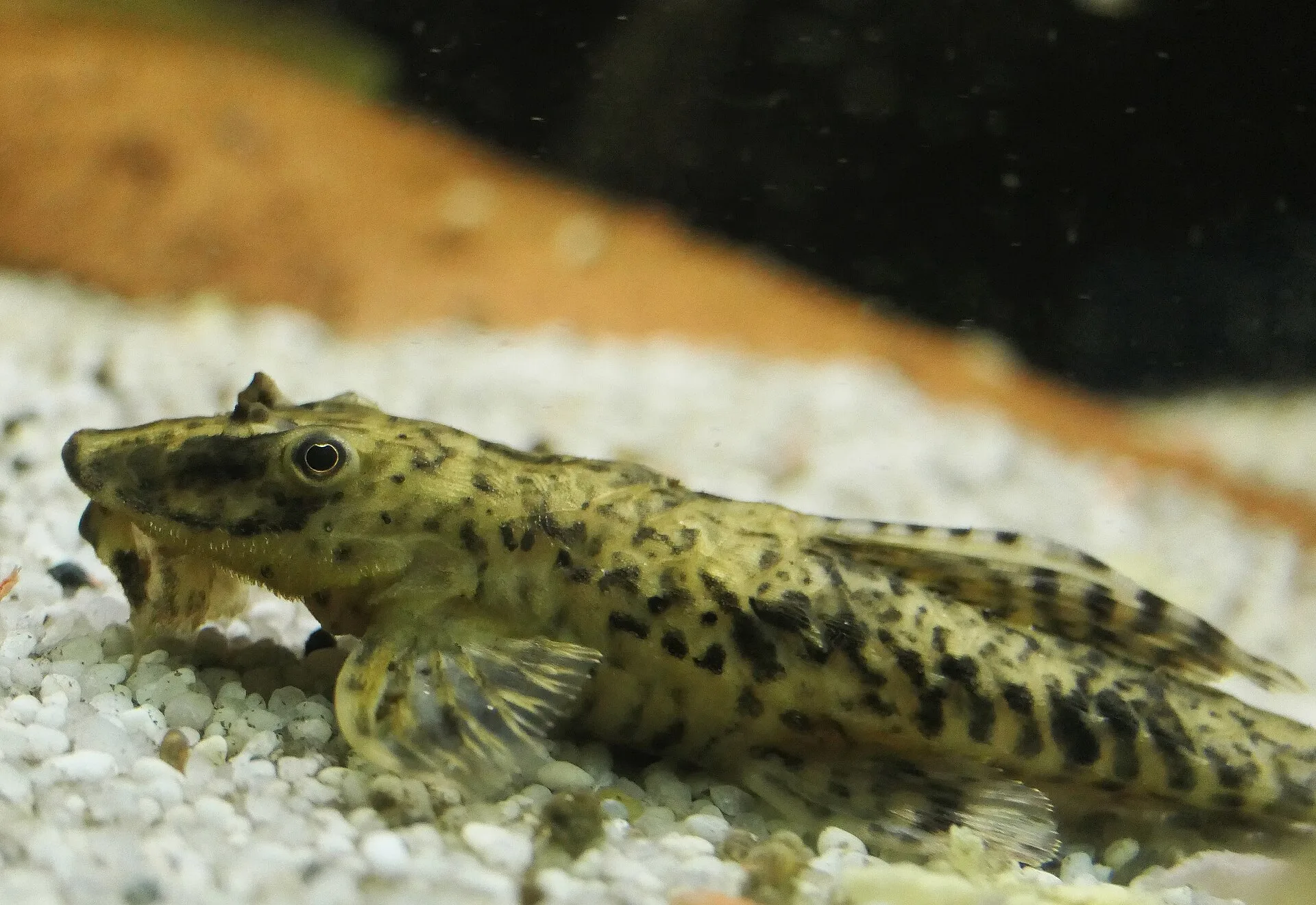
A filament, a flattened belly, a shy eye
Adults commonly 12–15 cm plus the caudal filaments, which can add length that does not need extra swimming room so much as it needs not to tear on décor. The body is flattened underneath for sitting. Colour is brown, tan, chocolate, sometimes with mottling that matches botanicals. Males in breeding condition may show thickened odontodes on the sides of the head and pectoral spines — a fuzzy or bristly look compared to the female. Females are fuller in the body. Sexing juveniles is guesswork.
They are not bristlenoses. No tentacle beard. If yours has a beard, reread the Ancistrus article.
Sand, litter, and a tube
Eighty litres for a pair or a small group if the floor is large. Sand is strongly preferred; they sit on it and they spawn in association with hollows. A layer of leaves is camouflage and a biofilm farm. Wood for rasping. A few PVC or clay tubes — they will spawn in these. Plants can be present; they may rest on Anubias leaves. Lighting can be modest; they look better and behave more naturally in a tank that is not a spotlight on white sand.
Flow: moderate, along the length, not a sandstorm. Filter intakes covered with sponge — fry and thin adults both die in impellers. They are not strong jumpers but a lid still prevents the one-in-a-hundred floor death. They produce less obvious mulm than a bristlenose but they still need clean water.
Warm South American, not brackish, not rift

Temperature 24–28°C, pH 6.0–7.5, soft to moderate water. They can adapt to a range, but eggs and fry of wild-type fish prefer the softer side. Weekly changes. They show poor water by sitting stiller than usual (hard to judge) and by fungal edges on fins. They show good water by being slightly more visible at feeding time and by a rounder belly.
Do not keep them with mbuna. Do not keep them in a goldfish tub. Do not add salt as a tonic.
Omnivore on the floor
Algae wafers, blanched vegetables, sinking omnivore pellets, and some frozen food (bloodworm, brine shrimp) that actually reaches them. They are slower than Corydoras. If you feed only at the surface, the whiptail gets crumbs. Drop a wafer in front of the fish after lights-out. Many keepers feed them at night on purpose. Wood is part of the diet in the loricariid sense — not calories enough alone, but they rasp it.
A hollow-bellied whiptail is underfed or parasitised. Shop fish are often thin. Feed well in a quiet tank before you add them to a bustling community.
Peaceful until you count the mouths
They ignore other fish. Other fish do not always ignore their food. Good tank mates: small tetras, rasboras, Corydoras, apistos that use caves instead of tubes, shrimp if the whiptail is well fed (adult shrimp usually fine). Bad tank mates: large cichlids, anything that sleeps on the same sand and rams, and a pack of hungry loaches that vacuum wafers in seconds. Multiple whiptails can share a large floor; males may compete for the best tube when breeding.
Tubes, eggs, a male who stays home
They spawn in cavities. The male often guards. Eggs are attached inside the tube. If you want fry, a mature tank with film, or a dedicated grow-out, and no hoovering catfish. Fry are tiny raspers. This is one of the more breedable “oddball” catfish for people who already keep loricariids. If you do not want fry, you may still get them. Tubes can be removed. Or you can enjoy the fact that a leaf had children.
Look twice before you siphon
Quarantine on sand with a tube, a leaf, and sinking food. They hide for days. That is normal. Thin fish need food more than they need a cocktail of meds. Ich and fungus after shipping: clean water, temperature stability, treat in a hospital that still has places to hide. A bare bright box will not show you if they are eating because they will not come out to eat.
Rineloricaria lanceolata is a catfish for people who like the bottom of the Amazon done quietly. Sand, leaves, a tube, vegetables that arrive at night, and a siphon wielded with respect. When a visitor asks where the fish is, point at the leaf that just walked. That is the whole point of the whip.
Explore other topics
Dive into more aquarium guides across the site.