

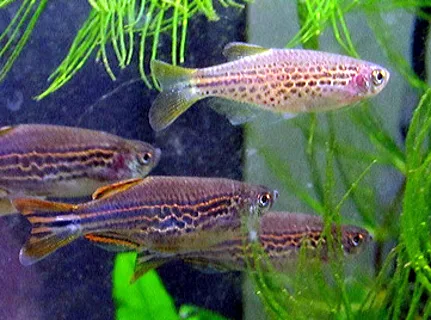
Danio kyathit is a Myanmar stream fish with orange fins and a body that can show spots, broken stripes, or a mix depending on population and mood. The orange-finned danio is not a zebra danio with dyed tails. It wants current, oxygen, and a tank that is long before it is tall. Keep it like a small river cyprinid, not like a tetra in still blackwater.
Irrawaddy spots and orange paddles
The species comes from the Irrawaddy drainage in Myanmar. Wild fish live in clear, moving water over gravel and sand, often with monsoon variation. In the aquarium that means 22–26°C (they dislike a constant 28°C stew), pH roughly 6.5–7.5, and hardness that can sit in the moderate range. They are more flexible chemically than Boraras and less flexible thermally than Mexican tetras. What they are not flexible about is stagnation.
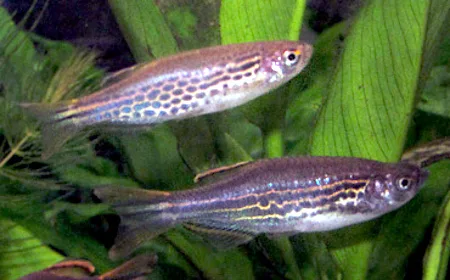
Adults reach about 4–5 cm. The orange in the caudal and often the other fins is the field mark. Body pattern is variable — some look spotted like a leopard, some show irregular stripes. That variability is normal, not a sign you mixed species. Hybridisation with zebra danios is a real risk if you spawn mixed Danio species; keep breeding tanks separate.
Length before litres
A 90 cm tank with a school of eight to twelve is a better kyathit home than a 60 litre cube of the same volume. They patrol up and down the current line. Tall tanks waste the depth. Flow from a spray bar or a powerhead aimed along the length, with plants or rock to break the blast, copies a stream without turning the box into a washing machine.
They jump. A lid is not optional. Stream fish bolt upward when a shadow hits. This is the same jumping problem as hatchets in outcome (fish on the floor) and a different problem in cause (current sprinters, not surface gliders).
A school that hunts in flow
They are active, slightly boisterous, and peaceful enough for robust tankmates of similar speed: other Danio of similar size, larger rasboras, fast loaches that like current, and barbs that do not stay small. They will harass slow, long-finned fish and they will outcompete dwarf pencils and chili rasboras for food. Do not put them in a still Amazon tetra display “for movement.” They will stress the tetras and the tetras will not use the current.
Males chase. In a proper group that chase is a ribbon of orange fins. In a trio it is bullying. Stock the school, then add current, not the other way around.
Feeding fish that never stop
Omnivores that pick drifting invertebrates in the wild. Flakes, micro pellets, frozen bloodworm, daphnia, and brine shrimp all work. Feed in the current so food suspends. Sinking wafers are for other animals. They have a higher metabolism than a phantom tetra; skinny danios in a pretty planted tank are usually underfed, not “streamlined.”

They will take some plant matter. They will not wreck a scape like Buenos Aires tetras, but they may nibble soft tips.
Eggs over a grate, not in a cave
Typical danio scatter: marbles, a mesh, or a spawning grate, slightly cooler water then a change, and removal of adults. Eggs hatch quickly. Fry are small but not Boraras-small. They take infusoria briefly then baby brine shrimp. You can spawn them as easily as zebras if you give current-conditioned adults. You cannot spawn them in a peat swamp nano without stressing the parents.
Why zebra care sheets almost work
Zebra danio advice on length, lid, and schooling is closer than any tetra sheet. Where it fails: kyathit often prefers slightly cooler, more oxygenated water and a bit more current, and the orange fins are a condition signal. Quarantine new fish; Myanmar exports can carry parasites. Watch for skinny fish and flashing. They are tougher than hatchets and more demanding of oxygen than still-water characins.
If you wanted pearls on a tiny body in still water, that is a celestial pearl danio — different habitat. If you wanted orange paddles in a Myanmar stream layout, D. kyathit is the fish, and the tank must be a runway with a roof.
Current, hybrids, and the orange report
Orange fins are the first thing to fade when oxygen is low or when the fish is mixed with zebras that hog food. If your kyathit look brown-finned, increase surface agitation, feed in the flow, and ask whether zebra danios are in the same box. Hybrids from accidental spawns can muddy the orange and the body spotting for generations. A lid stops jumpers; it does not stop eggs falling through plants into a community that already holds D. rerio.
Myanmar stream fish appreciate a monsoon impression: a larger-than-usual water change with a slight temperature dip, then a return to baseline. That often triggers spawning. It also cleans a high-metabolism tank. Do not combine that change with a heater spike to 28°C “to make them tropical.” You will gain ich risk and lose the stream cue.
Decorate for a runway. A solid wall of stem plants across the middle of a long tank blocks the only behaviour that keeps kyathit sane. Plant the back and the ends. Leave the centre as water. That layout is wrong for a peat rasbora and right for an orange-finned danio.
Orange paddles in a Myanmar stream layout need a runway, a roof, and a school that is not secretly half zebra. Keep kyathit in current, keep breeding groups pure, and treat the fins as an oxygen-and-diet meter rather than as a dye job you can buy in a bottle.
Spot versus stripe variation in kyathit is not an excuse to add mystery Danio from another bag. Keep the orange-finned school closed if you care about the paddle colour, and treat every zebra in the same river tank as a future hybrid you did not order.
A lid clip on the filter cut-out is cheaper than replacing a school that found the ceiling on the first night.
Explore other topics
Dive into more aquarium guides across the site.