

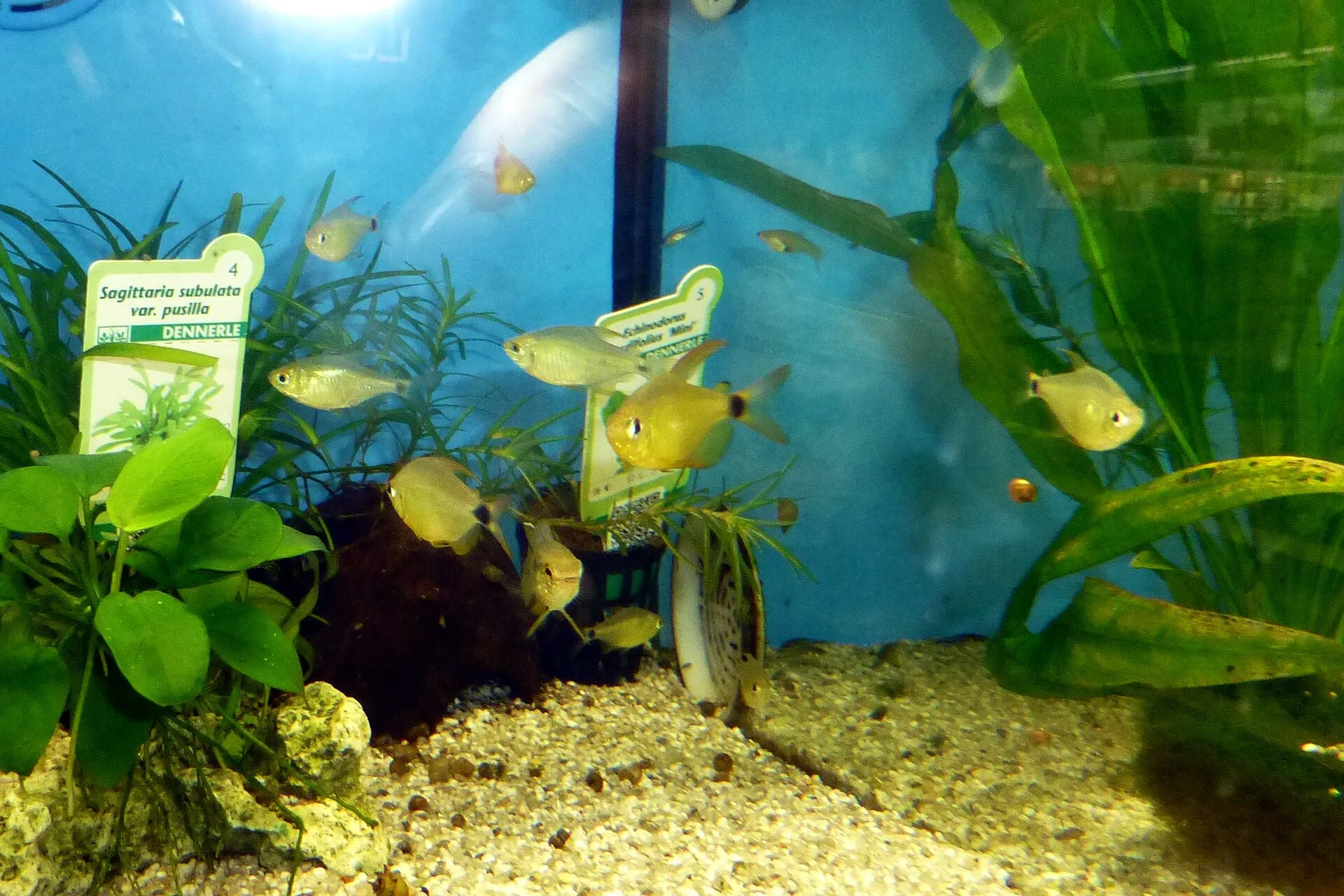
Hyphessobrycon heliacus was described in 2002 from the Rio Arinos in the Tapajós drainage of Brazil. The sun tetra is a small, warm-gold fish whose males grow a long, filamentous dorsal and anal fin that looks nothing like a “standard tetra” care-sheet drawing. It is still uncommon compared with neons. Keepers who treat it as a dither tetra in a busy community never see the sun in the name.
A Tapajós gold, recently named
The type locality is a clear-to-stained tributary system, not a generic “Amazon barrel.” Wild water is warm, soft, and structurally complex. In the tank, aim for 24–28°C, pH 5.0–6.8, very low hardness if you want spawning and full colour. They will persist in slightly harder water. They will not display. This is closer to a specialist Hyphessobrycon than to a Buenos Aires tetra, and it is nothing like a danio.
Adults are about 3–3.5 cm without the male’s streamers; with fins, males look larger. Females stay compact and gold. The species name heliacus refers to the sun — the yellow-gold body, not a lighting recommendation to blast them with noon LEDs.
Filaments that need still, stained water
Male sun tetras grow extended dorsal and anal rays that other fish will shred. That single fact should dictate stocking. No barbs, no small groups of nippy blues, no angels in a tight tank. A species tank or a very gentle community of tiny tetras, small Corydoras, and shrimp is the honest setup. A school of eight to twelve lets males display to each other without one fish being hunted as the only rival.
Flow must be low. Long fins in a current look ragged even without nipping. Plants and wood create still pockets. Floating plants dim the light so the gold reads as warm metal instead of washed yellow. They use midwater, not the surface film, not caves.
A display school, not a dither
Sun tetras are the point of the tank, or they are wasted. In a 60–80 litre planted display they hover, turn, and flare. In a 200 litre mixed “everything tropical” box they hide and lose fins. They are peaceful. They are also fragile in social terms: easily outcompeted, easily nipped, easily ignored at feeding time.
A lid is still wise. They are not hatchet jumpers, but a 3 cm fish can leave a rim gap. Do not lower the water for Copella-style spawning; heliacus scatters in the water among plants.
Diet that grows streamers
Tiny omnivore-predator. Baby brine shrimp, cyclops, crushed flake, microworms. Males building fins need frequent small protein meals. Large pellets are theatre props. If you keep them with even moderately greedy tetras, feed in two stages and watch whether the gold fish actually swallow anything.
Colour foods help after the chemistry and the school are right. They will not turn a singleton into a sun.
Companions measured against those fins

Ember tetras, small pencilfish, chili rasboras in a compatible peat-friendly tank, and shrimp are the usual list. Yellow phantoms are similar in softness needs but can still outcompete sun tetras if the phantoms are numerous and the suns are few. Hatchets occupy a different depth; possible in a large, calm Amazon tank if surface feeding does not stir panic. Danios are a no. Mexican tetras are a no. Buenos Aires tetras are a no.
Spawning a 2002 species
Soft, acidic, warm water, Java moss or a mop, a conditioned pair, dim light. Eggs are scattered and eaten. Fry are tiny. This is a specialist spawn, closer to other small Hyphessobrycon than to zebra danios. Do not expect cave-form behaviour. Do not expect aerial eggs. Success is more likely in RO-mixed water than in liquid limestone tap.
Because the species is still less factory-farmed than neons, captive-bred fish from careful keepers are worth seeking. Do not strip wild Arinos populations for a community tank that will shred the males.
Recognising trouble on a gold sliver
Faded gold, clamped fins, and a male whose streamers look chewed are the three early signs. Ich kills small tetras quickly. Quarantine in soft water; a sudden jump into hard tap after a soft-water exporter is a classic crash. They are more delicate than ornate tetras and far more delicate than Mexican tetras. Treat them as a Tapajós miniature, not as “another rosy tetra.”
If you wanted white tips and a deeper body, that is ornate tetra. If you wanted a tiny gold fish with ridiculous male fins from a named Brazilian tributary, H. heliacus is the one, and the tank has to be slow, stained, and devoted to keeping those filaments intact.
Filaments and the Tapajós bargain
If you are not willing to keep a gentle, species-focused tank, do not buy male sun tetras. The long rays are the species. Once shredded, they grow back slowly if at all in a stressful community. Females without streamers still need the same soft, warm water, but they are not the fish in the photos that sold you the bag.
Tapajós tributaries are not a license to use intense “river” lighting. Gold shows in moderate, warm-toned light over brown substrate. Cool white LEDs on pale sand make heliacus look like a poorly kept ember tetra. They are not embers. Embers are smaller, rounder, and far more common; they also lack the male’s ridiculous fins.
Because the species is newer to the hobby than bentosi, prices can be higher and stock thinner. Quarantine the whole group together in soft water. A singleton hospital tank is how a display fish becomes a hide-in-the-corner fish before it ever reaches the scape you built for it.
Sun tetra males are a Tapajós fin experiment. Soft, warm, slow water and tankmates that will not chew streamers are the bargain. If you cannot keep a gentle display, buy a common Hyphessobrycon instead of shredding a 2002 species for the sake of “one more tetra” in a busy box.
Java moss is both a spawning mop and a fin refuge. Do not tear it out for a “clean scape” if you paid for heliacus streamers. The moss is how a 3 cm Tapajós male keeps his filaments away from accidental snags and from the one slightly too-bold tankmate you should not have added.
Explore other topics
Dive into more aquarium guides across the site.