

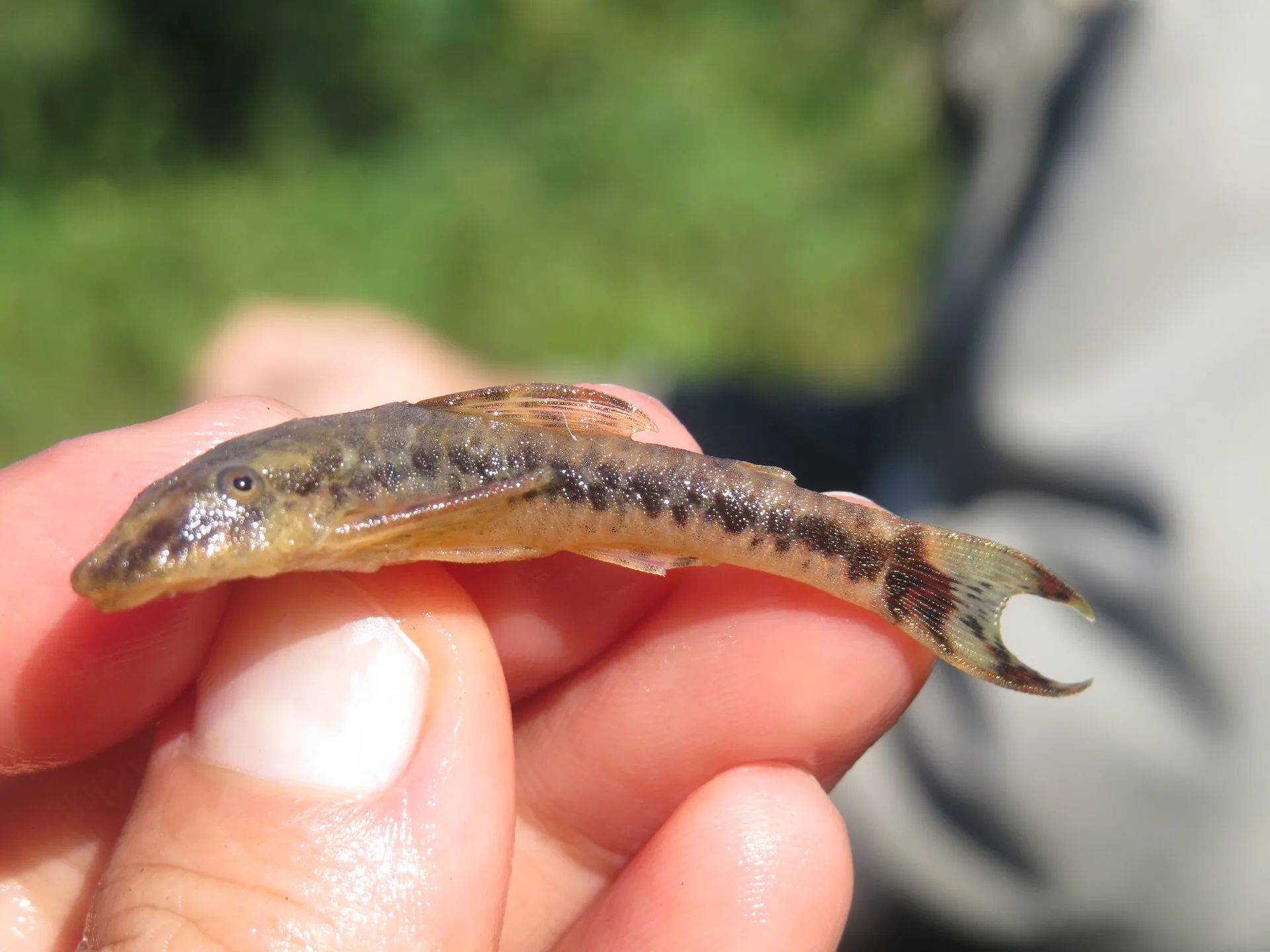
Parotocinclus maculicauda wears its identity on the tail: maculicauda means spotted tail, and the caudal fin typically shows dark spots on a paler field rather than the single peduncle ocellus of some Otocinclus. It is a small hypoptopomatine from coastal drainages of southeastern Brazil, a fish of sand, stones, and modest current. In the tank it behaves less like a leaf-clinging still-water oto and more like a miniature stream pleco that wants flow over a pale floor. It still grazes aufwuchs. It still stays small. It is not Ancistrus, not a rubberlip of the Andes, and not a generic “oto” bag mix.
Coastal Brazilian riffles and sandy runs
The species is tied to Atlantic forest and coastal river systems in southeastern Brazil, where clear water runs over sand and pebbles between remnant forest. Current is part of the story. These are not stagnant pools. They are also not 2,000-metre Andean torrents. Think of a bright, shallow run with patches of gravel, some plants at the margin, and a lot of periphyton on hard surfaces.
That habitat is under the same urban and agricultural pressure as other Rio and São Paulo drainages. Wild fish are not an infinite resource. If you find captive-bred Parotocinclus, prefer them. If you find a mixed “dwarf pleco” import, look at the tail: spots on the fin itself, a slightly more terete or compact stream body, and a habit of sitting on sand and stone in flow rather than only on plant leaves.
Seasonal rains raise the runs. The fish does not then become a blackwater Amazon specialist. Keep the picture: coastal Brazil, sand, current, film on stone.
The tail that names the fish
Adults often land around 4–6 cm, a little more robust than the skinniest otos. Ground colour is brown to olive with mottling. The caudal fin’s spots are the field mark when they are expressed. The snout is a rasping suckermouth without tentacles. Odontodes may catch the light on males. Compared with Macrotocinclus affinis, this fish is less about a gold wash and more about a stream-camouflage, spotted-tail look.
Healthy fish hold station on glass or stone in a shop vat with flow. Fish that are skeletal, or that have shredded tails from panic, have already paid the import tax. Belly profile from the side tells you whether they have been eating film or starving in a box.
Males can show more odontodes and a slimmer build. Females look rounder. You still want a group, because a single dwarf in a scape is a lost grazer.
Sand, pebbles, and a visible current
Build a long, shallow-ish tank of about 60–80 litres for a group, with sand, scattered pebbles, and a powerhead that creates a lane of flow. Plants can sit at the sides; the main stage is the run. Wood is fine as a grazing surface but this species is not a log-cavity bristlenose. Leave open sand for them to sit on. That posture — on the floor in current — is a clue you have a Parotocinclus setup rather than a still oto jungle.
Oxygen should be high. They are small, but they are stream fish. A stagnant, warm, film-choked surface is the wrong kind of “mature tank.” Mature film on stone in moving water is the right kind.
Heater: aim cooler-tropical, not discus-hot. A lid prevents jumpers in the flow.
Clear, moving, not swampy
Temperature 20–25 °C, pH 6.0–7.4, moderate softness. They dislike ammonia as much as any dwarf loricariid. They dislike heat plus stagnation more than a still-water oto might. Keep nitrate modest with water changes that match the tank’s temperature and flow. Do not dump them from a cool importer vat into a 28 °C community and call it acclimation.

Hardness can sit in a gentle range. Extreme RO with no minerals is not a coastal stream. Remineralise if you start from pure RO.
Periphyton on stone, not a wood diet
Grazing film on pebbles and glass is the job. Wafers and blanched greens support a group in a tank that already has that film. They are not xylophagous. They will not replace a panaque. They will not polish a neglected tank overnight. Rotate a few “green rocks” from a lit bucket if the display is too clean.
Feed in a way that reaches the floor crew. Midwater fish will steal wafers. A sinking crumb after lights-down helps, but the real calorie source remains the run’s aufwuchs.
A small school in a stream community
Keep a group of five or more. Good companions are other small, current-tolerant, peaceful fishes that share cool-tropical, clean water — certain small characins or darter-like fish, not large cichlids, not giant catfish, not a pack of hungry loaches. Avoid mixing them only as “the oto substitute” in a still, hot, overstocked box.
They are not aggressive in the bristlenose-cave sense. They can be timid if the flow is too brutal or the lighting is a stage spot. Tune the powerhead until they sit on pebbles and rasp instead of hiding in a corner.
Spawning in the run
Hypoptopomatines typically place eggs on surfaces. Current and excellent water are more important than a PVC cave. Fry are specks that need film. Do not vacuum the pebble field if you see eggs. Home breeding is possible for dedicated keepers and is the right future for a coastal Brazilian dwarf.
What “current” means in a 70 litre tank
You do not need a river manifold. You need a powerhead aimed along the sand so the fish can sit in a lane and rasp pebbles without being thrown into the glass. If they only hide behind the heater, the flow is a washing machine. If they never leave a back corner, the tank may be too still and too hot. Tune until you see perching on stone. That posture is the species telling you the scape is close to a coastal run.
Clean the powerhead before it rattles to a stop. A dead pump in a closed lid is how a stream dwarf becomes a still-water corpse overnight in summer.
Spotted tail, stream body, separate care
If your dwarf suckermouth sits on sand in a current and shows a spotted caudal fin, you are in Parotocinclus country, not in generic oto-advice country. Give it a riffle in miniature, a group, and a living film on stone. See Otocinclus macrospilus and Macrotocinclus affinis for the stiller, leaf-oriented dwarfs, plus chemistry and cycling.
Explore other topics
Dive into more aquarium guides across the site.