

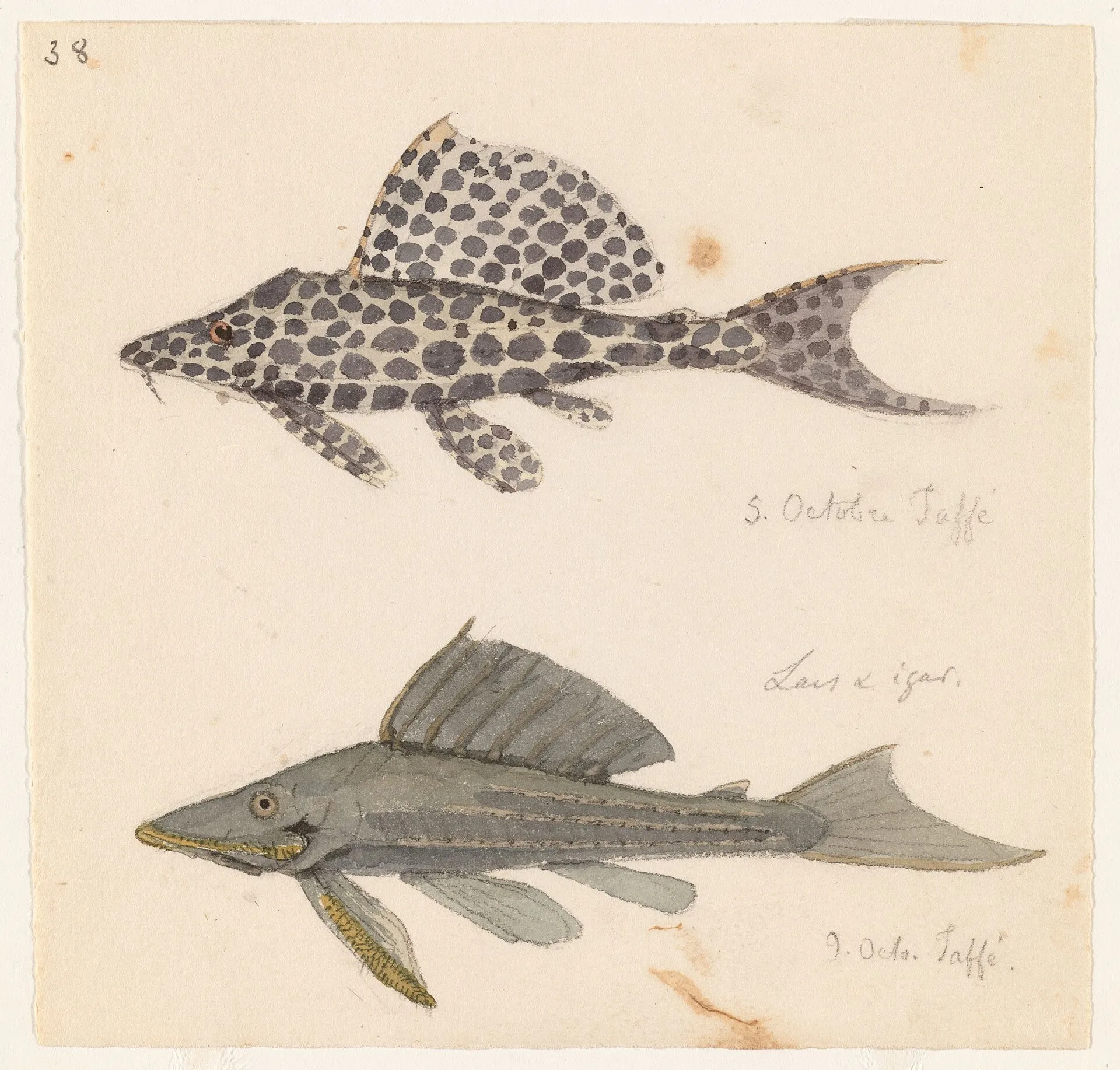
The sailfin pleco in this article is the leopard-spotted giant whose dorsal fin looks like a fan. The name on older papers is Glyptoperichthys gibbiceps; many sources now place it in Pterygoplichthys. Either way, the fish is an Amazon basin loricariid that grows to about 40–50 cm, sometimes more, with a sail that needs a tank like a small room. Juveniles are round, spotted, and sold next to tetras. Adults are waste factories with a night-time appetite and a talent for turning up in warm rivers far from home when people dump them. This is not Hypostomus plecostomus (already too big), not a 12 cm bristlenose, and not a striped wood-eating panaque. It is a huge spotted sailfin. Adult size is the whole conversation.
Amazon lakes, flooded forest, and then the world
Wild Pterygoplichthys gibbiceps belongs to Amazonian waters — slower channels, lakes, and flooded forest where wood and detritus accumulate. It is a tropical lowland fish. The sailfin genus as a whole has become infamous as an introduced pest in Florida, parts of Asia, and other warm places because aquarium fish get released. G. gibbiceps / P. gibbiceps is part of that cautionary tale even when a particular adult in a public tank is well kept.
In nature it rasps surfaces, takes plant matter, detritus, and animal protein when available, and hides by day in logs and undercut banks. Floods expand the restaurant. There is no flood in a 200 litre tank, only a fish that keeps growing.
Do not keep it as a cool-water goldfish companion. Do not keep it as a hillstream rubberlip. The Amazon lake is warm, structured, and large.
Leopard spots and a dorsal fin that needs airspace
The juvenile is almost cute: a disc of brown with dark spots, a growing sail, a sucker mouth. The adult is a flattened monster with a dorsal fin that can be as long as a hand when erected. Spots usually persist. The body becomes thick. The mouth is a rasping disc for a mixed omnivore diet, not spoon-shaped wood-gouging teeth.
A healthy sailfin in a huge exhibit shows a full sail, intact pectorals, and a belly that is rounded without being a balloon of fatty organ failure. Shop fish in cups have bent fins and no room to open the sail. That should be a moral stop, not a discount.
Sexing large adults may involve body shape and odontodes; it is irrelevant to the person about to buy a 8 cm spotted disc for a community tank. You are buying a future 50 cm animal, not a pair.
Public-aquarium length, or do not buy
An adult sailfin wants a tank measured in many hundreds of litres to a thousand-plus, with length, a canopy, and filtration that would look excessive on a smaller fish. Wood and rock must be heavy. Sand should be soft. Plants are decoration the fish will rearrange. Height is useful for the sail but length is how the fish patrols at night.
Powerful filtration, large water changes, and a plan for waste are the husbandry. A cute internal filter is a joke. They gulp air at the surface more readily than some loricariids; that is a Pterygoplichthys trait, not proof that dirty water is fine. An open surface and good oxygen still matter.
If you cannot offer that system for fifteen years, you cannot keep this species. There is no “I’ll upgrade.” The upgrade needed is a different species today.
Warm, dirty if you let it be, lethal if you do
Temperature 24–28 °C, pH around 6.5–7.8. They are tough, which is why they survive abuse and then invade ponds. Tough is not a care guide. Keep ammonia at zero. Keep nitrate from becoming soup. Big omnivores on mixed diets foul water faster than a school of tetras.

They are freshwater Amazon fish, not brackish sea catfish, not Yangtze suckers.
Omnivore with a sail, not a wood specialist
Juveniles rasp algae. Adults eat vegetables, wafers, detritus, and protein — including fish food and sometimes small fish. Offer sinking omnivore diets, greens, and some meaty items. Wood is habitat. They will rasp it; they will not live on lignin like Panaque nigrolineatus. If you wanted a wood-eater, you wanted a panaque and still needed a huge tank. If you wanted algae control, you wanted otos or a bristlenose in a tank that fits.
Feed at night. Siphon in the morning. A sailfin that is “helpful” at cleaning is also producing a cloud of waste you cannot see behind the wood.
Night bully, day log
By day the fish is a lump of spots under décor. By night it owns the floor. Slow, flattened tank mates get rasped. Small fish disappear. Robust, large companions in a huge Amazon display can work; a living-room community cannot. Two sailfins need even more space and more caves or they will quarrel.
They are not tiger shovelnose predators with a metre of pimelodid mouth, but they are still huge river loricariids. Honesty about size is the temperament guide.
Spawning in burrows you do not have
Pterygoplichthys are famous for digging spawning burrows in river banks in the wild and in invaded canals. That is not a behaviour to encourage in a glass tank, and it is not a reason to buy two juveniles. You will not run a sailfin hatchery at home. Invasive breeding in warm outdoor waters is a problem for ecologists, not a hobby goal.
Air-breathing is not a licence for a dirty tank
Pterygoplichthys can gulp at the surface. Keepers take that as proof the species likes swamp water. What it actually proves is that the genus can survive hypoxic ponds long enough to become invasive. In a glass box, surface gulping plus yellow water is still a failure. Keep the sail in oxygenated, changed water. The spots stay sharper, the fins stay intact, and you are not rehearsing the conditions that let dumped sailfins colonise a canal.
If your region has warm winters and you keep this fish outdoors, know the law. Released sailfins are an ecological problem, not a kindness.
Spots are not a size limit
The leopard sail is beautiful in a hall-sized Amazon exhibit. In a starter tank it is a future eviction. Choose a bristlenose, a Peckoltia, or no pleco at all. See common pleco, royal panaque, chemistry, cycling.
Explore other topics
Dive into more aquarium guides across the site.