

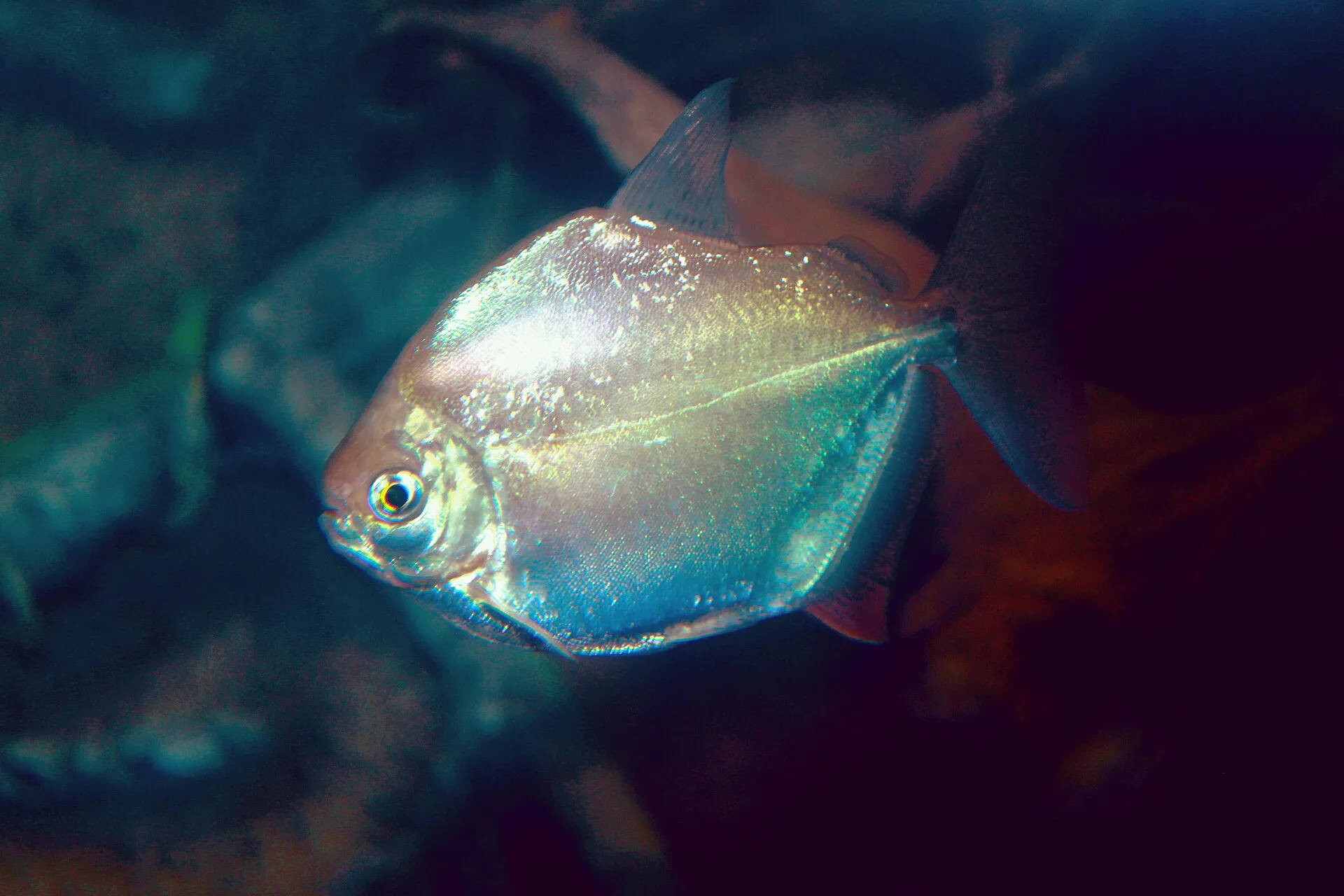
Silver dollars get sold as the polite cousins of piranhas, which is true in the same way that a cow is a polite cousin of a wolf: same neighbourhood of the family tree, different job. Metynnis argenteus belongs to the serrasalmids, the group that includes pacus and piranhas. It is a disc-shaped, silver, largely herbivorous schooling fish from Amazonian and Guianan waters, and it will convert a carefully planted tank into a salad bowl with a memory. If you love stem plants, this is not your centrepiece. If you love a shoal of living coins turning in open water, it might be, provided the tank is large enough for a fish that reaches 15 cm and wants company.
The common name covers more than one Metynnis in the trade. M. argenteus is the name on a lot of bags. The care does not change much across the lookalikes: big volume, a group, vegetable matter, and tank-mates that will not be swallowed and will not shred silver flanks for fun.
A coin with a bite for leaves
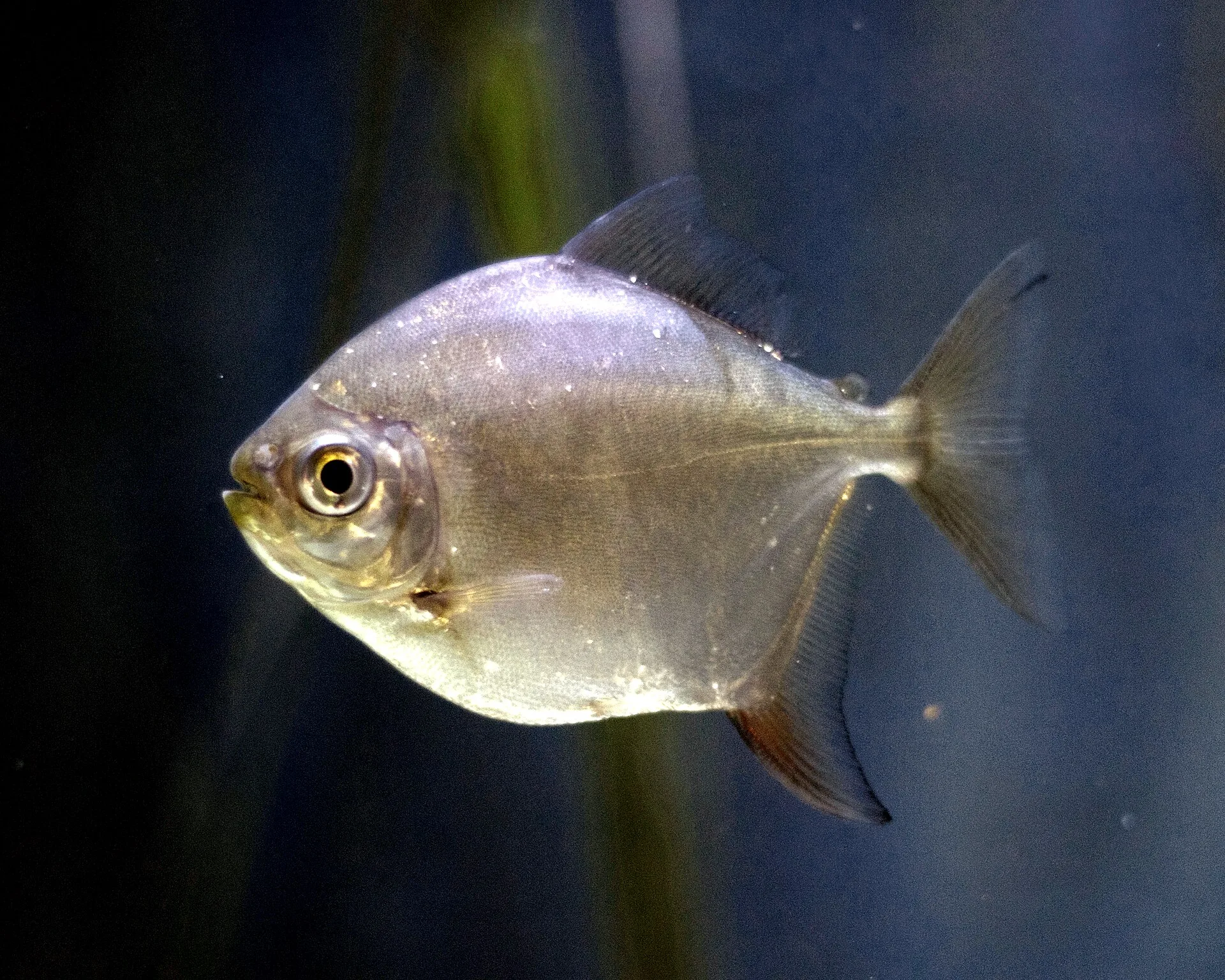
The body is strongly compressed, almost circular from the side, with a small head and a dark spot often visible above the pectoral region. Scales are reflective. Fins are usually clear to smoky. Sexing is annoying. Males may show a slightly more elongated dorsal or anal and a more intense colour around spawning, but many keepers guess wrong. Buy a group and let nature sort it.
Fifteen centimetres is a typical adult. That is a lot of sideways fish. They need height to look right and length to turn. A 200 litre tank is a starting conversation for a small group of six, not a trophy. More water is easier water.
Amazon open water, minus the garden you wanted
Temperature 24 to 28°C, pH 5.5 to 7.5, softness to moderate hardness. They tolerate a range if you avoid extremes and keep the water moving and clean. Décor: large driftwood, maybe some tough, bitter, or well-protected plants (Java fern and Anubias on wood sometimes survive, sometimes do not), and a lot of swimming room. Sand or smooth gravel. A lid, because a spooked school can launch. Filtration for messy herbivores who also take animal food — which is to say, oversized.
Lighting can be moderate. They do not need a planted-tank PAR chart if the plants are going to be eaten anyway. If you insist on plants, use pots you can snatch out, or choose species with tough leaves and accept losses as rent.
Feed salad on purpose, or they invent their own
The diet is the species. Blanched courgette, spinach, romaine, peas, spirulina flakes, herbivore pellets, and sinking wafers should appear daily. Frozen bloodworm and brine shrimp can be part of the rotation; they are omnivores with a plant bias, not cows. A silver dollar group fed only protein paste will still shred plants and may develop digestive issues. A group fed vegetables will still sample plants, but less desperately. Feed more than you think, then watch the water. Herbivorous schooling fish can be vacuum cleaners. Uneaten spinach becomes a nitrite project by morning.
Fruit is a debate. Some keepers offer banana or melon as a rare item. Sugar-heavy treats are not a staple. Vegetables are.

Schooling is how a silver disc feels safe
Six or more. Fewer than that and they stay nervous, darken, and hide behind the heater. They are generally peaceful with fish too big to eat and too calm to pick a fight. Good company: other large, peaceful characins, similarly sized gouramis, big peaceful catfish, and robust cyprinids in a huge tank. Bad company: anything small enough to look like a flake with fins, slow long-finned centrepieces in a cramped tank, and large aggressive cichlids. They are not community nano fish. They are not piranhas either; they will not strip a finger. They will, however, graze a slow, fancy goldfish in close quarters because the fins look like leaves. Do not test that.
They can be skittish. Sudden lights, looming shadows, and tapping on the glass send the school into the décor. Soften the room lighting before the tank lighting. Approach without performing a jump scare. A dented silver dollar is a fish that hit the wood at speed.
Spawning a coin
They are egg scatterers. Pairs or groups in huge, well-fed tanks sometimes spawn at dawn, scattering eggs that the adults will eat. Serious breeders use a separate tank, a grate, and a lot of water changes. Fry are small and numerous. This is not a first breeding project. Most owners will never see a successful spawn and will still have a valid aquarium. If you do spawn them, you will need a plan for a second school of 15 cm herbivores. That plan is rarely “the original 200 litres.”
Injuries, holes, and the cost of panic
Hole-in-the-head shows up in large characins kept dirty, mineral-poor, or on a miserable diet. Clean water, varied food including vegetables, and stable chemistry are the boring prevention. Fin nicks from décor happen when the school spooks. Round off plastic plants or skip them. Quarantine new fish; silver dollars in shops are often crowded and can bring ich, which looks extra ugly on a silver disc.
Watch the leading fish. If the whole school darkens and clumps in a corner, the problem is environmental. If one fish darkens and is chased off food, you may have a weak or sick individual that needs a hospital tub — a large one.
The honest aquascape for a leaf-eater
Wood, rock that cannot topple, maybe a single giant Anubias you are willing to sacrifice, and a school of silver discs in 24 to 28°C Amazon-adjacent water. That is a Metynnis argenteus tank. A Dutch garden with a silver dollar “for movement” is a Dutch garden with a deadline. Pick which hobby you are in. If you pick this fish, commit to the vegetables, the group, and the volume. The payoff is a midwater flash that looks like money and behaves like a river, minus the piranha folklore that got you to look at the bag in the first place.
They can live eight to ten years in good care. That is a long time to buy courgettes. It is also a long time to enjoy a school that only looks ordinary until it turns as one and the whole tank becomes a handful of coins catching the light. That turn is the species. Everything else is logistics for a serrasalmid that chose salad.
Explore other topics
Dive into more aquarium guides across the site.