

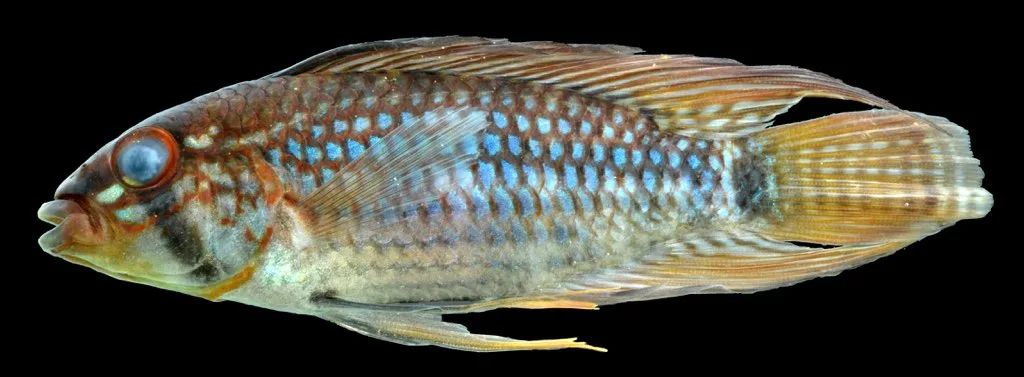
Steindachner’s apisto is the one you reach for when other apistos felt too fragile and too small. Apistogramma steindachneri comes from the Guianas, grows 7–9 cm (males especially can look like a “real” cichlid in a nano tank), and often tolerates a broader pH band than a wild Peruvian blackwater specialist. It is still an apisto: sand, caves, leaf litter, a male’s territory, females on nests. It is not a get-out-of-soft-water-free card. It is not a jewel cichlid. It is not a cylindricus that happens to be South American.
The extra size is why the tank steps up toward 90 litres and why tankmates need to be chosen as if the male had a proper mouth — because he does.
Guianan waters, not a single peat recipe
Native to the Guianas, in habitats that run from quite soft to moderately soft, with sand, wood, and cavities. They are used to a little more variation than a fish from a sealed blackwater tributary, which is why hobby lore calls them hardy. Hardy is relative. They still dislike liquid limestone, rift salts, and a barren gravel box. They still use leaf litter if you offer it; they will also use a ceramic cave on sand under a piece of wood.
This is closer to a general South American dwarf layout than to a Dicrossus-only tea tank, and it is still the opposite of Tanganyika.
A longer face, a bigger male
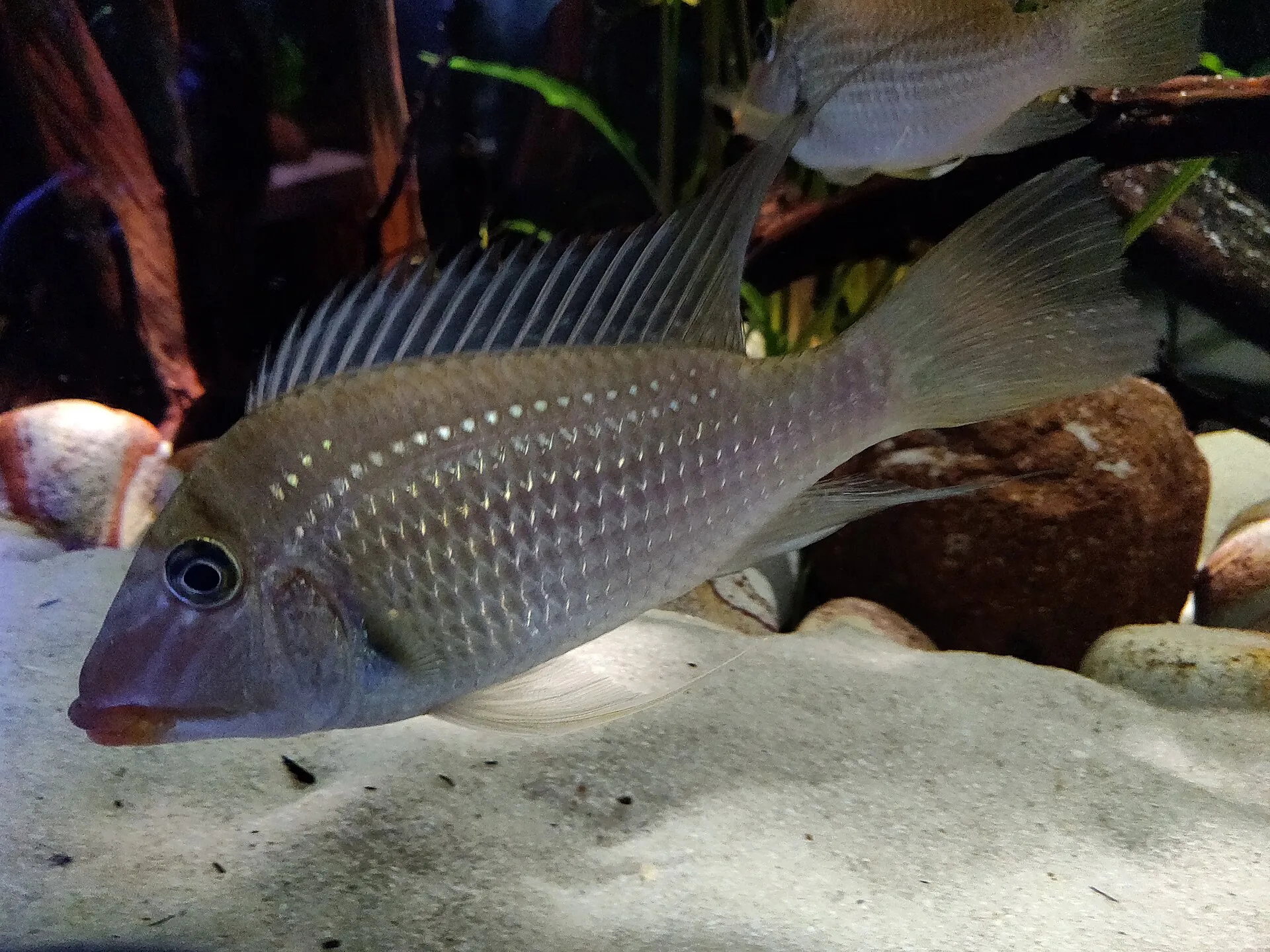
Males can be strikingly marked, with lyretail tendencies in some individuals, metallic spangling, and a presence that surprises people who only kept 5 cm apistos. Females are smaller, brood-coloured, cave-faithful. Seven to nine centimetres is not Uaru size, but it is large enough to eat fish that a nijsseni might only harass. Do not stock 2 cm rasboras as dithers unless you like watching them vanish.
Compared with viejita, the story is less about red/yellow commercial lines and more about a robust Guianan species that has been in the hobby a long time. Compared with agassizii, steindachneri is often stockier and more territorial for the length.
Ninety litres, because the male patrols farther
Give the male 90 litres or more to patrol. Fine sand, several caves, wood, botanicals, plants if you like (they may dig at cave mouths). Gentle to moderate filter. Sight-breaks matter more than in a 5 cm species because the male can see farther and hit harder. This is not a 150 litre compressiceps knife tank. This is not an 80 litre ocellatus shell prairie. It is a South American dwarf territory map drawn at a larger scale.
A 40 litre “apisto cube” that worked for a single pair of borellii may fail here.
Soft to moderately soft, still not alkaline
Temperature 24–28°C. pH 5.5–7.5. Many captive fish live at the upper end; colour and breeding still prefer the softer half. Hard alkaline water is for moorii, not for steindachneri. Cycle the tank; a 9 cm male plus females is a real load in 90 litres. Chemistry, cycling.
They may survive a community that would fade a nijsseni. Surviving is not the same as looking like the photo. If you can keep true blackwater, they will often look better there too.
A bigger mouth, a bigger grocery list

Frozen bloodworm (in moderation), brine, mysis, quality pellets, live foods. They will take larger items than a 2 cm rasbora can imagine. They will still ignore a Uaru’s vegetable diet as a staple. Feed so cave-holding females get a share. A fat male is a pretty male and also a more dangerous neighbour.
Tankmates that will not fit in the mouth
Dithers should be too big to swallow and too peaceful to shred: larger tetras that like similar water, maybe a group of Corydoras on sand, perhaps a peaceful catfish that stays out of caves. Risky: tiny Boraras, shrimp, other apisto males. Wrong: Tanganyika fish, large eartheaters that will plough the caves, Uaru that need a different scale of tank and warmer water, African butterflies only if the tank is huge and you like mixed-continent politics (usually you should not).
They can coexist with some other Guianan fishes. They cannot coexist with a Julie.
The same cave story, louder
Cave spawner, female-tended fry, male on the border. Because the male is larger, border wars are uglier. Extra caves, extra wood, extra litres. Not a mouthbrooder. Not a shell specialist. If you want a South American that mouthbroods on sand, look at Satanoperca, which is a completely different size class.
Torn subordinates and community myths
The myth is “hardy apisto = community fish.” The reality is a 9 cm cichlid with a cave. Quarantine in soft to moderate water with a cave. Watch for ich on imports. Watch for a male that never lets females eat. Thin females are a stocking problem, not a food-brand problem.
Read A. agassizii and cacatuoides for other common apistos, and viejita if you wanted colour-line Colombian dwarfs. For a West African dwarf of similar size with different spawning, see the African butterfly cichlid in this set — different continent, different pair bond, still not Tanganyika.
Using the extra centimetres honestly
People buy steindachneri for “hardiness,” then stock them with ember tetras. The extra centimetres are a mouth. Dithers should start at a size that does not fit. That may mean no dithers, or it may mean larger characins in a bigger box. The hardy reputation also makes people skip quarantine. A 9 cm import can still bring ich into a tank of fish that were truly hardy until then. Quarantine in a 40 litre with a cave, a sponge, and the same water you intend to keep, not in a bucket of salt.
Because males patrol farther, a long 90 litres beats a tall 90 litres. Put caves at both ends. If both females choose the same end, add a piece of wood that blocks the view. Sight-lines are the cheap upgrade before a bigger tank.
Guianan hardy does not mean gravel and a castle
The castle ornament with one hole is a death trap for a 9 cm male who will fight a 7 cm male for it. Provide several openings. Provide sand for the barbels of any Corydoras you added, and because apistos still forage on sand. Gravel-only tanks scrape them and hold waste in a way a sifter would at least stir. Steindachneri is hardy in water; it is not hardy in ugly husbandry. Use the reputation to keep it alive through a beginner’s first year, then still give it a proper dwarf-cichlid room.
Explore other topics
Dive into more aquarium guides across the site.