

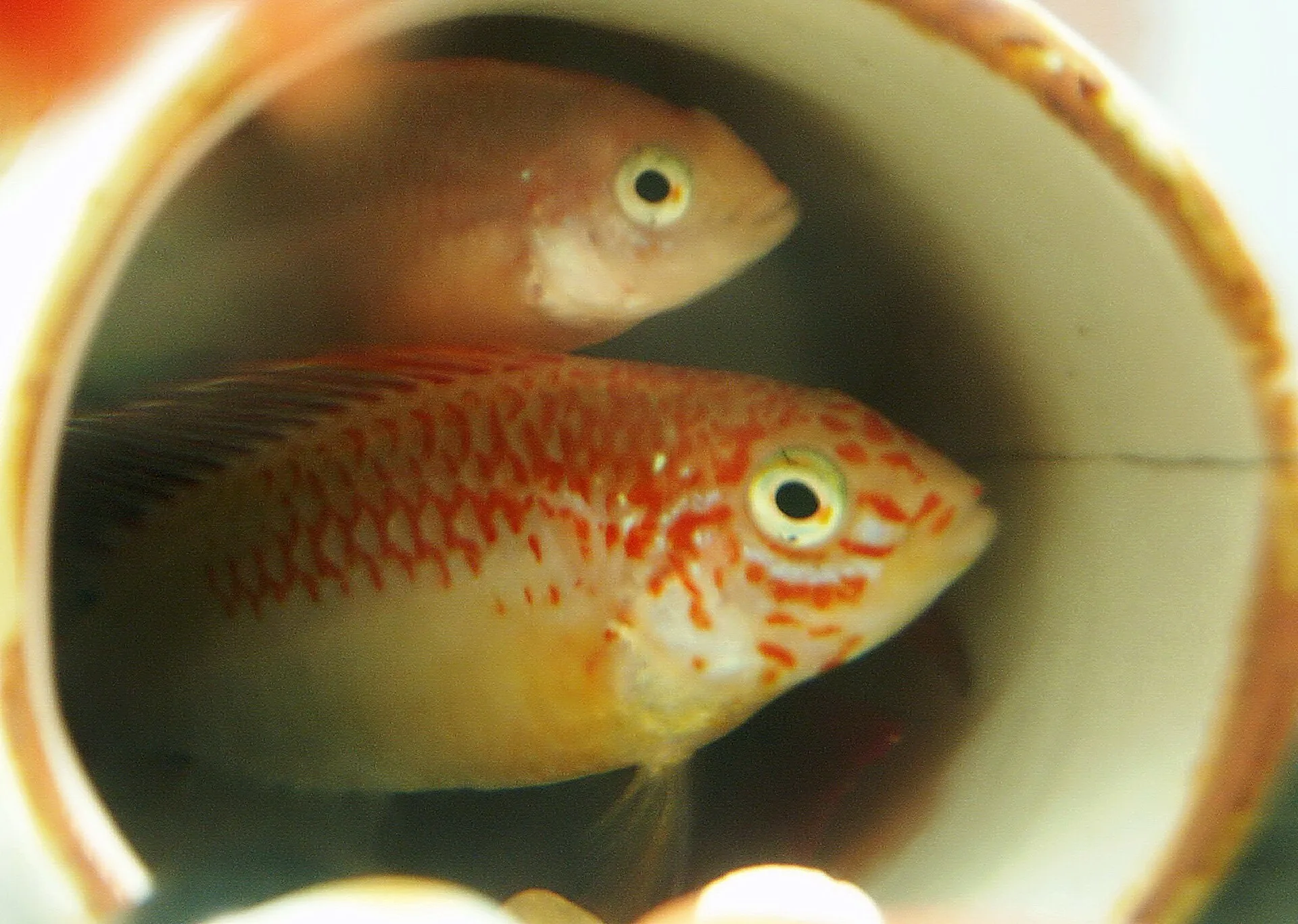
Viejita is the apisto that shows up in shop lists as red viejita, yellow viejita, or a string of codes that mean a collector’s locality. Under the paint, Apistogramma viejita is a Colombian stream dwarf, 5–6 cm, that holds caves in soft water with a leaf-litter floor. The red and yellow forms are still apistos. They still need botanicals. They still organise as a male with females in caves. They are not a West African jewel, not an African butterfly cichlid, and not a rift-lake rock fish that happens to be small.
If you chase the reddest male and ignore the water, you will own a beige fish with a Latin name on the receipt.
Colombian soft streams, not Peruvian panda water copied blindly
Native to Colombia, in soft streams with structure — roots, litter, modest flow, warm temperatures. pH is typically acidic to low-neutral. The habitat overlaps the general apisto story (leaves, caves, sand) but the drainage is not the Peruvian panduro/nijsseni blackwater in every detail. Captive lines may tolerate a slightly wider pH than wild-caught fish; they still look cheap in hard alkaline water. Do not add Tanganyika buffer “to help cichlids.”
Colombia also produces other dwarfs and tetras; that does not make a mixed “South American” tank automatic. Viejita still needs the cave and the litter.
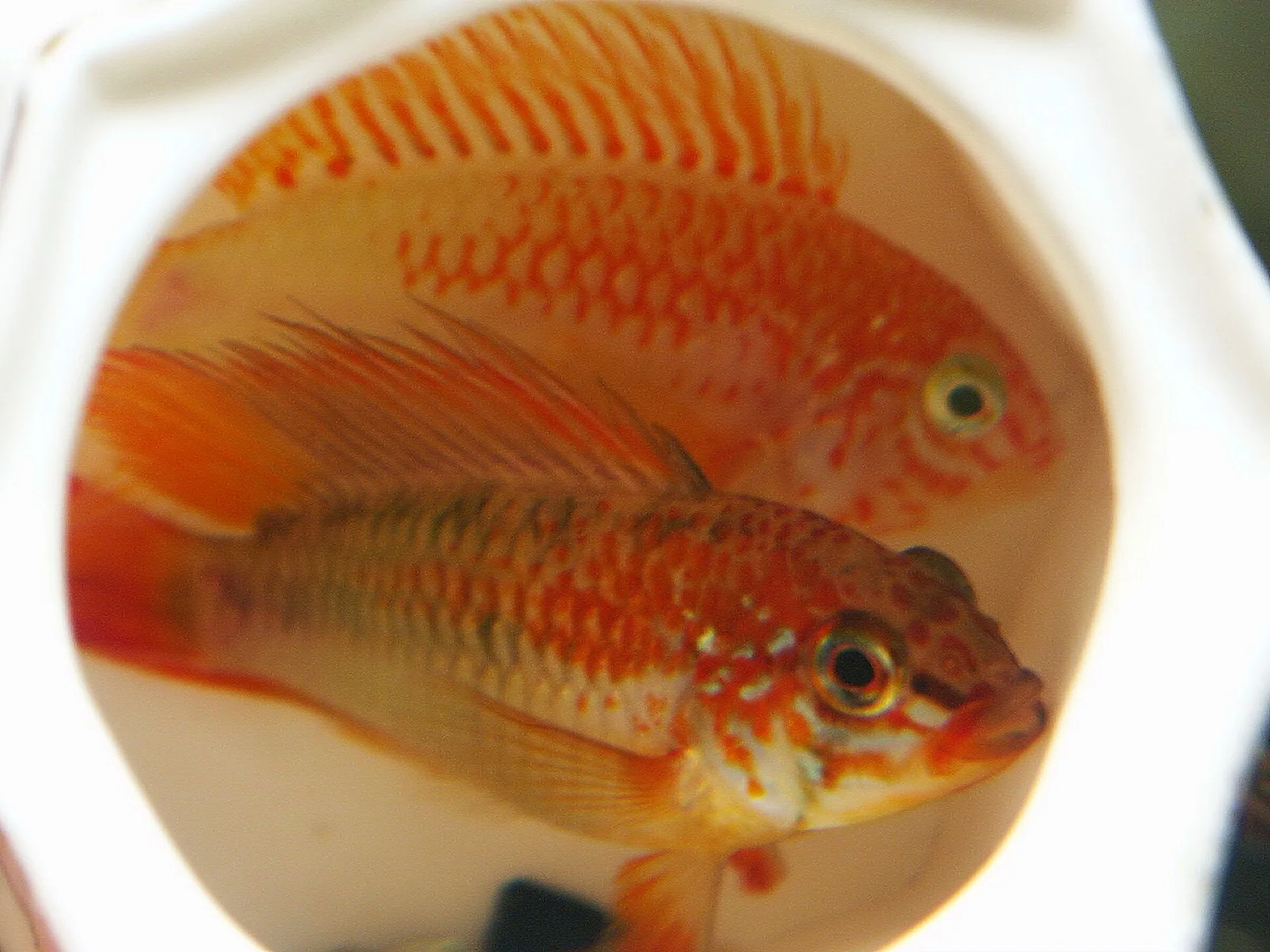
Red and yellow are marketing; the body is still a dwarf cichlid
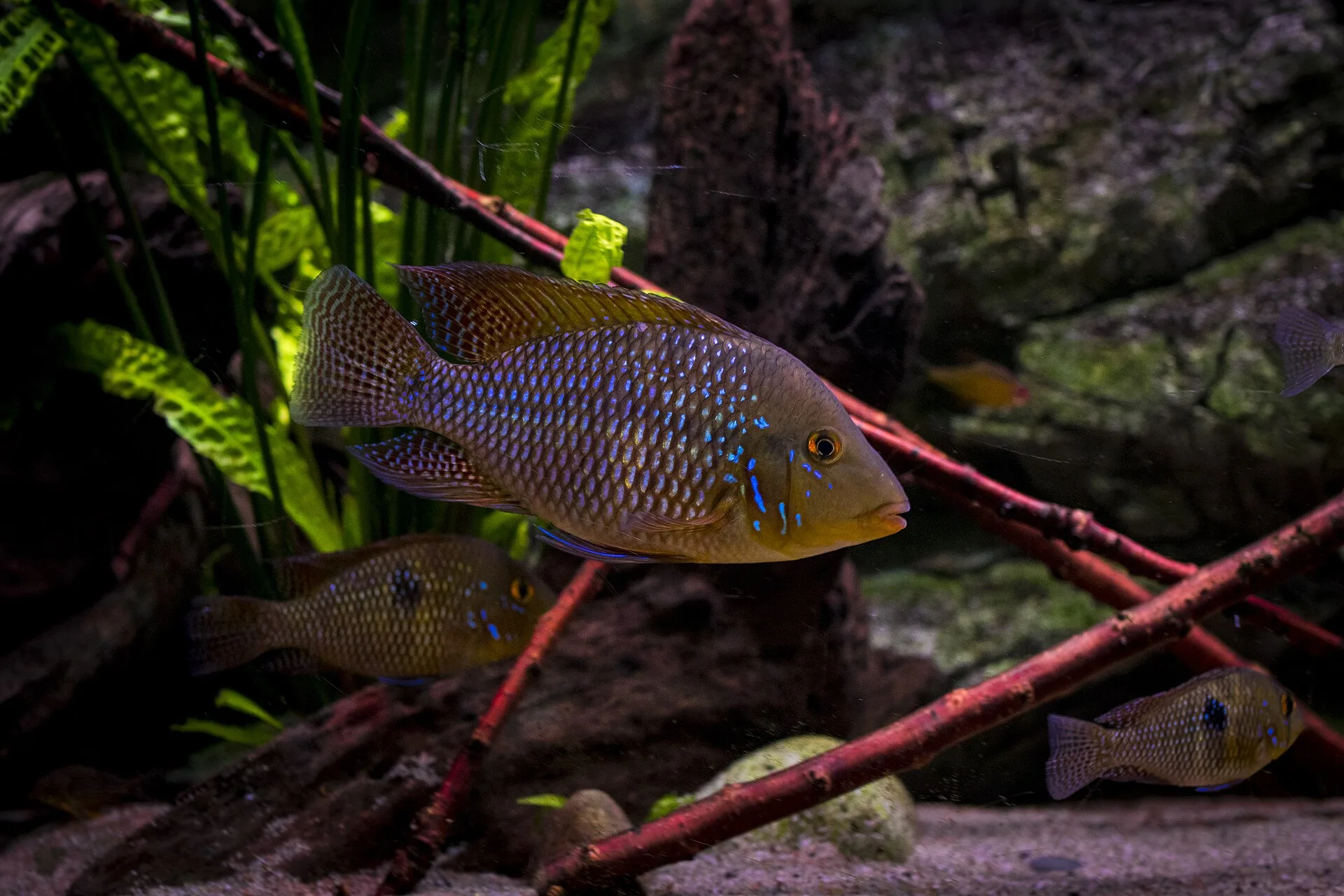
Males: extended fins, warm colours that can run from gold through orange-red depending on line, with typical apisto flank markings. Females: smaller, yellow-orange in brood care, a dark spot or blotch when holding territory. They do not wear a nijsseni panda cloak. They do not wear Julie bars. They do not get a nuchal hump like a Uaru. Shop photos are taken in blackwater with good food. Believe those photos only if you can copy the water.
Line names change faster than biology. If a seller cannot tell you it is A. viejita versus a macmasteri-type, you may be buying a similar-looking macmasteri complex fish. Care will still be leaf-litter dwarf care, but your breeding project will be a mess.
Seventy litres, colour only after the scape works
A harem wants 70 litres. Fine sand, leaves, caves with separate sight-lines, wood, dim light, gentle filter. Plant if you want — they are less destructive than a Geophagus — but plants are a bonus on top of caves, not a replacement. This is not a 400 litre Uaru tank and not a 30 litre Boraras swamp, though the pH may resemble the swamp more than the Uaru vat.
Red forms photograph well against dark litter. That is a hint, not an Instagram filter you apply with LEDs alone.
Soft to moderately soft, not “community 7.4”
Temperature 24–28°C. pH 5.0–7.0, with better colour toward the softer side. Many Colombian apistos are slightly more adaptable than the most extreme blackwater Peruvians, which is why viejita shows up in slightly less fanatical tanks — slightly. Hard well water with high KH is still a bad idea. Cycle; they are small and territorial, not ammonia-proof. Chemistry, cycling.
Do not mix with Anomalochromis in the same small tank just because both are “dwarf cichlids from somewhere.” One is South American, one is West African; water can overlap, temperament and language do not always.
Colour food is still invertebrate food

Frozen and live foods drive red and yellow. Pellets fill gaps. They are not herbivorous African butterflies in diet, and they are not eartheaters. Feed the sand and the cave mouths. Overfeeding in a leaf tank fouls fast; underfeeding fades the male you bought for colour.
Harem rules, Colombian edition
One male, two or more females, extra caves, dithers that like soft water. Dithers: small characins, pencilfish. Not: shell-dwellers, Julies, large geophagines, Uaru, greater scissortails. Corydoras on sand can work in a bigger tank with overlapping chemistry. Shrimp are fry food.
Two males in 70 litres is a torn-fin subscription.
Caves, not shells, not rock slits
Female lays in a cave. She guards. Male patrols. Same apisto reproductive essay as panduro, different flag colours. Colombian streams, leaf litter, ceramic coconut. Not a Tanganyika slit. Not a mouthbrooder. If you want a West African dwarf that pair-bonds more like a butterfly cichlid, that is a different article in this batch.
Beige males and fungus on eggs
Beige males: water and diet. Fungused eggs: water swings, inexperienced female, male too rough. Quarantine in soft water with a cave. Do not medicate with copper if you have shrimp. Do not “salt the tank” like a livebearer cure-all.
Nearby dwarfs: A. macmasteri (often confused), cacatuoides, panduro. For a larger, more adaptable Guianan apisto, A. steindachneri. Still not a Julie.
Red lines, yellow lines, and the price of a code
Collectors pay for locality codes. Pet shops pay for “red viejita.” Genetically mixing two coded lines because both are pretty is how unique populations disappear in the hobby. If you are breeding, keep one line. If you are just keeping, still ask what you bought. Colour food will not turn a yellow line into a red line. Soft water and live food will make whichever line you have look like itself.
Colombian stream, Canadian tap
A lot of viejita in the trade are tank-bred. They may spawn at pH 6.8 when a wild fish would not. Use that slack if you must, then still offer leaves and caves, because behaviour is not only pH. A viejita in a barren hard-water community is a beige bully in a corner. A viejita in a modestly soft planted tank with three caves is the fish on the label. Meet it halfway if you cannot meet Peru-level blackwater; do not meet it with Malawi salt because a staff member said cichlid.
When the red male is also a bad roommate
Colour and tyranny travel together. A stunning red viejita male in 70 litres with one female is a widow-maker. Two females, three caves, wood in the sight-line, and a dither school that actually uses the top half — that is the minimum social furniture. If he still pins a female, you need more litres, not more colour food. Rehome the extra male you were sold as a “pair” when both had pointed fins.
Explore other topics
Dive into more aquarium guides across the site.