

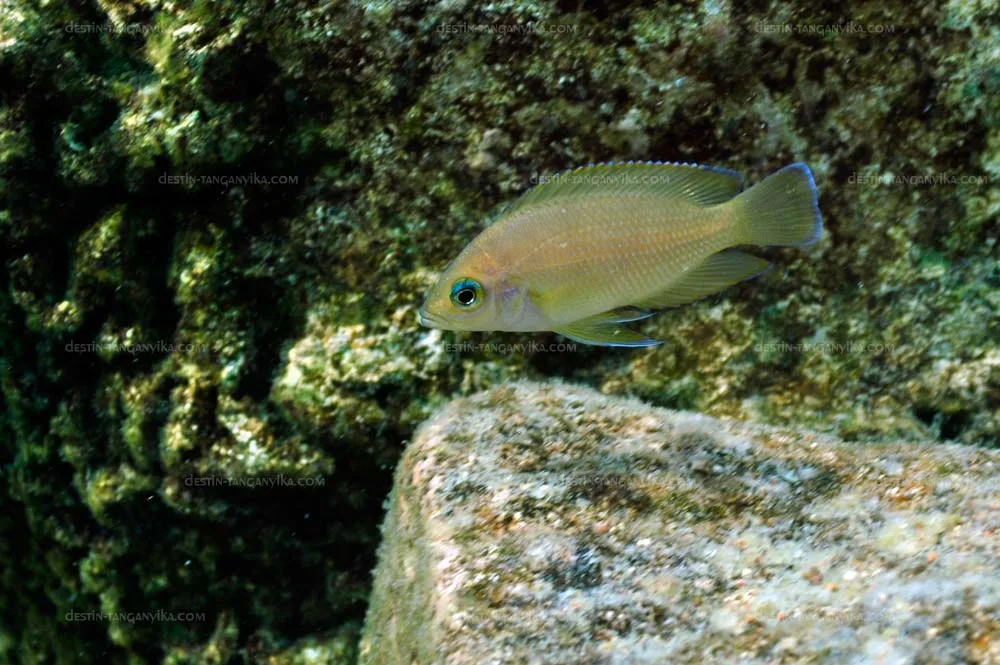
People remember Variabilichromis moorii as the yellow Tanganyika cichlid that grows into a dark fish. Juveniles are a bright, almost sunny yellow. Adults, especially territorial ones, turn a deep brown-black with a blue eye-ring that looks like a different species. That metamorphosis is the point of the fish. It is not a colour morph of a Julie. It is not a Malawi yellow lab. It is a rocky-shallow Tanganyika cichlid about 9–11 cm long that holds a patch of rock, grazes aufwuchs, and will wreck tankmates that enter the patch.
The genus name is a warning: variable. Mood, age, and status rewrite the paint. If you buy six yellow juveniles for a “pretty school,” you will own one dark tyrant and a story about the others.
Rocky shallows, sun on stone, algae on stone
Native to Lake Tanganyika’s rocky shallows. The habitat is well-lit compared with a deep-wall Paracyprichromis site. Algae and biofilm on rock are part of the diet. Water is hard, alkaline, mineral-rich, 24–27°C. They are territorial substrate spawners on rock, not pelagic mouthbrooders, not shell-dwellers. The shallows part matters: they are used to a bit of light and a lot of rock surface, not a dim peat tank and not a sand desert of shells.
Malawi yellow labs (Labidochromis caeruleus) occupy a different lake, different politics, different mineral mix details. Do not mix “yellow African cichlids” as a category.
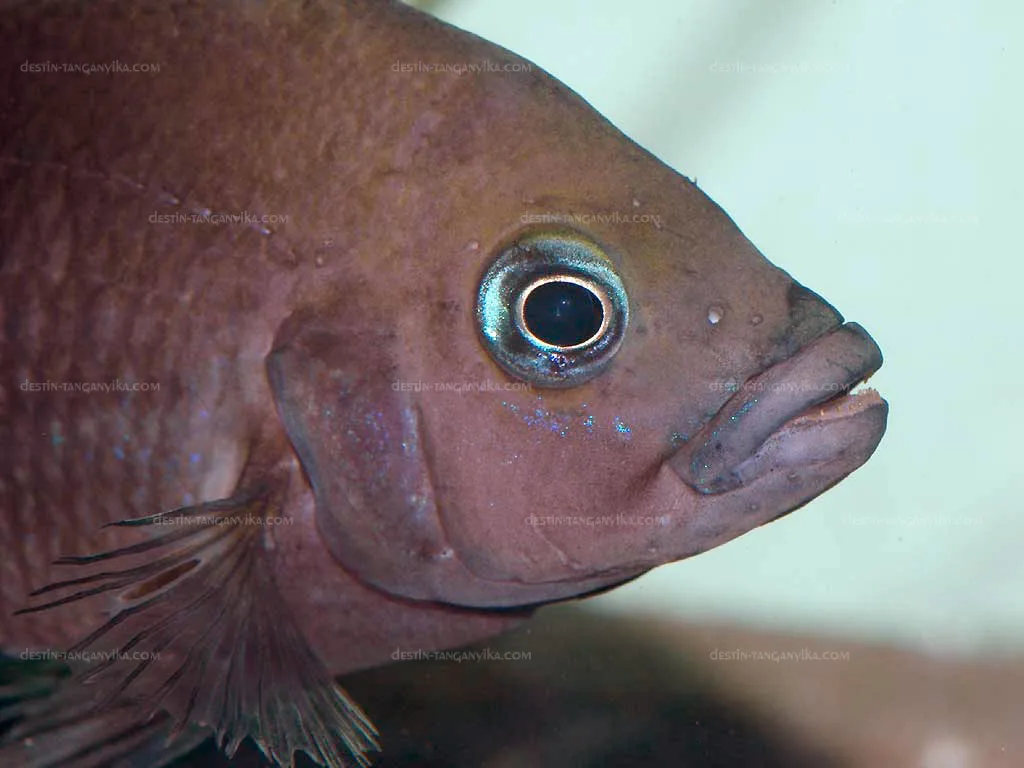
Yellow first, then the dark adult
Juveniles: yellow, almost cheerful. Subadults: muddy transitions. Adults: dark body, striking eye, a look that photographs as “moorii” rather than “lemon cichlid.” Neolamprologus leleupi stays yellow as an adult and is a different animal (more of a hunter in rock). Moorii’s yellow is a life stage. If your adult is still pale yellow and washed out, it may be stressed, poorly fed, or not actually moorii.
Body is deeper than a Julie, not compressed like Altolamprologus, not a tube like cylindricus. Fins can show blue edges on a good fish. Sexing is easier when a pair holds a rock and spawns than from a bag of mixed juveniles.
One hundred fifty litres of rock real estate
Territory starts around 150 litres or more. They need a territory measured in rock surface, not in “a cave decoration.” Multiple piles with gaps reduce murder if you try more than a pair — and you should be cautious about more than a pair. Fine sand between rocks. Strong filtration. Lighting can be brighter than a Julie tank because aufwuchs growth is useful; you are not growing a Dutch plant scape, you are growing a grazing surface in alkaline water.
Do not give them a shell lawn as the only structure. They may use a cave, but they are not ocellatus. Do not give them a planted Amazon. Plants will be grazed, uprooted, or chemically unhappy.
Alkaline water, and a diet that includes the wall
Temperature 24–27°C. pH 7.8–9.0. High hardness. Same lake chemistry family as other Tanganyika rock fish, different job. Cycle thoroughly; adults are messy. Match KH on water changes. Chemistry, cycling.

Soft water is a health problem. Malawi salt mix is the wrong lake. Amazon blackwater is a different essay.
Aufwuchs plus meat, not lettuce-only and not pellets-only
They graze rock. Offer spirulina-based foods, blanched greens occasionally, and still include protein: frozen invertebrates, quality cichlid pellets. A moorii kept like a pure herbivore mbuna can look wrong; a moorii kept like a pure predator compressiceps misses the grazing. Scrapeable rock and a bit of light help. They will still eat small fish. They are not a cleanup crew for a tetra tank that should not be in this water anyway.
Feed along the rock. Watch the dark adult get first pick. Subordinates starve politely in the corner if you only toss food once a day in one spot.
Politics: a patch of stone is a country
A pair in a spacious rock tank is the standard. Tankmates in a large lake-style aquarium must stay off that patch: open-water cyprichromines high in the water column, perhaps distant species. Julies, fairy cichlids, cylindricus, and compressiceps all want rock. That is a conflict map, not a community list. Shell-dwellers on the open sand in a huge tank might work if the moorii stay on the rock — might. South American fish will not work. Rasboras will not work. Corydoras will not work.
Do not use yellow juveniles as dithers for a more aggressive cichlid. They grow into the problem.
Eggs on the rock you lit for algae
Substrate spawners. Pair defends a site on rock. Fry are guarded. This is not mouthbrooding. This is not a shell clutch. If you never see fry, the pair may be eating them, or tankmates may be, or the spawn site is in a gap you cannot inspect. Yellow young in the tank are a success and also a future territorial crisis. Have a plan to rehome.
When the yellow never darkens, or the dark fish hangs
Chronic yellow in a large fish can mean poor diet, poor water, or misidentification. A dark fish gasping at the surface is water and oxygen. Hole-in-the-head and related issues track nutrition and dissolved organics — keep the tank clean, vary the diet, do not treat with folklore. Quarantine new fish in alkaline water with rock; they should graze and take food, not pace a bare box.
If you wanted adult yellow, look at N. leleupi. If you wanted a milder rock pair, a Julie is smaller and differently shaped. If you wanted shells, go back to ocellatus. Moorii is the colour-change grazer of the shallows, and the dark adult is the fish you actually have to house.
Lighting for algae without cooking the fish
Moorii wants aufwuchs, which wants light, which grows algae on the glass you did not want. That is the deal. Scrape the viewing pane; leave the back rock. If you run high light and high phosphate in alkaline water, you will get a mess, not a grazing lawn. Moderate light, a few hours extra on the rock zone if you can aim it, and green foods in the diet if the wall is slow to grow — that is the practical mix. Do not dose planted-tank fertilisers as if this were a hydrocotyle scape. You will fuel the wrong growth and still have a territorial cichlid.
Explore other topics
Dive into more aquarium guides across the site.