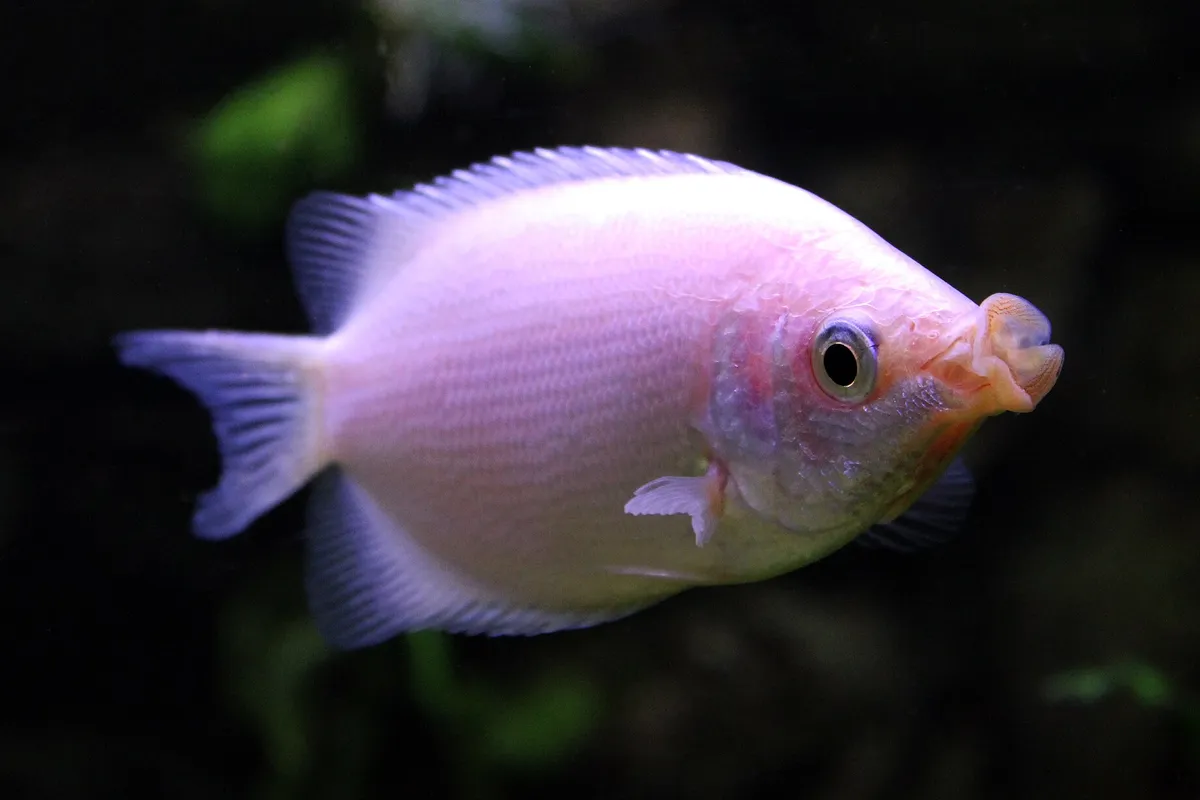
The kissing gourami gets its name from the way two fish press their thick lips together. It looks affectionate, but it is actually a contest between rivals. Helostoma temminckii is a hardy, long-lived fish, and one of the easiest large gouramis to keep, as long as you know how big it grows.
Most kissing gouramis are sold at 3–5 cm. Adults reach 20 cm in a good aquarium and up to 30 cm in the wild, so this is a fish for a large community tank, not a nano.
Where kissing gouramis come from
The species comes from Southeast Asia: Thailand, Cambodia, Malaysia and the islands of Sumatra, Borneo and Java. It lives in slow, heavily vegetated rivers, swamps and lakes, and is also farmed as a food fish. It is the only member of its family, Helostomatidae.
Appearance and behaviour
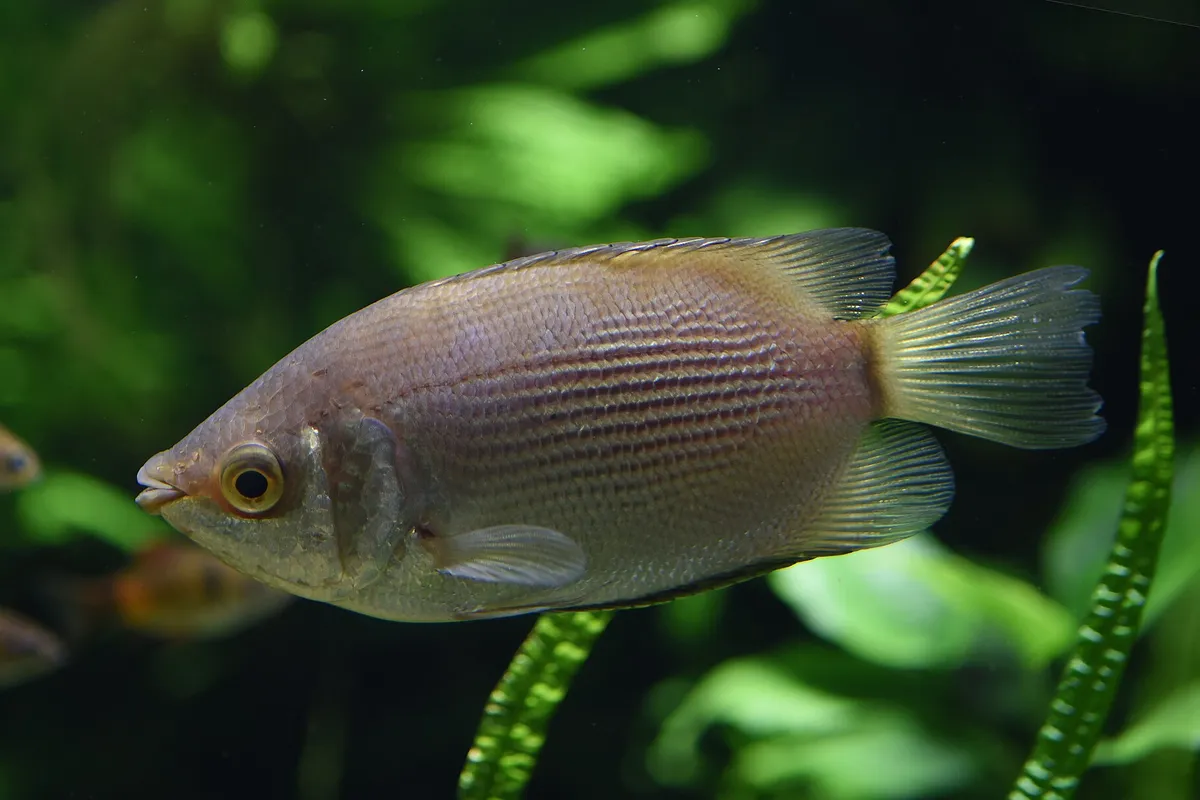
There are two forms. The pink form, the one most stores sell, is a domestic colour variety. The wild form is silvery green with faint dark stripes along the body. Both have the same tall, oval body and the famous lips, which are lined with fine teeth for scraping algae and biofilm.
Kissing gouramis are mostly peaceful, but they are not shy. Males lock lips and push each other to settle rank, and larger fish can harass smaller tank mates. Like all labyrinth fish, they gulp air from the surface, so they need access to it.
Tank setup
A single adult needs at least 200 litres, and a group of three or more needs 300 litres or more. Give them open swimming space in the middle, with plants and driftwood at the back and sides. Expect them to graze soft plants, so use tough species such as anubias, Java fern and bolbitis. A tight lid keeps humid air above the water and stops jumping.
Water parameters

Kissing gouramis handle a wide range of water. Aim for 22–28°C, pH 6.5–7.8 and soft to moderately hard water. They are big eaters, so change 25–30% of the water weekly and keep an eye on nitrate. See our guide to controlling nitrates long term.
Feeding
In the wild they filter plankton and scrape algae, so their diet should lean towards plants. Feed a good spirulina flake or small pellet as the base, with blanched lettuce, spinach, cucumber and peas, and algae wafers or sheets. Add frozen daphnia, brine shrimp or bloodworms two or three times a week.
Tank mates
Choose robust fish of similar size: larger barbs, rainbowfish, silver dollars, plecos, loaches and peaceful medium cichlids such as severums. Avoid small tetras, which may be pushed around, and slow, long-finned fish. If you keep more than one kissing gourami, keep three or more so the lip-locking is spread out.
Breeding
Unlike most gouramis, kissing gouramis do not build bubble nests or guard their eggs. Pairs spawn under floating plants, releasing hundreds to thousands of floating eggs. The adults should be removed afterwards. The fry hatch in about a day and need infusoria at first, then baby brine shrimp. Females are slightly rounder, but the sexes are very hard to tell apart.
Common problems and lifespan
The most common problem is a tank that is too small, which leads to stress and stunting. Fights between males can split lips and fins, so watch for injuries. Kissing gouramis are hardy and rarely sick in clean water, but quarantine new fish as usual using our quarantine protocol.
With good care, kissing gouramis live 15 years or more, sometimes up to 25.
Explore other topics
Dive into more aquarium guides across the site.