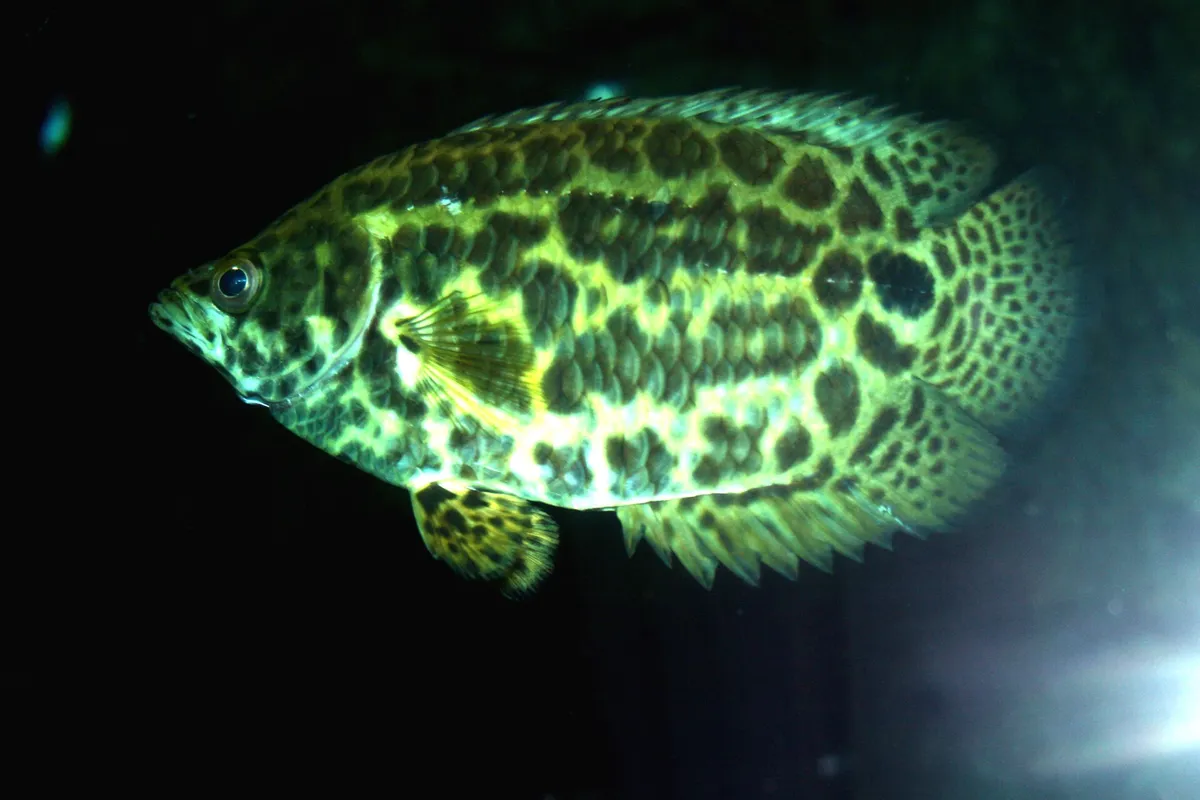
The leopard bushfish, also called the spotted ctenopoma or leopard ctenopoma, is a hunter that relies on patience. Ctenopoma acutirostre drifts slowly among roots and plants, angled like a dead leaf, until a small fish swims too close. Then it opens its large mouth and the fish is gone.
It is a calm, long-lived fish that adds real character to a quiet, planted tank. It grows to about 15 cm and is peaceful with anything it cannot swallow.
Where leopard bushfish come from
The species comes from the central Congo River basin in the Democratic Republic of the Congo. It lives in slow, shaded water among roots, fallen branches and overhanging plants. Like gouramis, it is a labyrinth fish and can breathe air from the surface.
Appearance and behaviour
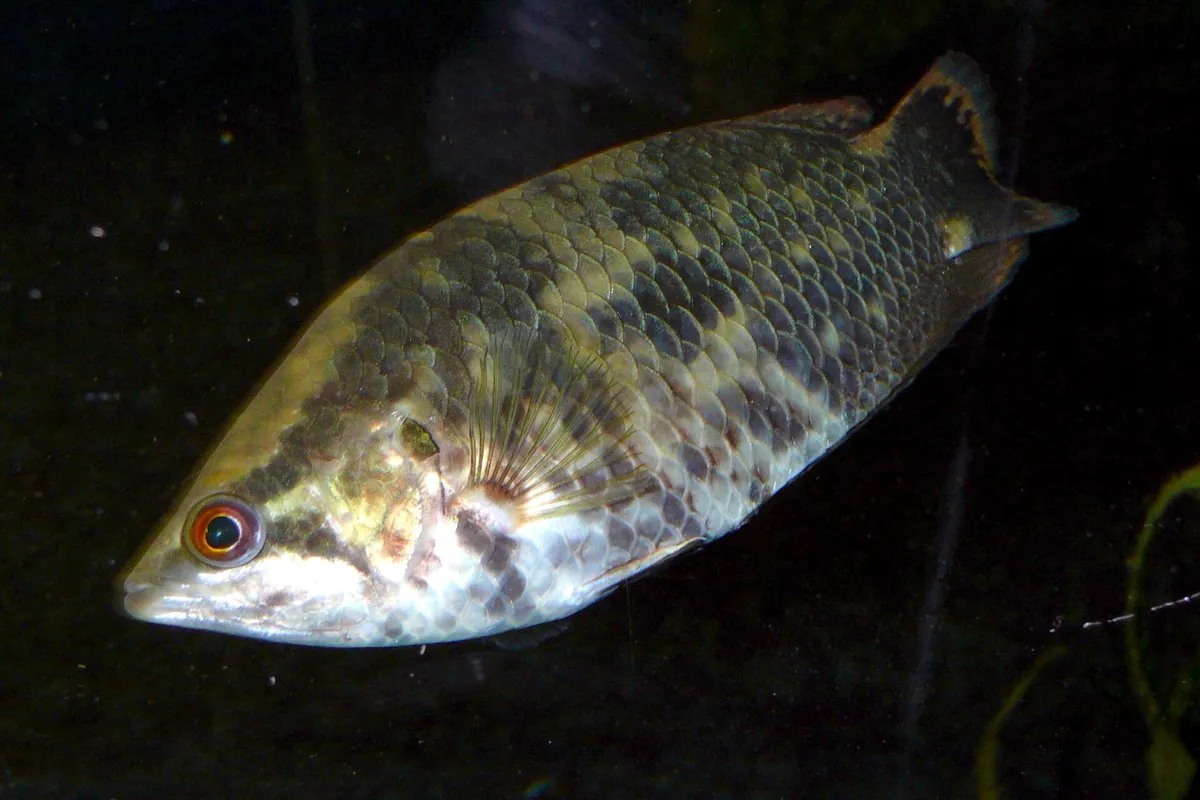
The body is tall, oval and flattened, with a pointed snout. It is covered in dark brown spots on a tan, olive or golden base, and the tail often shows a dark eyespot. The colour can lighten or darken to match the surroundings.
Leopard bushfish are shy and mostly active at dawn and dusk. In bright, open tanks they hide all day. In a well-planted, dimly lit tank, they come out and patrol slowly.
Tank setup
One or two fish need at least 150 litres. Give them plenty of driftwood, roots, caves and dense planting, plus floating plants to dim the light. A blackwater setup with leaf litter suits them perfectly. Keep water flow gentle and the lid tight, and leave a gap of warm, humid air above the water so they can breathe at the surface.
Water parameters

Keep the temperature at 23–28°C, pH at 6.0–7.5, and water soft to moderately hard. Leopard bushfish are hardy, but they do best in stable, clean, slightly acidic water. Read our guide to soft water and blackwater chemistry.
Feeding
They are carnivores. Feed frozen bloodworms, brine shrimp, mysis, chopped shrimp and earthworms. Many take sinking carnivore pellets once settled, but some only accept frozen or live food. Feed in the evening, when they are most active. Avoid feeder fish, which spread disease.
Tank mates
Anything that fits in the mouth will be eaten, including neon tetras, small rasboras and shrimp. Good companions are calm, medium-sized fish: larger tetras such as Congo tetras, peaceful catfish, larger gouramis and peaceful West African cichlids. Avoid fast, boisterous fish that take all the food.
Breeding
Breeding in aquariums is rare. Reports describe males building loose bubble nests under floating plants, with eggs floating up into the nest. Most fish in the trade are wild caught or farmed.
Common problems and lifespan
Refusing food after import is the most common problem; offer live blackworms or bloodworms to get new fish eating. Bright lights and busy tank mates cause stress and hiding. Wild-caught fish should be quarantined for parasites.
With good care, leopard bushfish live 10–15 years.
Explore other topics
Dive into more aquarium guides across the site.