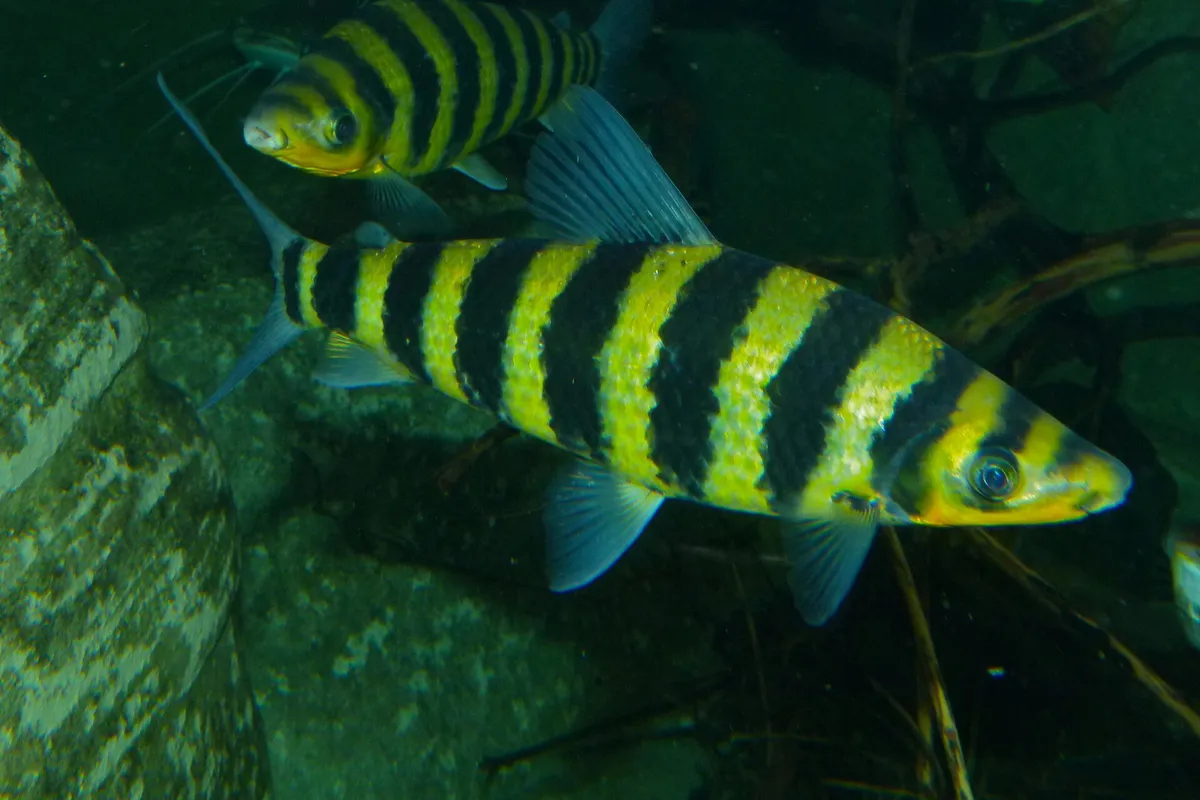
Few fish have such a striking pattern as the banded leporinus: ten black bars across a bright yellow body and a red-orange throat. Leporinus fasciatus looks great in a store tank at 5 cm, and it is a strong, healthy fish. It is also one that many keepers underestimate.
This species grows to around 30 cm, eats almost any plant, and can be aggressive with its own kind. In the right tank it is a long-lived, eye-catching centrepiece. This guide explains what the right tank looks like.
Where banded leporinus come from
Banded leporinus live in the Amazon and Orinoco basins and the rivers of the Guianas. They are found in fast, clear water around rocks and fallen trees, where they graze on plants, seeds and small animals. They belong to the family Anostomidae, the headstanders, and are cousins of the striped headstander.
Appearance and behaviour
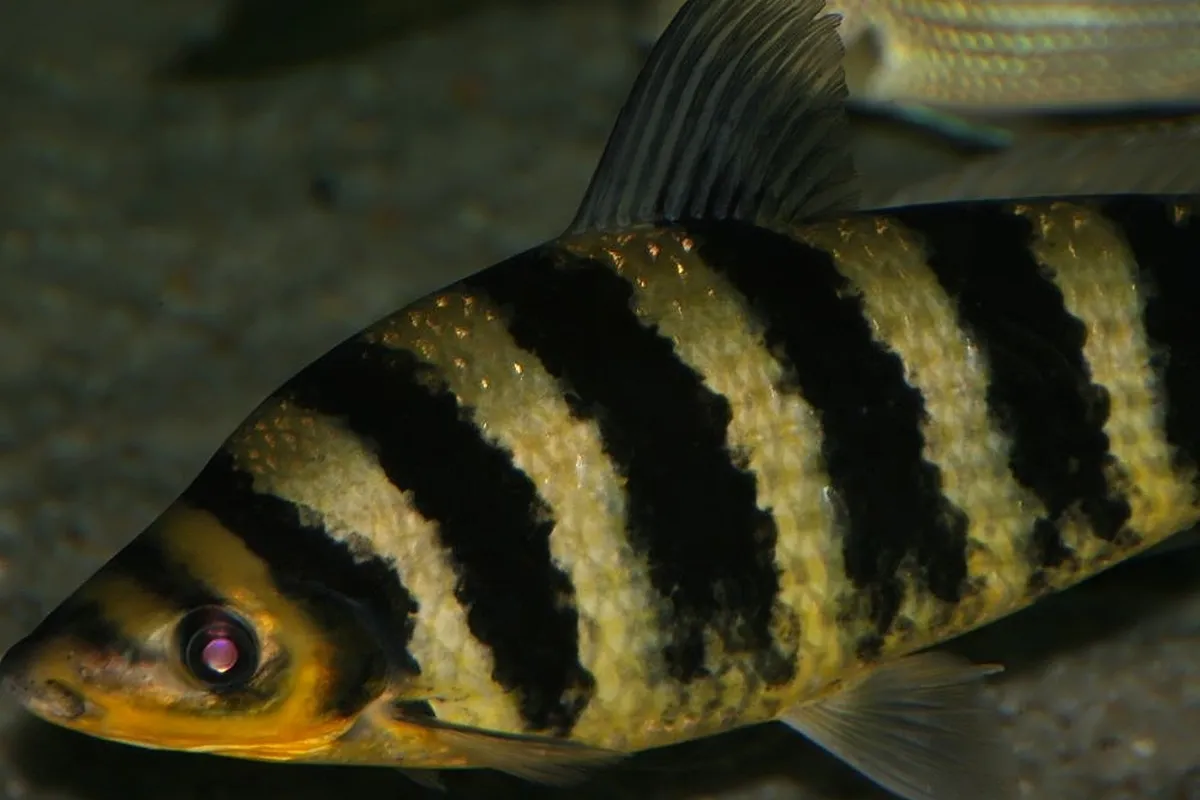
Juveniles have five broad black bands. As they grow, the bands split into ten narrower ones, and adults have a bright yellow body with a reddish throat. They swim at a slight head-down angle when feeding, like other headstanders.
They are active and powerful swimmers and very strong jumpers. They can be aggressive with each other, so keep either one fish or a group of five or more, so no single fish takes all the attention.
Tank setup
One adult needs at least 400 litres, and a group needs much more. Provide a long tank with lots of swimming room, strong water movement, rocks and driftwood. A heavy, tight lid is essential, as they will jump through any gap. Choose decor that cannot be dug up or knocked over.
Water parameters

Keep the temperature at 23–27°C and pH at 6.0–7.5, with soft to moderately hard water. Clean, well-oxygenated water matters most. Use a filter rated for a much larger tank and add a powerhead for flow. Our guide to aquarium oxygen levels explains the signs to watch for.
Feeding
Leporinus are omnivores with a strong taste for plants. Feed sinking spirulina pellets and flakes, blanched lettuce, spinach, zucchini and peas, plus frozen bloodworms, brine shrimp and krill a few times a week. Expect them to eat any soft live plants in the tank. If you want greenery, use hardy plants such as anubias and Java fern, or plastic plants.
Tank mates
Good companions are large, robust fish: silver dollars, larger barbs, plecos, Synodontis catfish and peaceful large cichlids such as severums. Avoid long-finned and slow fish, which may be nipped, and small fish, which may be eaten.
Breeding
Banded leporinus have not been bred reliably in home aquariums. Their size and the need for a large group make it very hard. Fish in the trade are wild caught or bred on commercial farms.
Common problems and lifespan
Jumping out of the tank is the main cause of loss. Fighting in a group that is too small comes next. Stress from a cramped tank leads to faded colour and disease. Read our guide on preventing fish from jumping.
With good care, banded leporinus can live 10–15 years or more.
Explore other topics
Dive into more aquarium guides across the site.