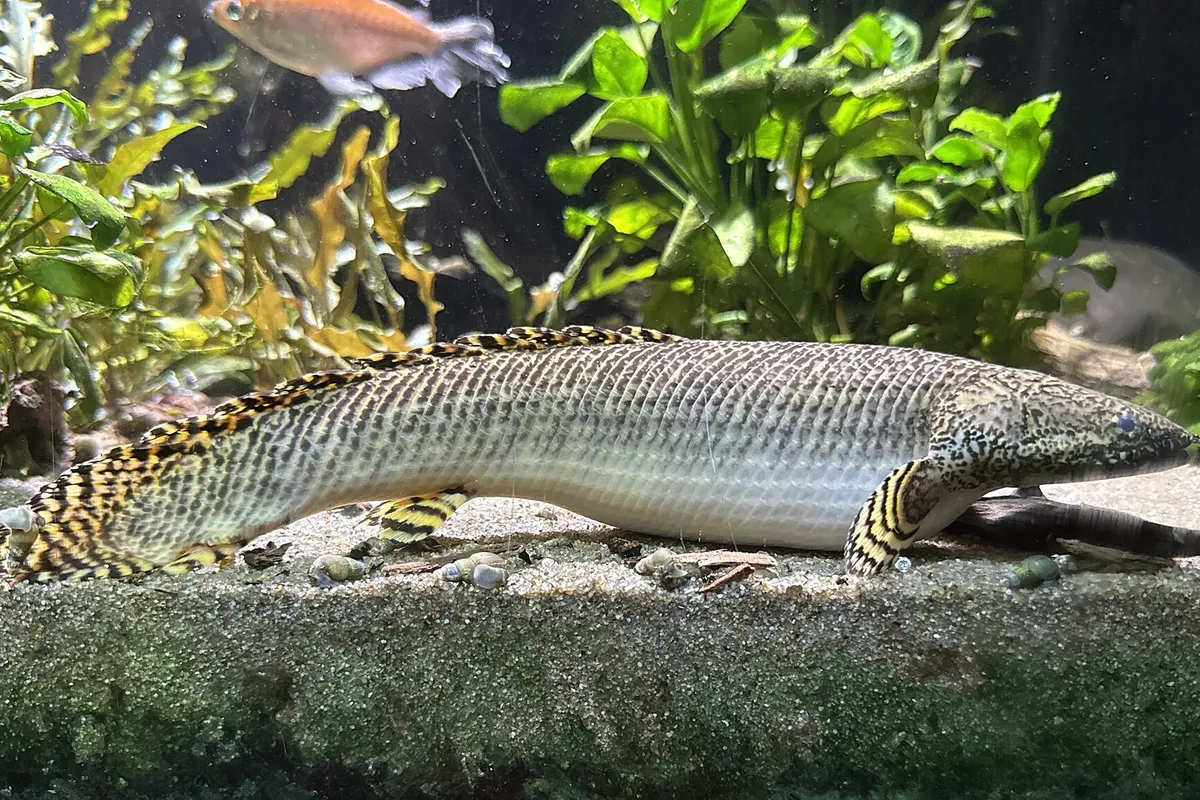
The ornate bichir is the most beautiful member of an ancient family. Polypterus ornatipinnis has a long, snake-like body covered in a dark net pattern over gold, with banded fins and a row of small dorsal finlets. Bichirs have changed little in tens of millions of years, and they still have lungs and breathe air.
It is a calm, curious and long-lived fish, but a large predator. Adults reach 40–60 cm and will eat any fish that fits in their mouth. This guide covers how to keep one safely.
Where ornate bichirs come from
Ornate bichirs live in the Congo River basin and Lake Tanganyika drainage in Central Africa. They are found in slow, vegetated rivers, swamps and floodplains, often in poorly oxygenated water, where their air-breathing gives them an edge.
Appearance and behaviour
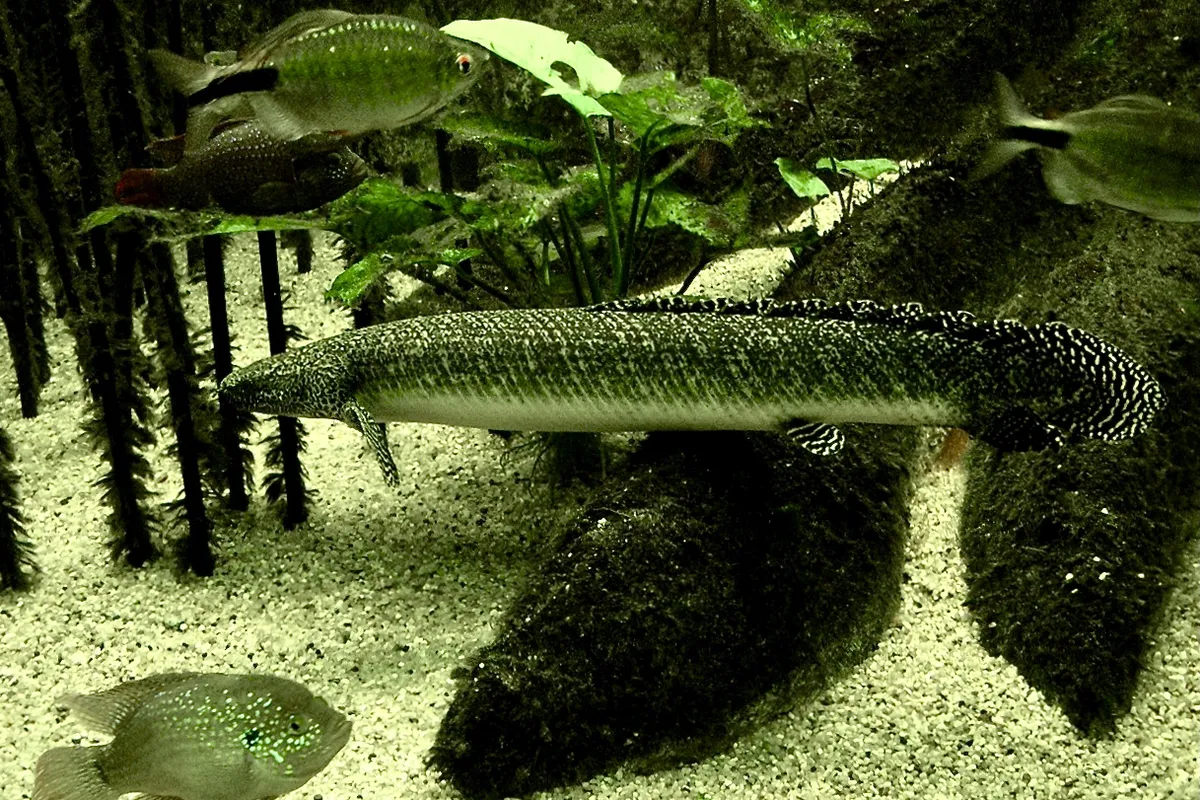
The body is covered in hard, diamond-shaped scales. The pattern is a dark reticulation on a yellow to golden-brown base, and the pectoral fins are boldly banded. The 9–11 dorsal finlets can be raised like a row of sails.
Bichirs spend most of the day resting on the bottom and become active at dusk. They hunt mostly by smell. They swim to the surface regularly to gulp air, so they need open access to the surface at all times.
Tank setup
An adult needs at least 500 litres, and more floor space is better than height. Use a soft sand substrate and add caves, driftwood and plants. The lid is the most important part of the setup: bichirs are escape artists that can squeeze through small gaps and survive for a while out of water. Seal every opening for cables and pipes.
Water parameters

Keep the temperature at 25–28°C, pH at 6.5–7.5 and water soft to moderately hard. Bichirs are hardy but produce a lot of waste, so use strong filtration and change 30% of the water weekly. Keep surface agitation gentle so they can reach the surface easily.
Feeding
Ornate bichirs are carnivores. Feed sinking carnivore pellets, frozen shrimp, mussels, krill, earthworms and pieces of white fish. Feed in the evening, when they are most active. Juveniles should eat daily; adults do well on food every other day. Avoid feeder goldfish, which carry disease and are poor nutrition. See our guide to feeding carnivores, herbivores and omnivores.
Tank mates
Keep them with fish that are too large to swallow and peaceful enough not to bother them: larger cichlids, silver dollars, larger catfish, arowanas and knifefish. Our clown knifefish guide covers another large night-time hunter. Ornate bichirs are the most aggressive of the common bichirs, so be careful when mixing them with other bichir species.
Breeding
Breeding in home aquariums is very rare. Fish in the trade come from farms in Asia and Eastern Europe, where hormones are often used. Males have a thicker, larger anal fin than females.
Common problems and lifespan
Escapes are the most common cause of death. Small tank mates disappearing is the most common complaint. Bichirs are also sensitive to many medications, so use half doses and research any treatment first. For another bichir, see our Senegal bichir guide.
With good care, ornate bichirs live 15–20 years or more.
Explore other topics
Dive into more aquarium guides across the site.