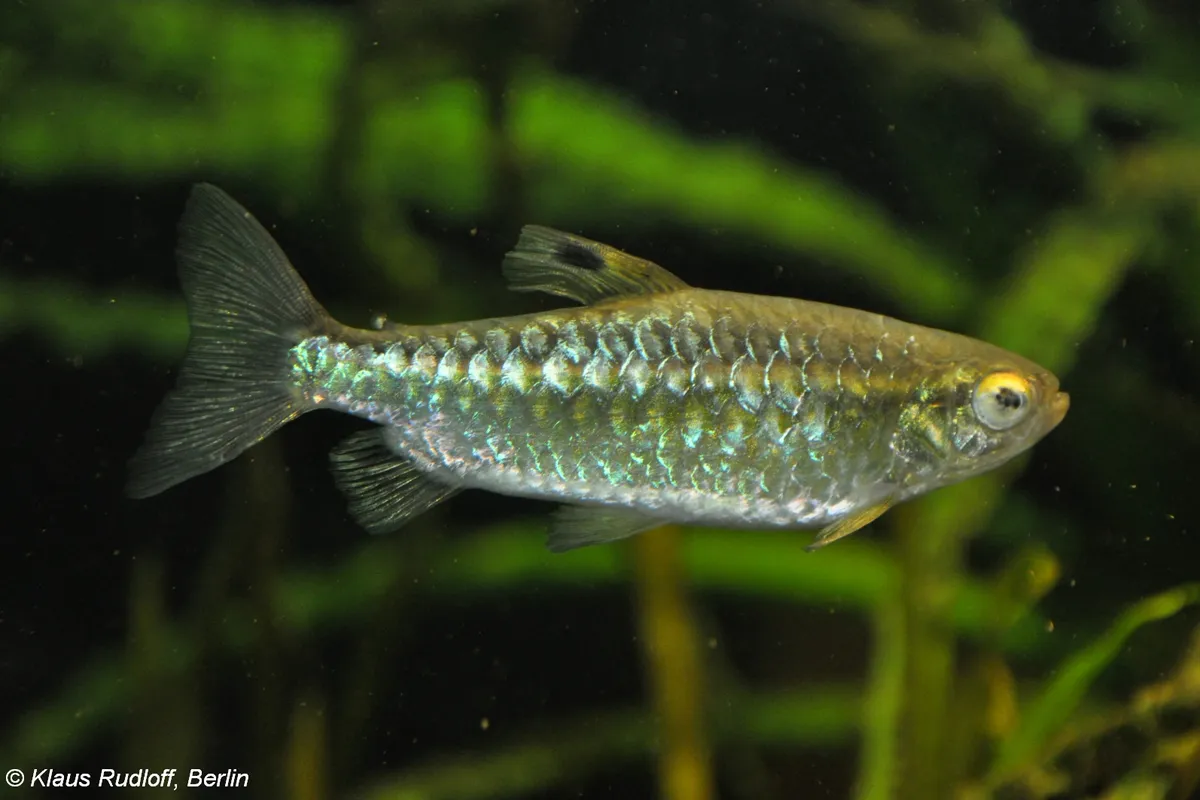
The African red-eyed tetra is one of the best large schooling fish you can buy. A group of Arnoldichthys spilopterus moves as one, flashing gold, green and blue scales under the light, with a bright red stripe across the top of each eye. They are peaceful, hardy and active from morning to night.
The catch is size and energy. These fish reach 7–10 cm and swim constantly, so they need a long tank and a proper group.
Where African red-eyed tetras come from
This species comes from a small area of southwest Nigeria, mainly the Niger delta and nearby coastal rivers such as the Ogun. It lives in rainforest streams with clear to tea-stained, soft, slightly acidic water. Most fish in the trade today are farmed rather than wild caught.
Appearance and behaviour
The body is long and slightly flattened, with large scales that reflect gold, green and violet. The upper half of the eye is bright red. A black blotch sits on the dorsal fin, and the tail has yellow and black markings. Males tend to be more colourful, with a striped anal fin; the female's anal fin is plainer and her belly fuller.
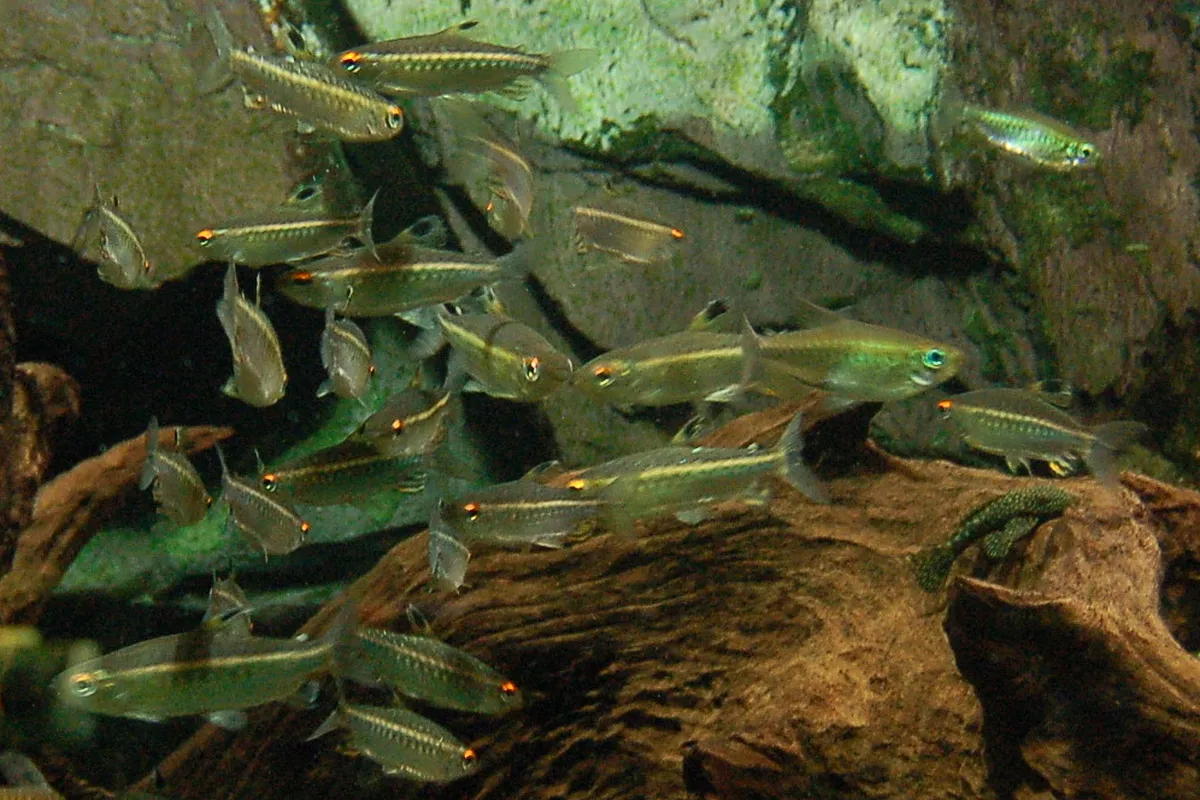
They are peaceful, open-water schooling fish. Keep at least six, and ideally ten or more. In small groups they are nervous and pale; in a big group they are bold and show their best colour.
Tank setup
A school needs a tank of at least 200 litres and 120 cm long, with lots of open swimming space in the middle. Plant the back and sides, add some driftwood, and use a dark substrate to bring out their shine. They are strong jumpers, so a tight lid is a must; our guide to stopping fish jumping out explains why. A gentle current from the filter suits them well.

Water parameters
Aim for 23–28°C, pH 6.0–7.5 and soft to medium hardness. Farmed fish are adaptable, but they colour up best in softer, slightly acidic water. Our guide to soft water and blackwater chemistry covers how to get there. Keep nitrate low with regular water changes.
Feeding
African red-eyed tetras are omnivores that feed mostly on insects in the wild. Give them a good flake or small pellet as the base, plus frozen bloodworms, brine shrimp, daphnia and mysis. They are fast, greedy feeders, so make sure slower tank mates get their share.
Tank mates
They suit large community tanks with fish of similar size and temperament: Congo tetras, larger rainbowfish, barbs, peaceful cichlids such as African butterfly cichlids, synodontis catfish and corydoras. Very small fish such as neon tetras may be eaten, and the constant activity can stress shy species.
Breeding
Breeding at home is possible but not common. Condition a group on live and frozen food, then move them to a soft, slightly acidic breeding tank with fine-leaved plants or spawning mops. Females scatter several hundred to a thousand eggs. Remove the adults after spawning, because they eat eggs. Fry hatch in about 36 hours and need infusoria, then baby brine shrimp.
Common problems and lifespan
Jumping is the main cause of losses. Stress from small groups can lead to white spot and other infections, so buy a proper school at once and run it through a quarantine tank. With good care they live 7–10 years.
Explore other topics
Dive into more aquarium guides across the site.