

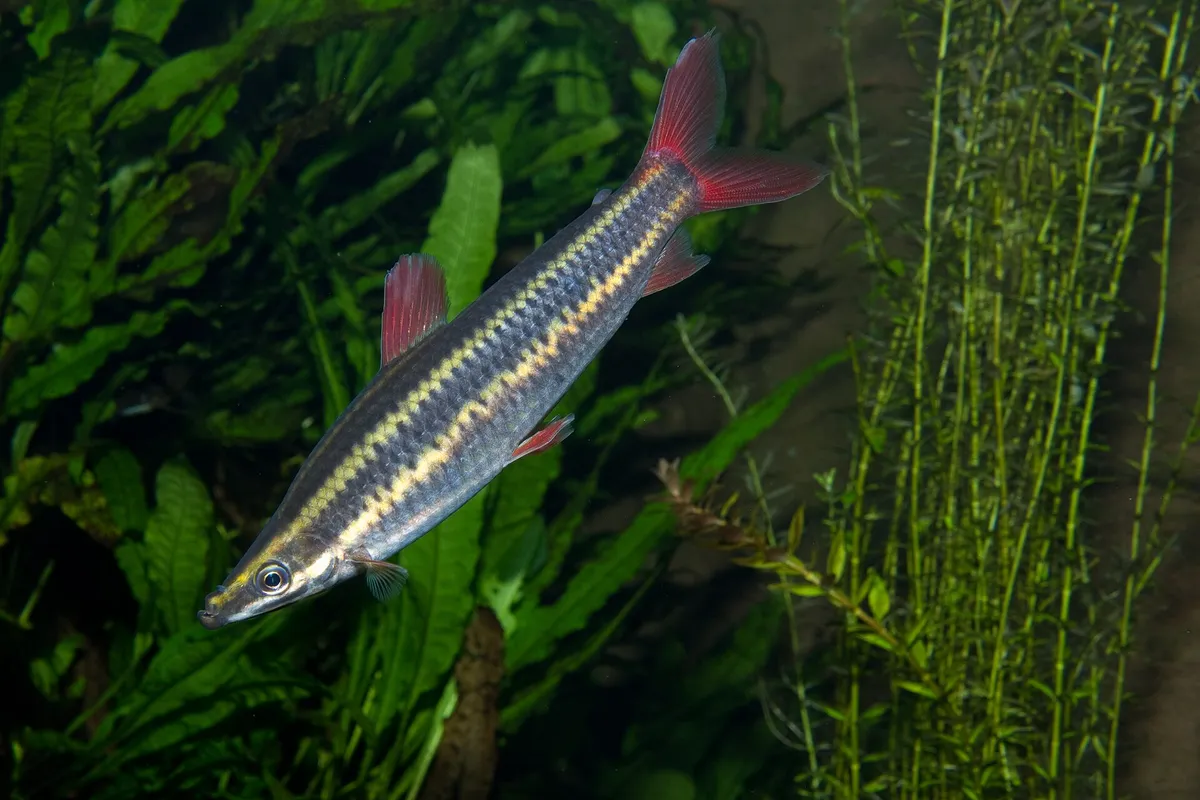
The striped headstander is easy to recognise. It swims at a steep head-down angle, nose to the rocks, picking at algae and tiny animals. Bold gold and black stripes and red fins make Anostomus anostomus a striking fish for a larger South American tank.
It is not always an easy fish to fit in. Headstanders grow to 12–16 cm, like strong current, and can squabble among themselves and nip slow fins. This guide covers how to keep them well.
Where striped headstanders come from
Striped headstanders live in the Amazon and Orinoco basins and rivers of the Guianas. They prefer fast, clear water over rocks, often in rapids, where they shelter in cracks and graze the surfaces. Water there is usually soft and slightly acidic.
Appearance and behaviour
The body is long and torpedo-shaped, with three black stripes separated by gold to cream bands. The fins are red at the base, and the small mouth points upward. Females are usually a little larger and rounder than males.
The head-down posture lets them pick food from rocks and cracks. They are generally calm with other species, but they can be aggressive to each other. Keep either one fish, or a group of six or more so the squabbling is spread out. Pairs and trios often end with one fish bullied.
Tank setup
A group needs a tank of at least 300 litres and 150 cm long. Recreate a rocky river: smooth stones, rock piles with cracks, driftwood and a sandy or fine gravel floor. Add strong flow with a good filter and a powerhead, and keep oxygen levels high. Hardy plants such as anubias and java fern attached to rocks work; soft plants get eaten. Headstanders jump, so use a tight lid.

Water parameters
Aim for 24–28°C, pH 5.5–7.5 and soft to medium hardness. Clean, well-oxygenated water matters more than exact numbers, so do weekly water changes and keep filters clean. Our guide to soft water chemistry explains how to match Amazon conditions.
Feeding
Headstanders are omnivores that need plenty of plant matter. Feed spirulina flakes, algae wafers, blanched spinach and courgette, plus frozen bloodworms, brine shrimp and mysis. Several small feeds a day suit their grazing habit and reduce fighting at mealtimes.
Tank mates
Choose robust, active fish of similar size: larger tetras, silver dollars, eartheaters, larger peaceful cichlids, and armoured catfish such as plecos and doradids. Avoid long-finned, slow fish like angelfish and bettas, and other head-down species such as leporinus, which compete directly.
Breeding
The striped headstander has rarely been bred in home aquariums. Commercial breeding uses hormones, and most fish sold are wild caught. Telling the sexes apart is difficult outside spawning condition.
Common problems and lifespan
Fighting in small groups, nipped tank mates and jumping are the main problems. Poor oxygen levels and dirty water lead to stress and disease. Quarantine wild-caught fish in a quarantine tank and feed well before moving them in. With good care striped headstanders live 10 years or more.
Explore other topics
Dive into more aquarium guides across the site.