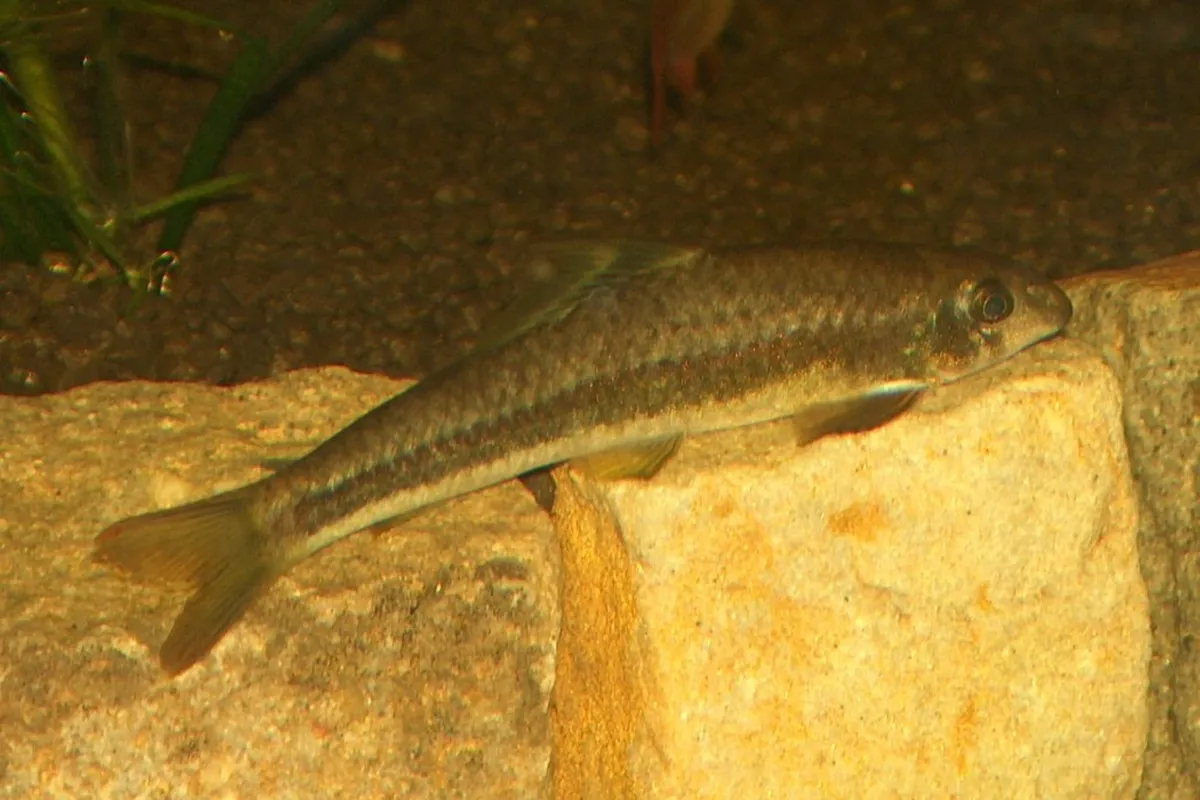
The flying fox is a slim, striped cyprinid sold as an algae eater, and it does graze all day. It is also a bold, territorial fish that grows to 12–15 cm and will chase anything that looks like it. Epalzeorhynchos kalopterus is a fine choice for a medium or large community tank, as long as you know what you are buying.
It is also one of the fish most often mixed up with the Siamese algae eater. Telling them apart matters, because their temperament and adult size are different.
Where flying foxes come from
Flying foxes live in clear, fast-flowing streams and rivers in Thailand, Malaysia, Sumatra and Borneo, especially in forest areas. They rest on rocks and wood in the current and graze biofilm and algae from every surface. During floods they move into flooded forest.
Appearance and behaviour
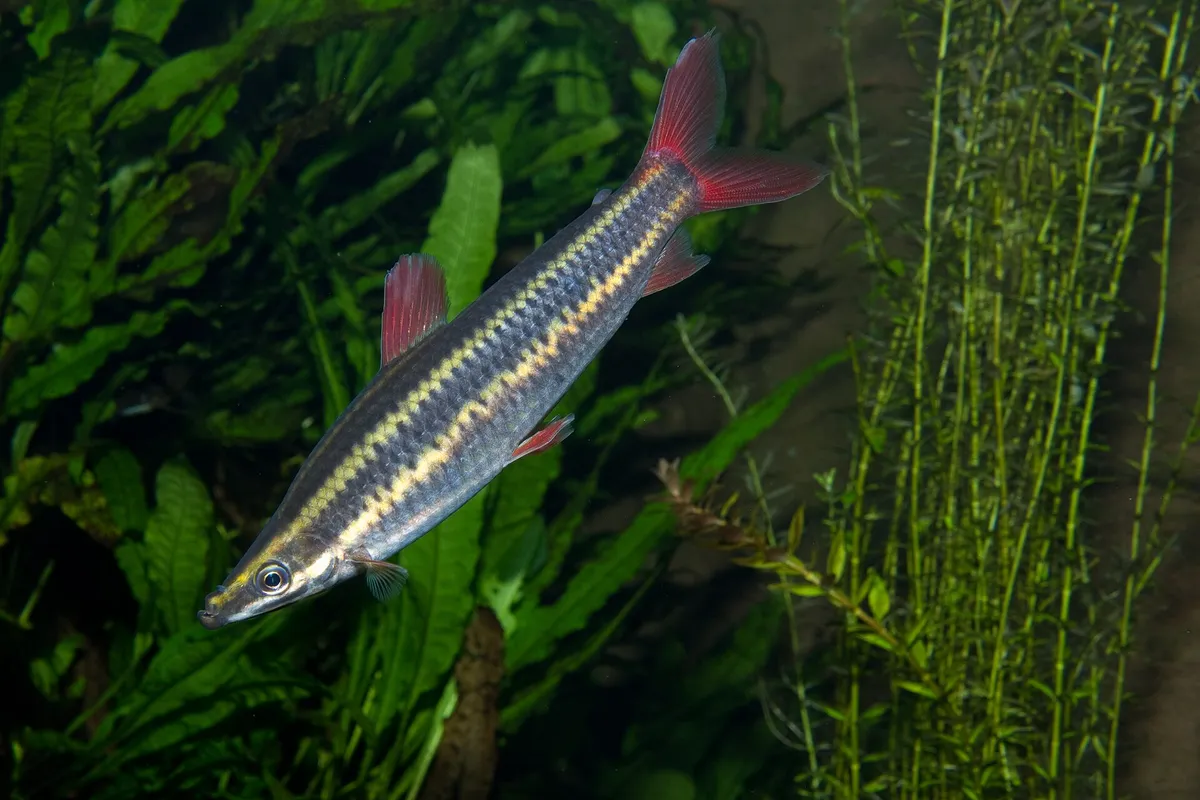
The body is long and flat underneath, brown to olive above and pale below, with a bold black stripe from snout to tail. Above that stripe runs a thin gold line. The dorsal, anal and pelvic fins have black and white edges, and there are two pairs of barbels at the mouth.
To tell it from the Siamese algae eater (Crossocheilus), look at the fins and stripe. The flying fox has black and white fin edges, a gold line above the stripe, and a smooth-edged stripe that stops at the tail. The Siamese algae eater has clear fins and a zig-zag stripe running into the tail fin.
Flying foxes rest propped on their fins, then dart off to graze or chase. They are territorial with their own kind and similar-looking fish, so keep one per tank unless the tank is very large.
Tank setup
One flying fox needs at least 120 litres and a tank at least 90 cm long. Give it smooth rocks, driftwood and plants to graze on, with open swimming space in front. A moderate current from a good filter or a small powerhead suits it. These fish jump when startled, so use a lid.

Water parameters
Flying foxes are not fussy. Aim for 24–27°C, pH 6.0–7.5 and soft to medium hardness. They need well-oxygenated, clean water, so keep up weekly water changes and do not let flow drop as filters clog.
Feeding
They graze algae and biofilm, but cannot live on what grows in a clean aquarium. Feed sinking algae wafers, spirulina flakes, blanched courgette and spinach, plus small frozen foods such as bloodworms and daphnia a few times a week. Well-fed fish are less pushy at the food.
They eat soft green algae and some hair algae when young. Adults become lazier grazers once they find easier food, so do not rely on them as a clean-up crew.
Tank mates
Good companions are active, mid-water fish of similar size: barbs, larger rasboras, danios, gouramis and many peaceful cichlids. Avoid red-tail and rainbow sharks, other flying foxes and Siamese algae eaters, because they look alike and fight. Small, slow, long-finned fish may get chased.
Breeding
The flying fox has not been bred reliably in home aquariums. Commercial breeding in Asia uses hormone injections. Males and females are hard to tell apart; females look a little fuller when mature.
Common problems and lifespan
Most problems come from fighting and jumping. Watch for split fins on tank mates and give everyone enough space and cover. They are hardy otherwise, but like any new fish should go through a quarantine tank first. With good care flying foxes live 8–10 years.
Explore other topics
Dive into more aquarium guides across the site.