

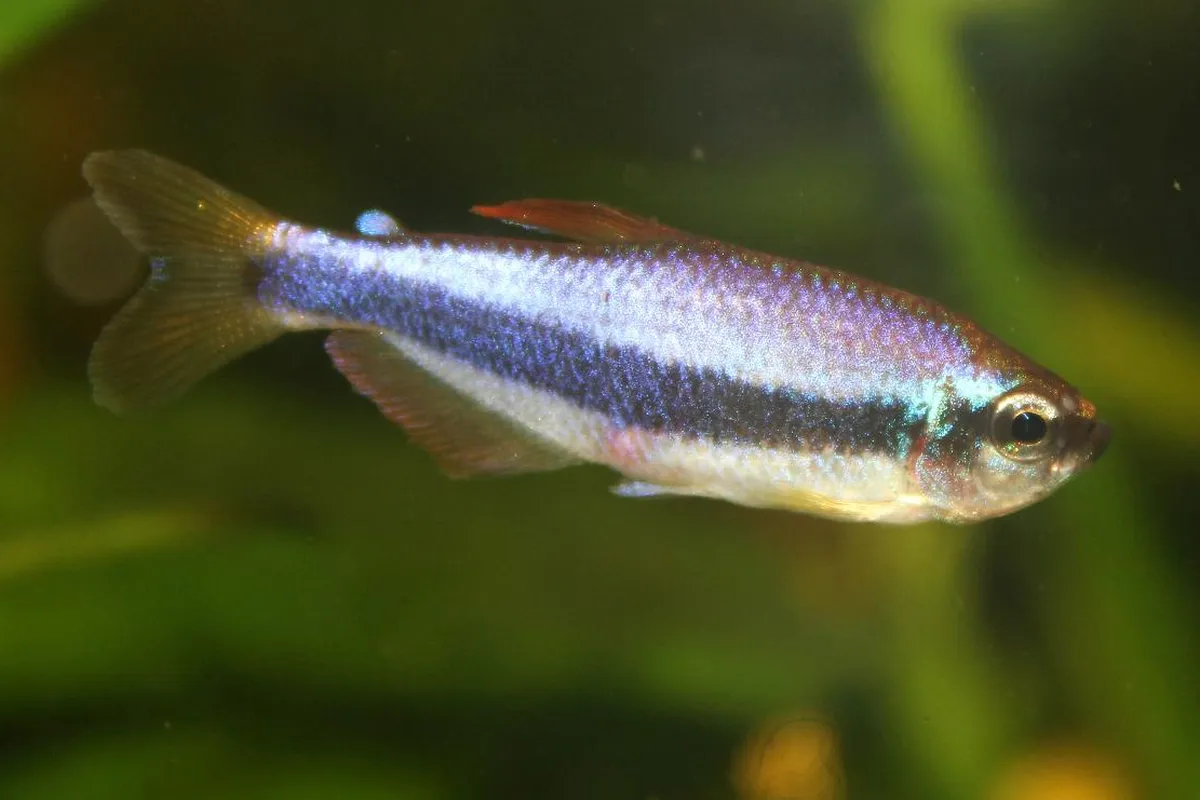
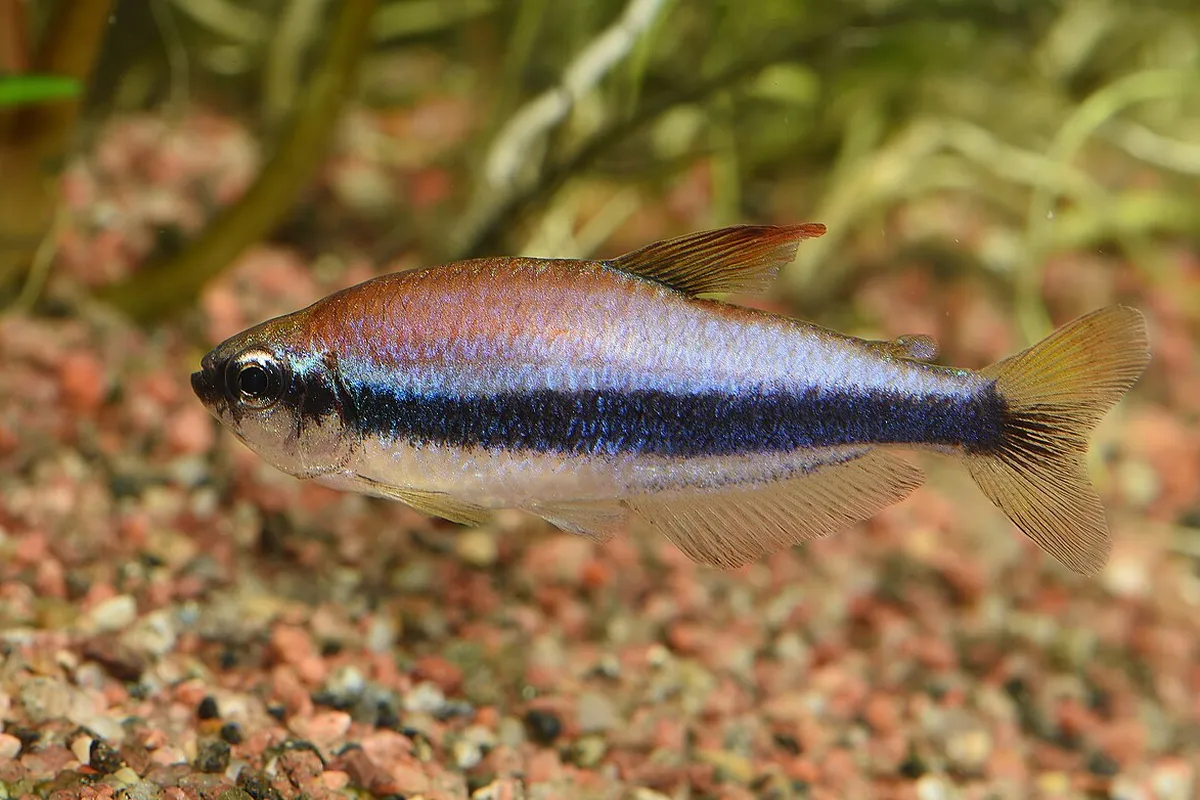
The royal tetra, also sold as the blue emperor tetra, is a small Brazilian characin with a dark band running the length of its body. Under good lighting, males shine metallic blue above the band, while females are more yellow-brown. Adults reach about 4 cm.
Inpaichthys kerri is peaceful, hardy and easy to feed, which makes it a good alternative to the more common neon tetra in a planted community tank.
Where royal tetras come from
The species comes from the upper Rio Aripuanã and Rio Madeira tributaries in western Brazil. It lives in slow, clear to tea-coloured streams with plenty of vegetation and fallen wood.
Appearance and behaviour
Males are larger-finned and show the strongest blue, with a violet sheen when displaying. Females have a reddish adipose fin and a plainer body. Males spar mildly with one another, especially in the morning, but rarely cause damage.
Keep at least eight. A bigger school shows more natural behaviour and better colour.
Tank setup
A 60-litre tank suits a small school. Use a dark substrate, plenty of plants and some driftwood, with open space in the middle. Floating plants soften the light and bring out the blue. Gentle to moderate flow is fine.
Water parameters

- Temperature: 24–27°C
- pH: 5.5–7.5
- Hardness: 2–12 dGH
Royal tetras adapt to a wide range. Soft, slightly acidic water gives the best colour and is needed for breeding.
Feeding
Feed quality flakes or micro pellets, plus frozen or live daphnia, brine shrimp and bloodworms a few times a week. They eat greedily from the middle of the water column.
Tank mates
Good companions include other small tetras, pencilfish, rasboras, dwarf cichlids such as apistogrammas, and corydoras. Avoid large or predatory fish.
Breeding
Royal tetras scatter eggs among fine plants or a spawning mop in soft, acidic water. Move the adults out after spawning, as they eat the eggs. The fry hatch in about a day and need infusoria before moving on to baby brine shrimp.
Common problems and lifespan
They are hardy. The main problems are fading colour in small groups and common diseases such as ich in new fish. Quarantine new arrivals. They live three to five years.
Explore other topics
Dive into more aquarium guides across the site.