

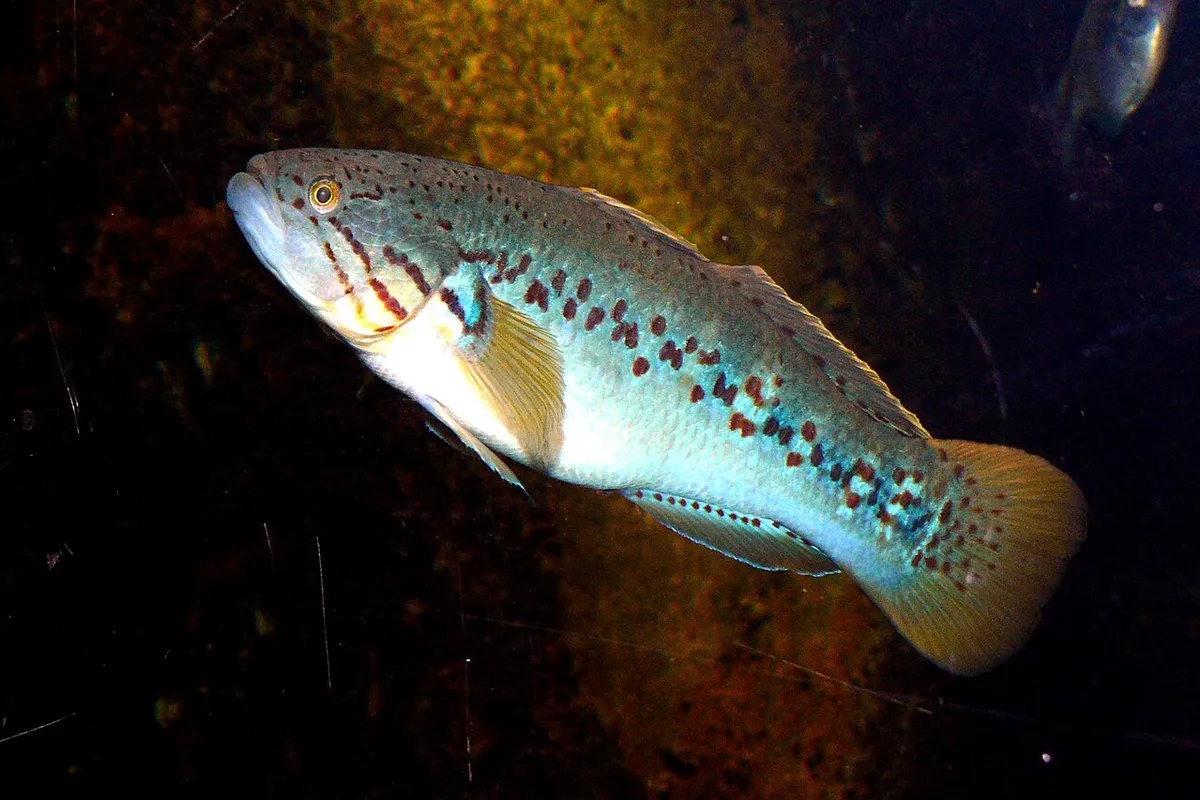
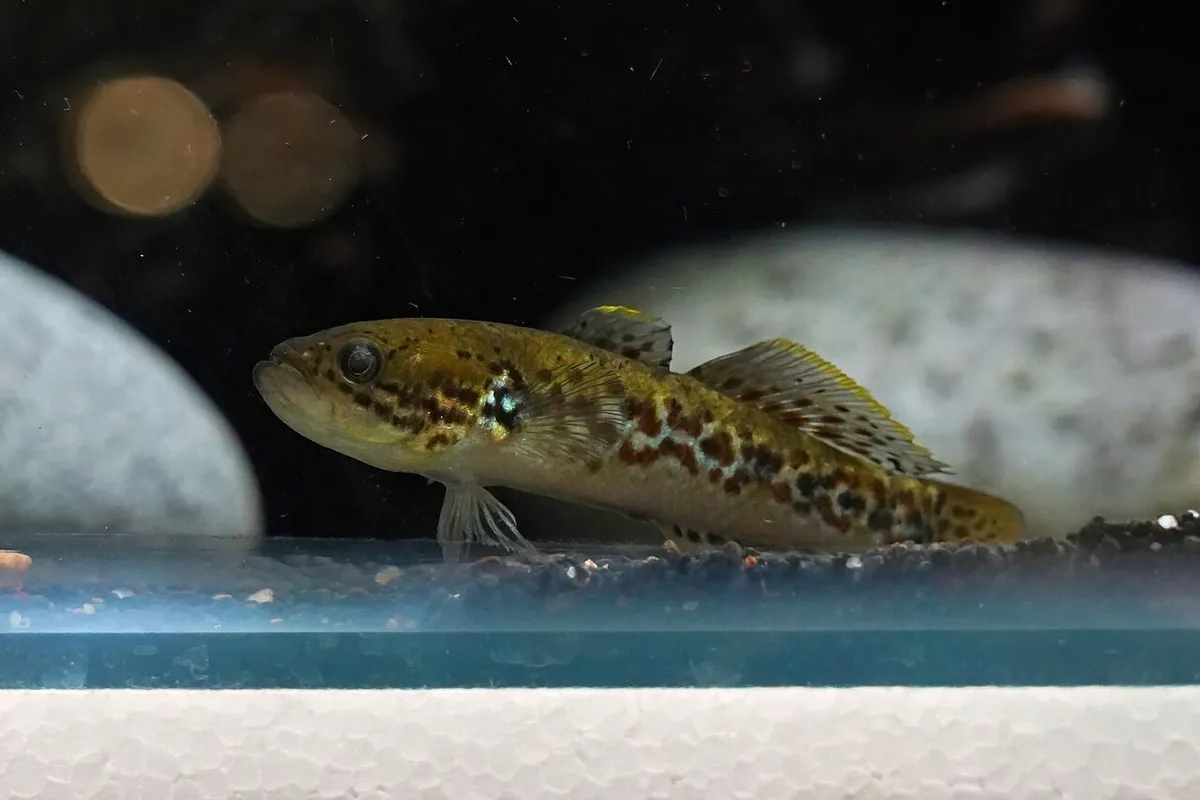
The southern purple-spotted gudgeon is one of Australia's most colourful freshwater fish. Its brown to blue-grey body is covered in red and purple spots, with orange and blue stripes on the cheeks and fins. Breeding males are the brightest of all.
Mogurnda adspersa grows to about 10–12 cm. It is a hardy, sit-and-wait predator that suits a semi-aggressive community or a species tank, and it is one of the easier native fish to breed.
Where purple-spotted gudgeons come from
The species lives in eastern Australia, mainly in Queensland and New South Wales, with relict populations in the Murray–Darling Basin. It favours slow, weedy streams, billabongs and lagoons. Some populations are protected, so buy only from breeders and check your local rules.
Appearance and behaviour
Gudgeons have a stocky, rounded body with two separate dorsal fins. They spend most of their time resting on the bottom or on wood, then dart out at passing food. Males develop a swollen forehead and stronger colour when breeding.
They are territorial towards each other and will eat any fish that fits in their mouth. Several can share a tank if each has its own cave.
Tank setup
A pair needs at least 80 litres, and a small group 120 litres or more. Use sand or fine gravel, rocks, wood and caves, with plants around the edges. Keep the flow moderate. Our guide to creating hiding places helps with layout.
Water parameters

- Temperature: 18–26°C
- pH: 6.5–8.0
- Hardness: 5–20 dGH
This is a subtropical fish that does not need a heater in a warm room, and a cooler winter period helps trigger breeding in spring.
Feeding
Gudgeons are carnivores. Feed frozen bloodworms, brine shrimp, mysis, chopped prawn and earthworms, plus sinking carnivore pellets once they accept them. Feed once a day and avoid feeder fish, which can bring in disease.
Tank mates
Choose fish too large to swallow and robust enough to ignore a grumpy neighbour, such as larger rainbowfish, robust barbs and larger catfish. Avoid small tetras, shrimp and slow, long-finned fish.
Breeding
Females lay several hundred sticky eggs on a cave wall, rock or flat piece of wood. The male fans and guards them until they hatch, after about a week. Remove the female after spawning, and remove the male once the fry are free-swimming. The fry need infusoria at first, then baby brine shrimp.
Common problems and lifespan
Fighting between males and disappearing tank mates are the usual problems. Gudgeons can live five to eight years.
Explore other topics
Dive into more aquarium guides across the site.