

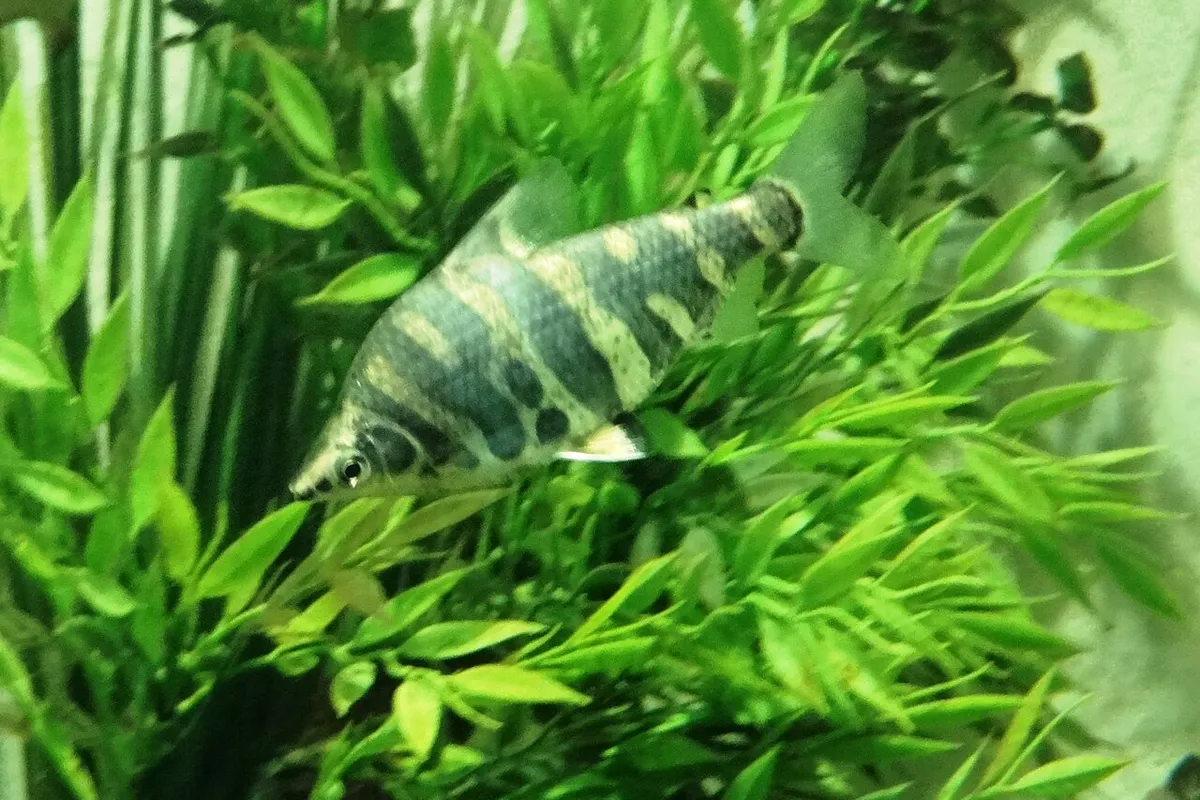
The marbled headstander gets its name from its feeding posture. It tilts head-down to pick at algae, biofilm and small invertebrates on wood and leaves. Its tall, humped back and dark, irregular bands make it one of the more unusual characins in the hobby.
Abramites hypselonotus grows to about 12–14 cm. It is hardy, but it nips plants and fins and becomes quarrelsome as it ages, so plan tank mates with care.
Where marbled headstanders come from
The species lives in the Amazon and Orinoco basins and in the Paraguay and Paraná river systems. It is found in rivers and flooded forest, usually close to wood and vegetation.
Appearance and behaviour
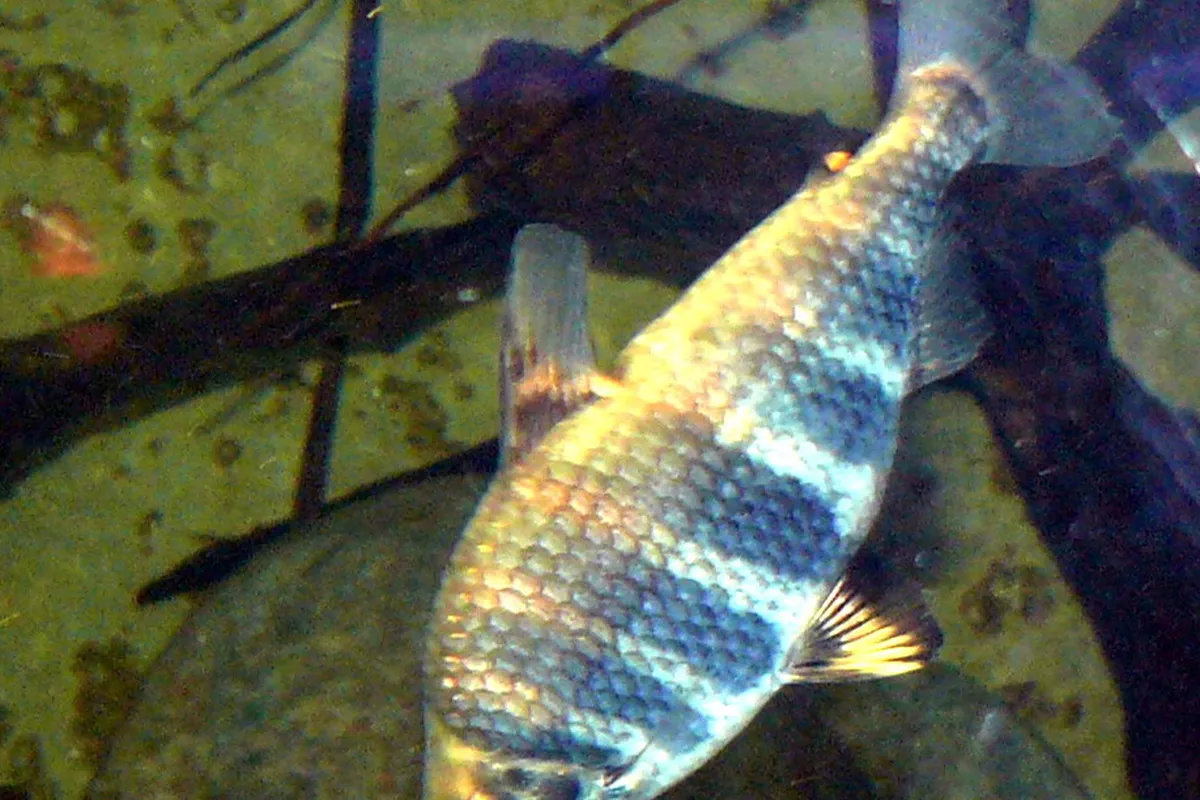
The body is pale tan to silver, crossed by dark bands that break up into a marbled pattern. Fins are partly dark with clear edges. The mouth is small and points upward slightly.
Young fish can be kept in a small group, but adults often bicker with each other. Keep a single fish, or a group of five or more in a large tank so aggression is spread out. Pairs and trios tend to fight.
Tank setup
Provide at least 250 litres for one adult and more for a group. Use sand, smooth stones and plenty of driftwood, which gives them surfaces to graze. Leave open swimming space and use tough or artificial plants: they eat soft plants such as cabomba. A lid is wise.
Water parameters

- Temperature: 23–28°C
- pH: 6.0–7.5
- Hardness: 2–15 dGH
They adapt well to most tap water if it is clean and stable. Good filtration matters because they are messy, plant-heavy eaters.
Feeding
Headstanders are omnivores with a strong vegetarian side. Offer spirulina flakes, algae wafers, blanched spinach, peas and courgette, plus frozen bloodworms and brine shrimp. Our guide to feeding herbivores and omnivores has more ideas.
Tank mates
Pick robust, fast fish of similar or larger size, such as silver dollars, larger barbs, plecos and robust cichlids. In very large tanks, the related banded leporinus can also work. Avoid long-finned fish and slow species.
Breeding
The marbled headstander has not been bred reliably in home aquariums. Fish in the trade are wild-caught or farmed.
Common problems and lifespan
Expect plant damage, fin-nipping in mixed tanks and fighting between pairs. With a varied diet and space, they live 10 years or more.
Explore other topics
Dive into more aquarium guides across the site.