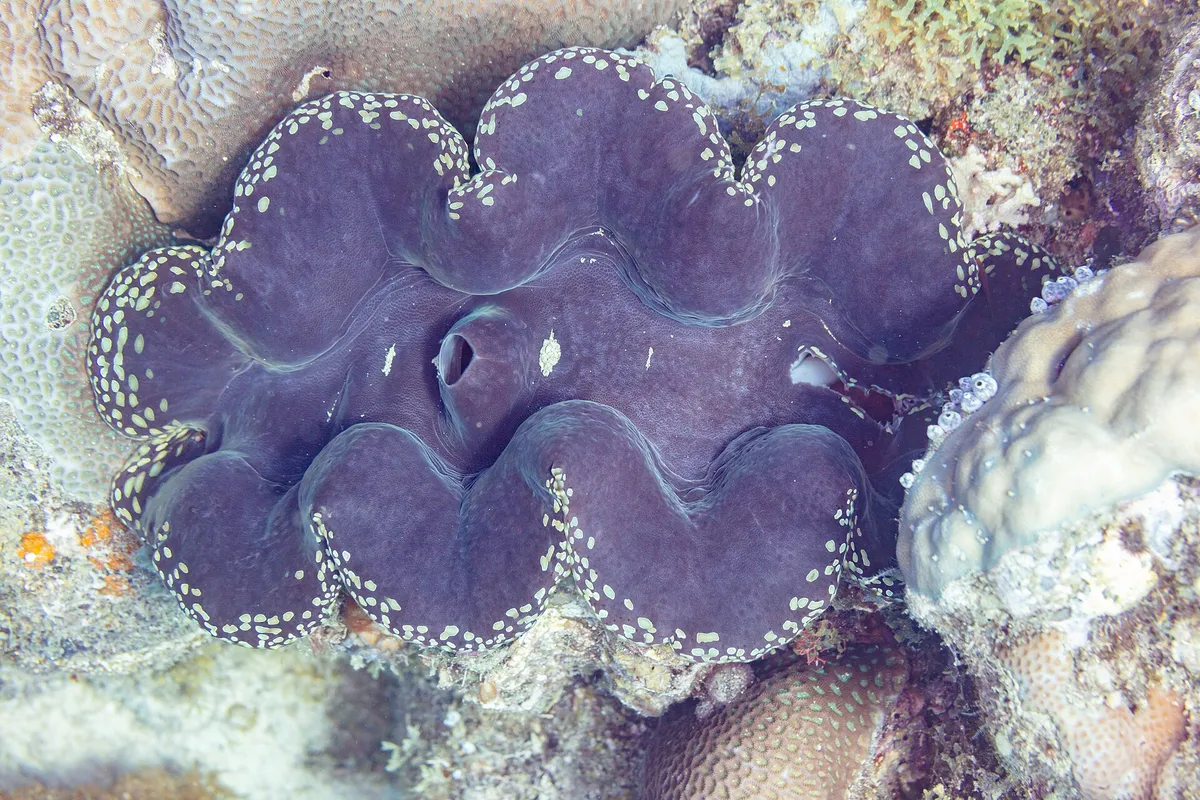
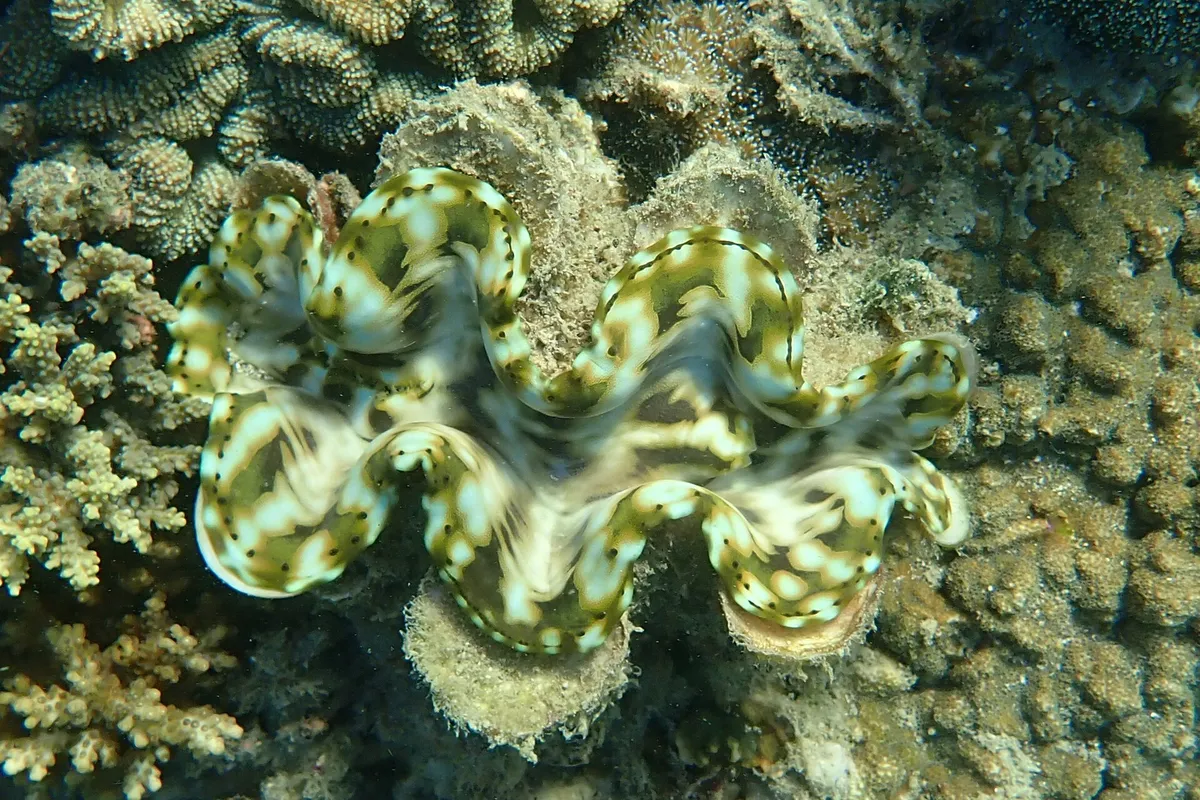
Giant clams are some of the most striking animals you can keep in a reef tank, and the squamosa clam is one of the most beautiful. Tridacna squamosa has a shell with large, scale-like flutes, and a colourful mantle that ranges from brown and gold to green, blue and purple. It is also one of the more forgiving Tridacna species, as it tolerates lower light than the maxima or crocea clams.
Where squamosa clams come from
The species is found across the Indo-Pacific and Red Sea, from East Africa to the central Pacific. It lives on reef flats and lagoons, usually resting on sand or rubble, or wedged loosely among rocks. Wild populations have been heavily fished, and giant clams are protected under CITES, so look for captive-bred, farm-raised clams.
Appearance and behaviour
Squamosa clams can reach about 40 cm long in the wild, though aquarium clams grow slowly. The shell has four to six large folds with leafy scutes. The mantle, which spreads out over the shell edge, carries symbiotic algae called zooxanthellae, which provide much of the clam's food from light.
Clams close quickly when a shadow passes over them, and reopen within minutes. A clam that stays closed or only half open is stressed.
Tank setup and placement
Keep squamosa clams in a mature reef tank of at least 200 litres, set up for six months or more. They need moderate to strong light. Place them on the sand bed or on a flat rock, in the lower to middle part of the tank under strong reef lighting. Introduce them to stronger light gradually. Squamosas do not bore into rock like crocea clams, so they are easy to move.
Water parameters
Keep the temperature at 24–27°C, specific gravity at 1.024–1.026 and pH at 8.1–8.4. Clams use a lot of calcium and carbonate to build their shells, so keep calcium at 400–450 ppm, alkalinity at 8–11 dKH and magnesium at 1,250–1,400 ppm. See our guides to reef alkalinity and magnesium. Small clams under 5 cm need more feeding and careful conditions.
Feeding
Most of a squamosa's food comes from light. Clams also filter nutrients and fine particles from the water, so a reef with some dissolved nutrients suits them better than an ultra-clean tank. Small clams benefit from phytoplankton dosing a few times a week.
Tank mates
Clams are safe with corals and fish, but some tank mates attack them. Avoid angelfish and butterflyfish that nip at mantles, and puffers, triggerfish and large wrasses. Watch out for pyramidellid snails, tiny white parasites that feed on clam tissue at night, and remove them by hand or with a six-line wrasse. Large hermit crabs and some bristleworms can also damage weak clams.
Breeding
Squamosa clams are bred on farms in the Pacific and Australia, and these farm-raised clams are the best choice for aquariums. They do not breed in home aquariums.
Common problems and lifespan
Gaping, a shrunken mantle and a bleached look point to light or water problems. Pinched mantle is a sign of pests or bacteria. Buy healthy clams with full, responsive mantles. With good care, squamosa clams can live for decades. Also see our maxima clam guide.
Explore other topics
Dive into more aquarium guides across the site.