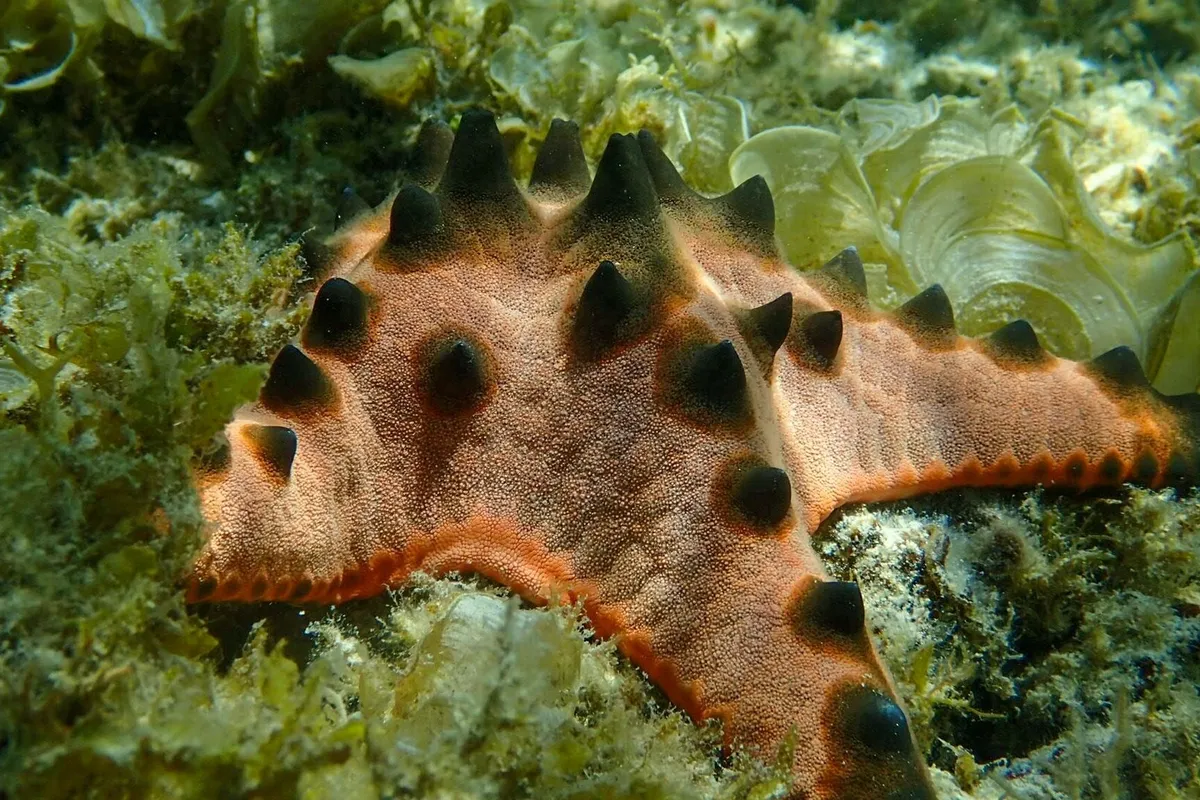
The chocolate chip starfish gets its name from the rows of dark, cone-shaped knobs on its back, which look like chocolate chips on a cookie. Protoreaster nodosus is one of the hardiest starfish in the hobby and readily eats prepared food, which makes it far easier to keep than delicate species like the blue linckia.
The catch is that it is an active predator of slow-moving invertebrates, including corals. It belongs in a fish-only tank, not a reef.
Where chocolate chip starfish come from
The species lives in the Indo-West Pacific, from the Red Sea and East Africa to Australia and the western Pacific. It is found on sand flats and seagrass beds in shallow, warm water, often in large numbers. It is also collected and dried for the souvenir trade.
Appearance and behaviour
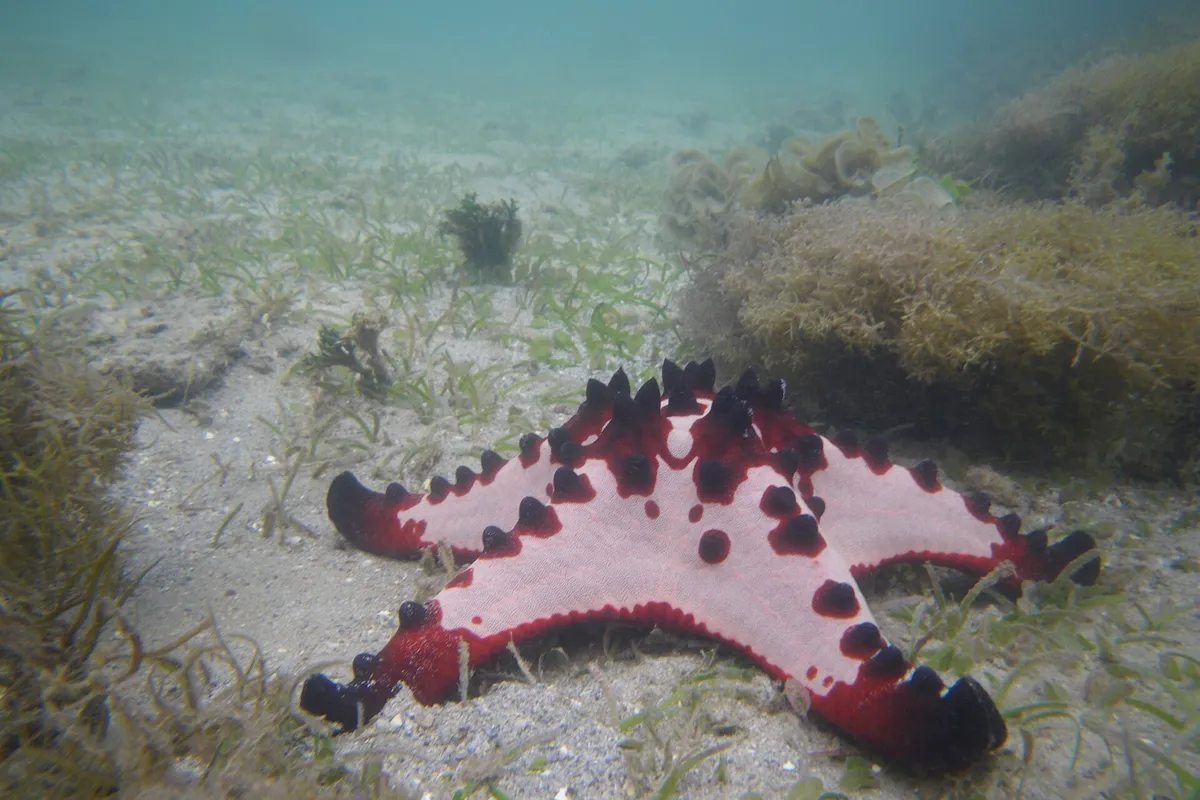
Adults reach about 30 cm across. The body is thick and firm, usually tan, orange or red, with black or dark brown horns along the arms and in the centre. Colour varies a lot between individuals and areas.
Chocolate chip starfish move slowly but steadily, day and night, searching the sand and rock for food. Like other starfish, they feed by pushing their stomach out over their prey.
Tank setup
A single adult needs at least 200 litres. A sand bed with live rock suits it. Avoid sharp rockwork it can damage itself on. Make sure powerhead intakes are covered, and keep the water very stable.
Acclimation
Starfish are very sensitive to changes in salinity. Use drip acclimation over at least an hour, and never expose the starfish to air, which can trap bubbles in its body.

Water parameters
Keep the temperature at 24–27°C, specific gravity at 1.023–1.026 and pH at 8.1–8.4. Keep nitrate low and avoid copper. Top up evaporation daily so salinity stays steady.
Feeding
Chocolate chip starfish are omnivorous scavengers and predators. Feed pieces of shrimp, clam, mussel, squid and fish, placed under or next to the starfish, two or three times a week. It will also take sinking pellets. A well-fed starfish is less likely to go after tank mates, but it will still eat invertebrates if it finds them.
Reef safety and tank mates
Chocolate chip starfish are not reef safe. They eat soft corals, stony corals, zoanthids, clams, snails, sponges and sometimes slow or sleeping fish. Keep them in fish-only tanks with peaceful to semi-aggressive fish. Avoid fish that eat starfish, such as triggerfish, many puffers and some angelfish, and the harlequin shrimp.
Breeding
They spawn by releasing eggs and sperm into the water, and the larvae drift for weeks. They are not bred in home aquariums.
Common problems and lifespan
Poor acclimation and sudden changes in salinity cause most deaths. Watch for white patches, a soft body or arms falling off, which are signs of serious stress or infection. Check new arrivals for small parasitic snails.
With good care, chocolate chip starfish can live five years or more in an aquarium.
Explore other topics
Dive into more aquarium guides across the site.